I left Villadangos around 8:30 and it was 55 F and dry, partly cloudy. No desayuno (breakfast) was available at The Fly Cafe. The forecast says there’s a chance of a t-storm at 11am, so I’m rigged for rain today (meaning my poncho is readily at hand).
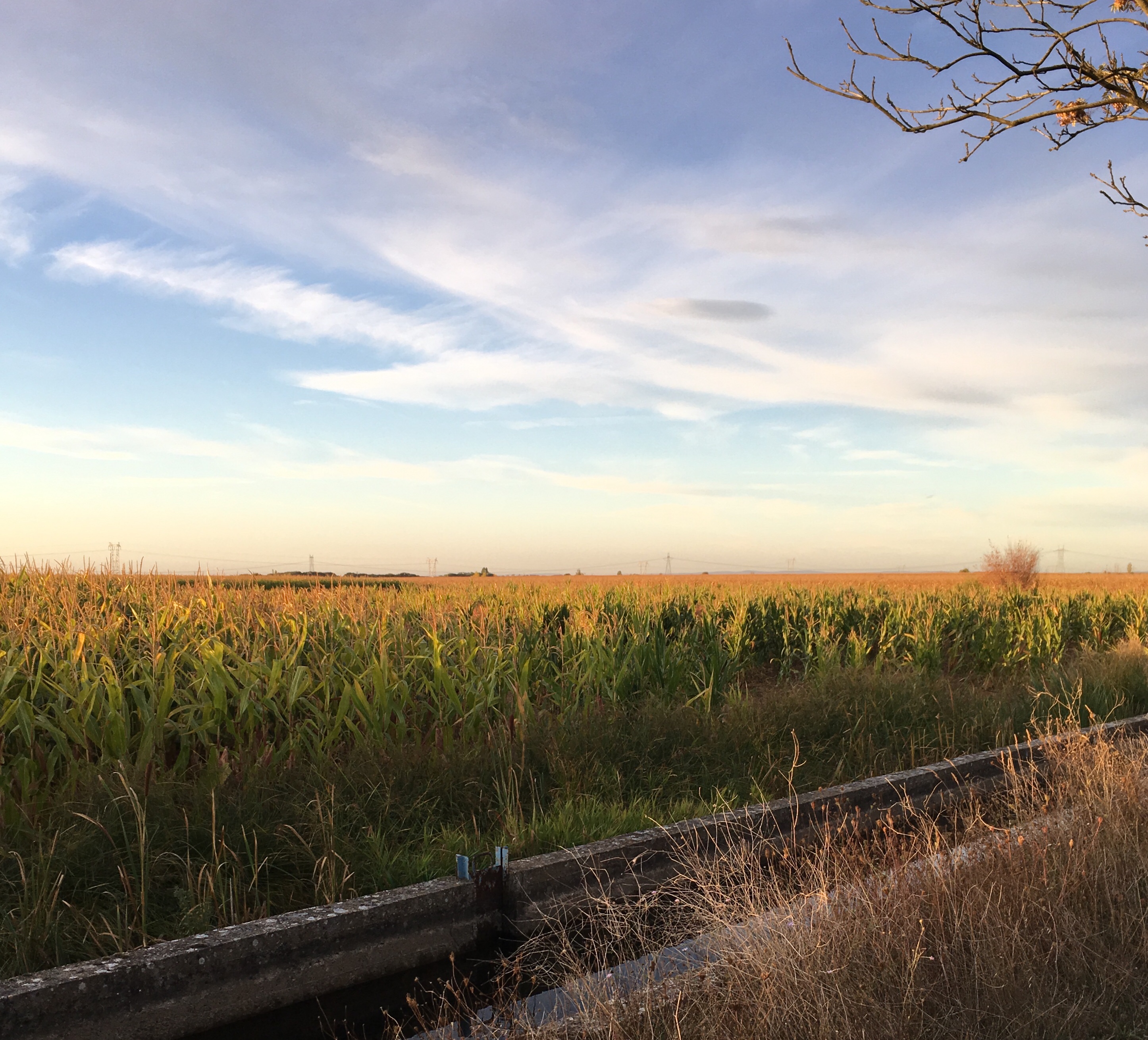
I was soon walking past acres of corn fields, on a nice, smooth, flat path. It turned into a beautiful day with no rain. I’ve started to see the huge stork nests that appear on top of many structures, like this church bell tower.
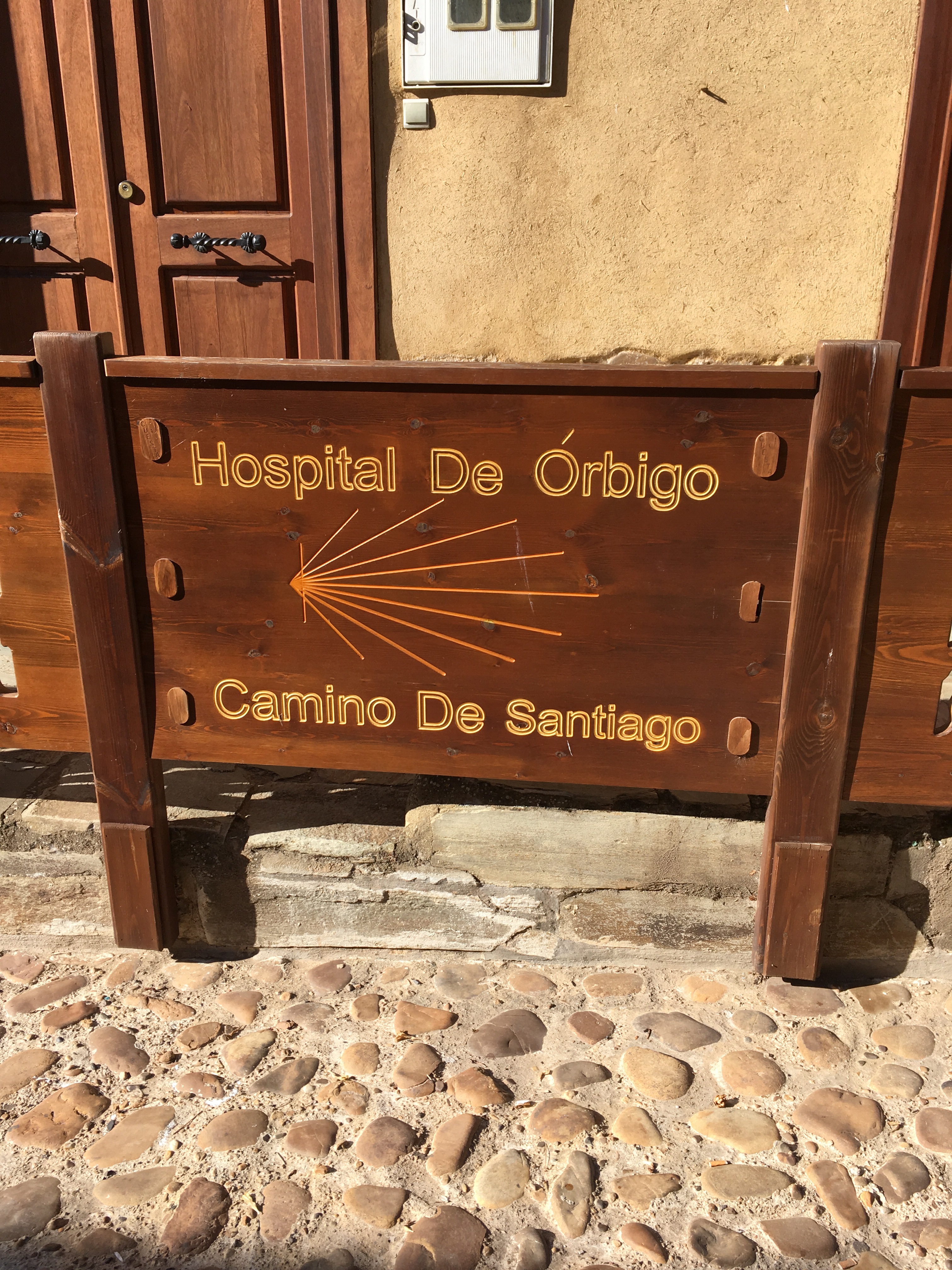
I made really good time today and my walk was just 15 Kms so I arrived fairly early, 11:30am, in Hospital de Orbigo, a town with medieval origins.
The Camino path usually goes right through the heart of these towns and so, then, do the pilgrims, with their Euros to spend. This town has a magnificently restored bridge leading into it, but no one likes walking on cobblestones with tired feet.
Although this pilgrim, with his horse and pack horse, probably didn’t care:
Yes, riding pilgrims are allowed but it must be difficult finding albergues that will stable your horses!
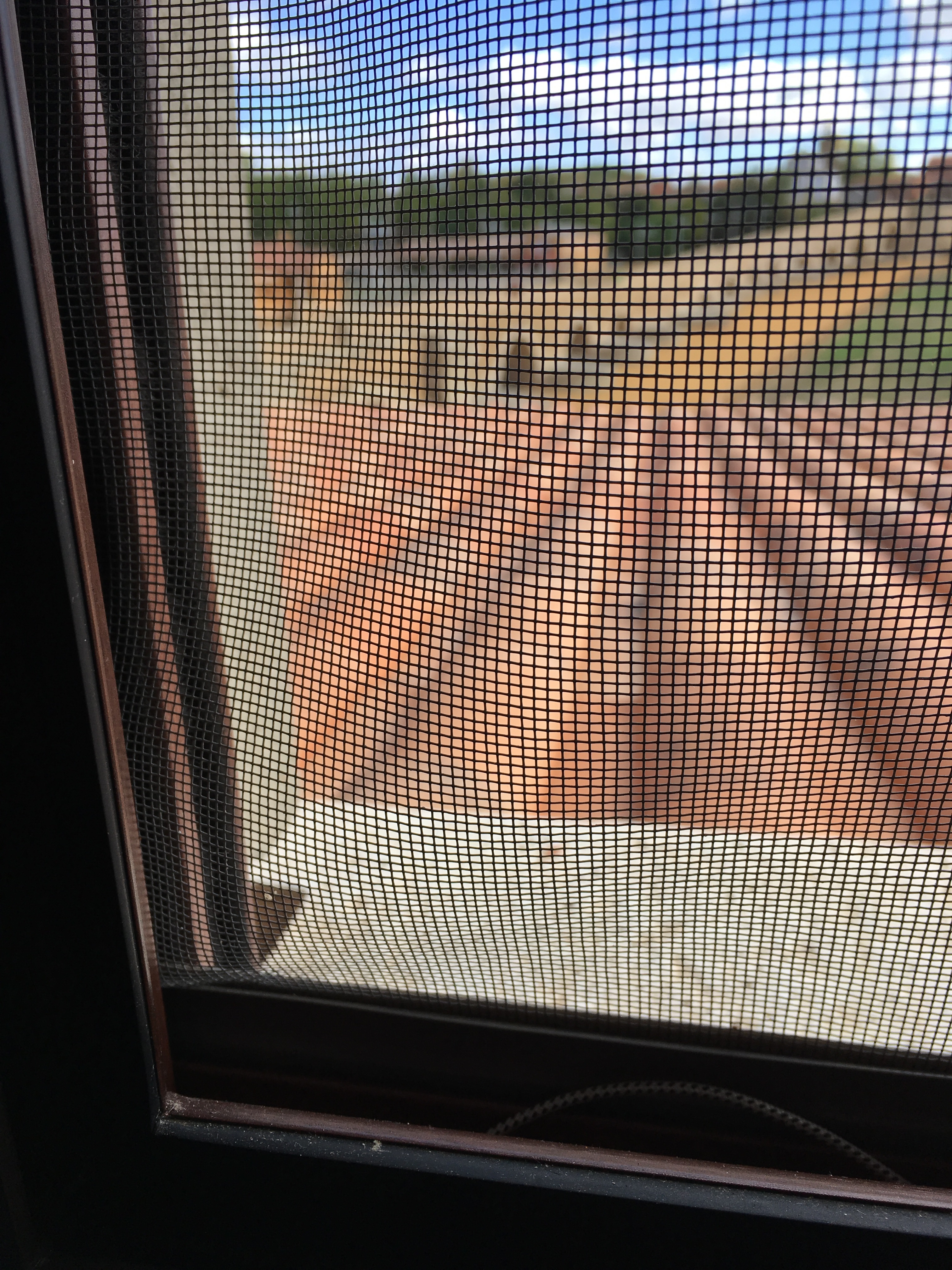
Here are two interesting things about my room that night, at the Hostal Don Suero de Quinones: yes, ladies and gentlemen, that is window screening in my room = no flies.
And this is the world’s smallest bathroom (seemed like it). The shower was only 4-feet wide:
I can’t believe it’s October already. I often lose track of what day of the week it is, but it’s interesting to find out we’re in a new month. Only 16 more days to Santiago…
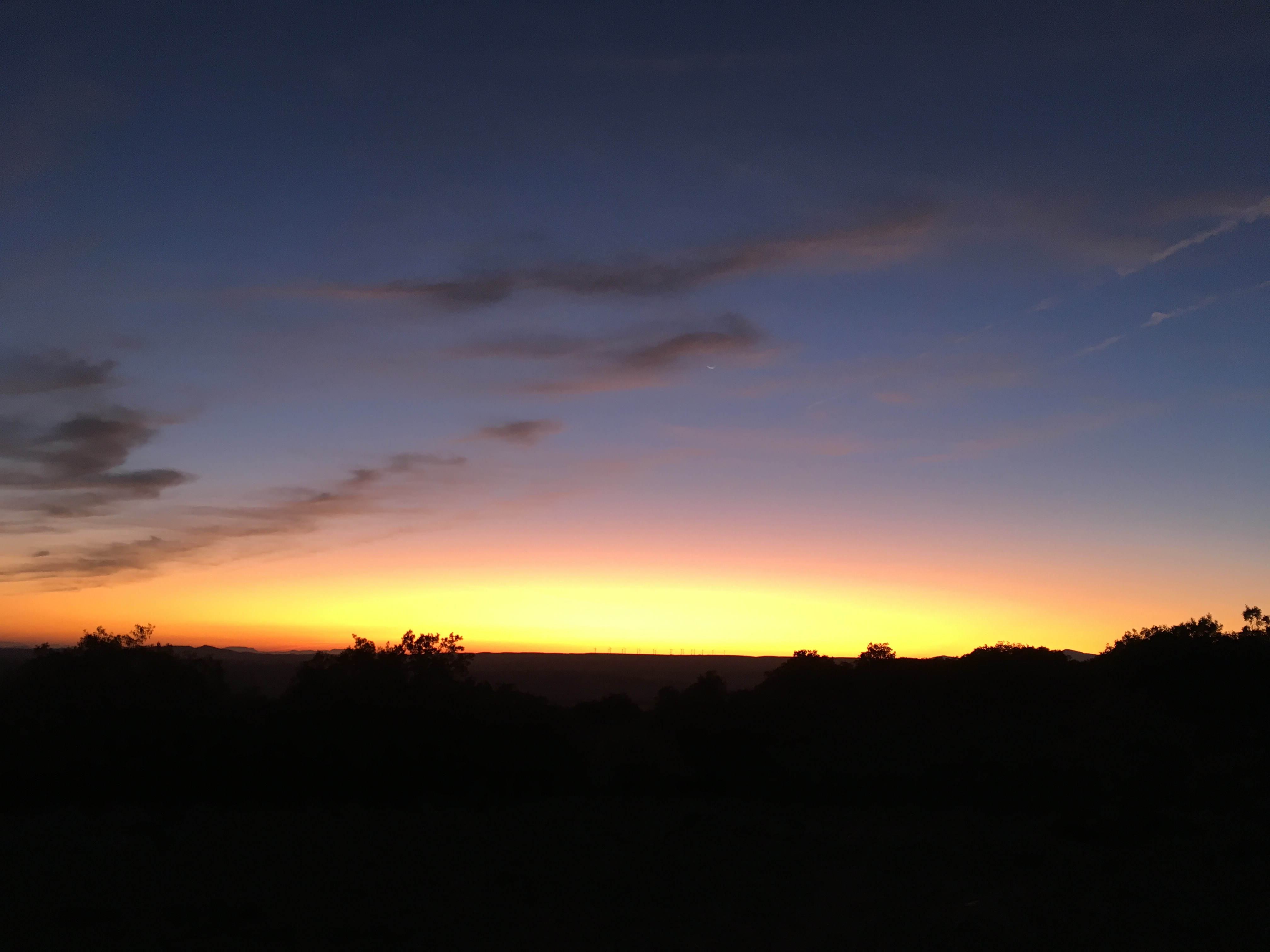
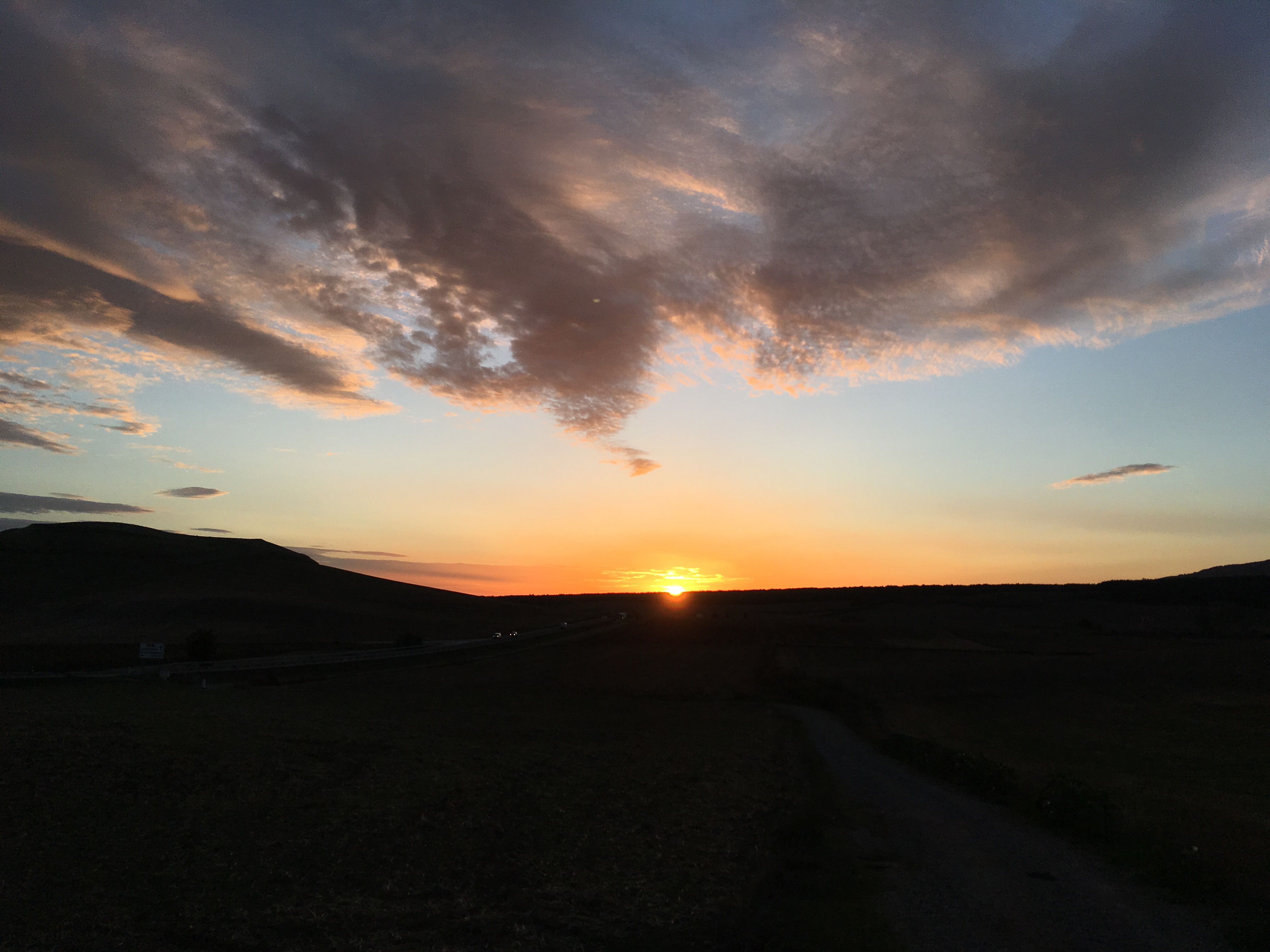
I departed Leon at day break into 48 F, dry, cloudy, on a 21 Km walk. Had to go through 8 Kms of Leon industrial zone just to get out of town; not sorry to see Leon in the rearview mirror (so to speak).
This realization struck me as I walked this morning: instead of thinking “I just have to get through three more weeks”, all of a sudden I was thinking “there are only three weeks left, how lucky I have been to be able to do this”. They say the second part of the Camino is mental.
Most the morning was overcast as the trail wandered through fields and alongside the N-120 two-laner.
Eventually, the sky cleared and large, puffy clouds remained, along with a view of the mountain range I’d be climbing through in the next week.
My general walking routine, if possible, is to walk for an hour or so, then stop, get coffee con leche and remove my boots, do a little foot massage, and start walking again after 10 minutes.
Then I try to go on until my halfway point, where I stop, stock up on a sandwich and fruit for lunch later (if necessary), get off my feet for 15-20 minutes, and change my socks. The sweaty socks are hung off the back of my pack to dry. At the 3/4 point, I rest again and get the boots off for 10 minutes. Seems to work well, but is dependent on the stage easily being broken into thirds or fourths and there being places to sit down. I’ve had to be creative at times.
At one albergue-cum-truck stop today they had a scale available. In my stocking feet, I weighed in at 95kg = 209lbs. Really!? It’s probably not that accurate, but if it is, I’ve lost around 25 pounds on my Camino.
Villadangos is a one-horse town with a lot of trucks barreling through it. I stayed in the Hostal Libertad, which featured a lot of older men in the bar, aka The Fly Cafe, for scheduled afternoon card games. Town population: 1100. The albergue facilities were OK, nothing special. I did manage to have my favorite late lunch:
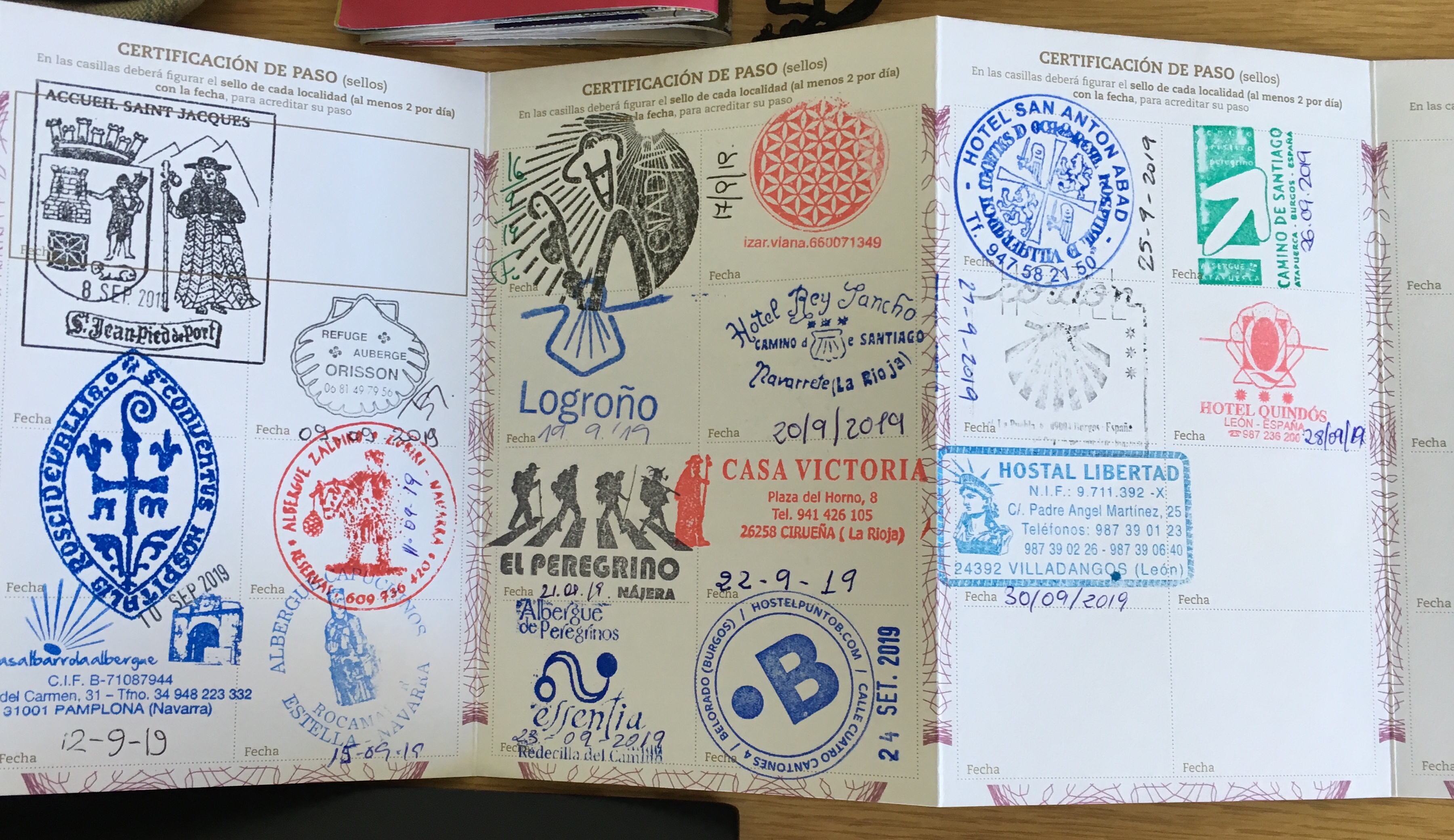
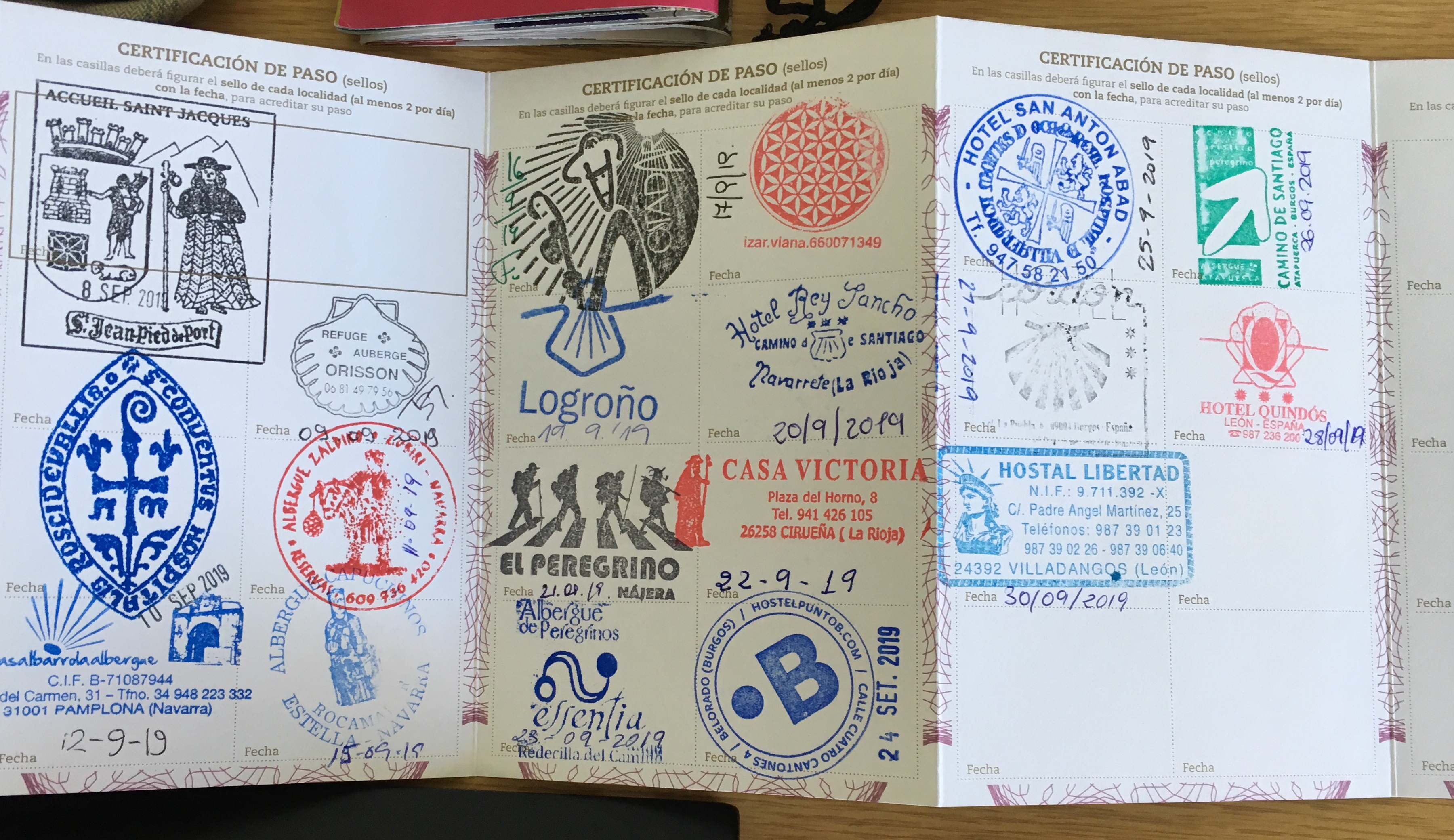
You may remember that we pilgrims carry a credencial or “pilgrim passport” and we get it stamped along our walk. Here’s what my credencial looks like now:
My feet seem to be fully healed and it feels like my whole body has finally adjusted and become stronger, and is now ready to move ahead on my walk. The first few weeks, physically, were a shock, indeed, but it’s great to have rebounded and not have that as a concern now.
I don’t want to give the archaeology work at Atapuerca short shrift – we went through the local museum and it was fascinating – so here’s a link to more information: Unesco Atapuerca
We stayed at the Albergue El Peregrino in Atapuerca, sharing a double room for 17.5 euros each. Over dinner, we met some interesting women in our age group who insisted I had to go to Bali. I’ve been getting lots of suggestions for future destinations and noting them down.
It was really dark during our pre-dawn climb (of course) out of Atapuerca, and we clambered over some really rocky trail sections by headlamp. After sun up, we passed through a few quaint villages and pine forests on our way to Burgos.
The last 8 Kms into Burgos go through an industrial area and it’s amazing that the guide books don’t mention that this means no food, no water, no bathrooms, and not even a place to sit down on a roadside bench. C’mon, don’t the people who work in these factories and warehouses have to eat? How about a bus stop with a bench?
This means I have no pictures of our entrance into Burgos. If you’ve seen one Volvo truck plant, you’ve seen ‘em all.
We finally made Burgos, found the Old Town, and got checked-in. After the usual Pilgrim Routine, we headed out for a late lunch:
Still my favorite: Ensalade Mixta
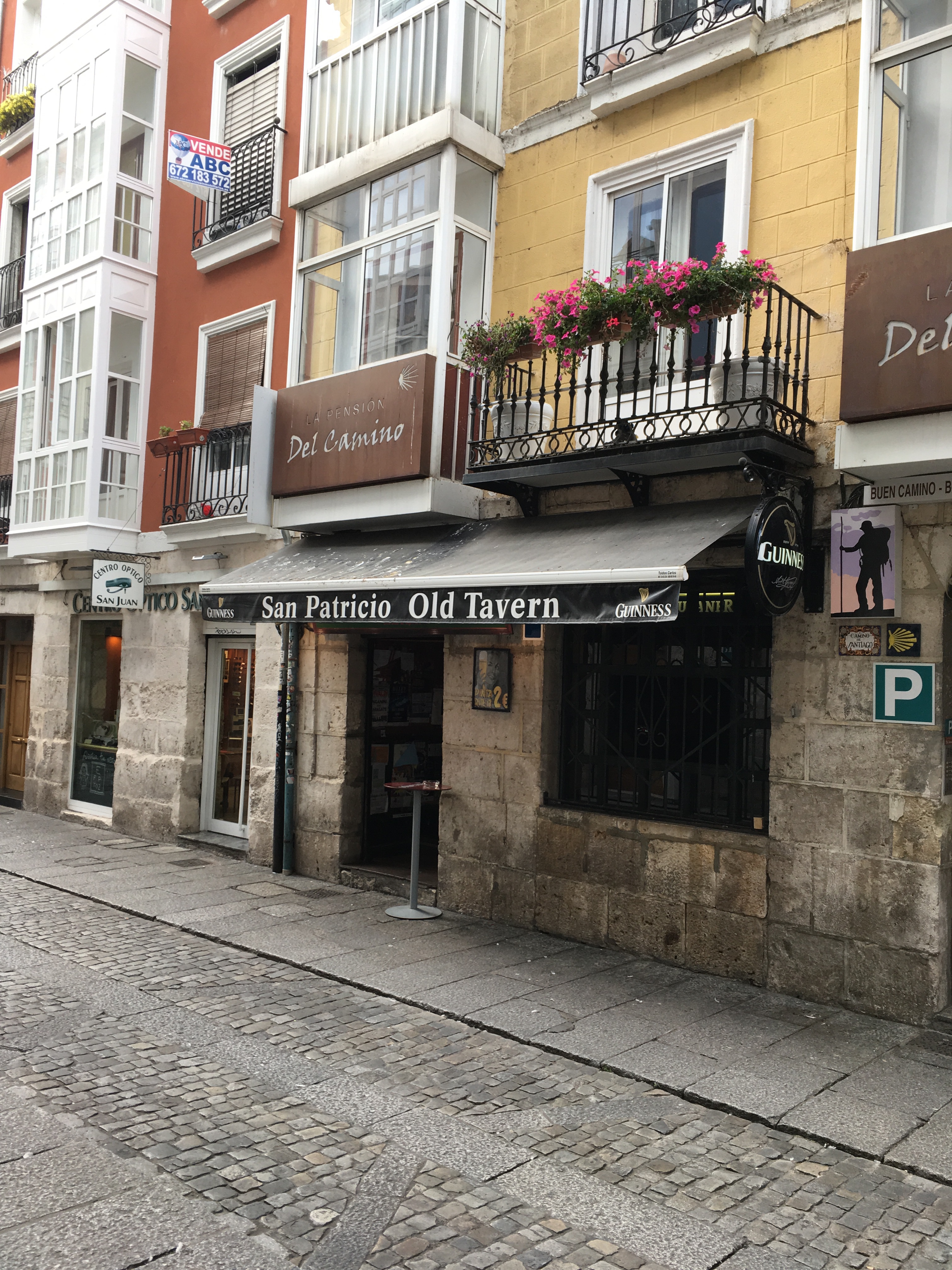
Claude and I are going our separate ways tomorrow; he with a day off in Burgos and then some Camino route variations, and I by catching the train to Leon. We decided to celebrate and found this “Irish pub” in the Old Town:
Note the Guinness sign
And we decided to have a Gin & Tonic. I was really surprised when the bar tender delivered this tasty monster:
We were both surprised and, of course, had to have another one to be sure the first one wasn’t just a fluke. It wasn’t. And, of course, that led to Claude suggesting we go to Burger King. Isn’t this how all these weird things start?
So, we Google Burger King and find one nearby. We go on over and examine the menu full of “Master Burgers” (not “Whoppers” but looked similar) and the touch-screen-only ordering. Cue the sensory dislocation due to cultural differences (plus G&Ts) and, after much dithering and screen-poking, we place our order and eventually we get our food and sit down.
It’s only then that we notice that 98% of the clientele consists of girls aged 10-14. The sound track was a dead giveaway: shrieking, OMGing, and loud cell-phone-on-speaker mania. It was spooky. Claude and I ate up and got out as quickly as we could. You think two old guys stood out in that crowd? And, no, the food was not that good.
The next morning, nursing a bit of a hangover, I packed up and went along to the train station and caught the 12:34 train to Leon. You may remember I have a full-size, 40-liter pack and a day pack. On the Camino path, I carry one or the other and ship the other one ahead. Not this time – I had to carry both and it was really awkward. I almost took a header down the steps getting off the train. The train trip itself was uneventful and there were a lot of pilgrims on board. We crossed the flat, hot, shadeless “Meseta” wheat fields and I was not unhappy about skipping the area.
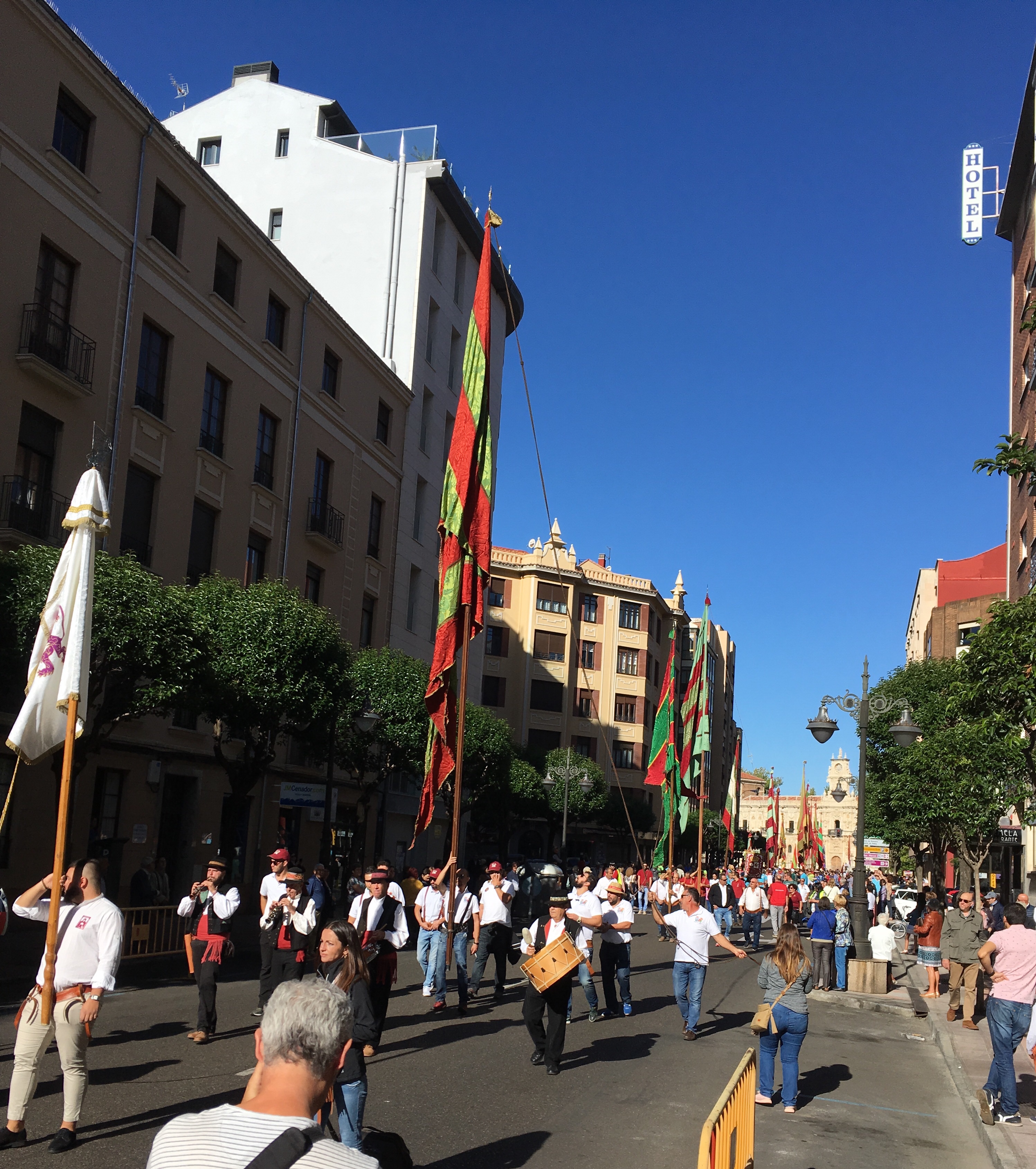
Leon is a big, big city and I had a day off there the next day (Sunday – September 29th). There was a big parade of “Pendones” right past my hotel the next morning.
The Pendones are the big banners
I may not have this totally correct, but it looked as the banners were carried and accompanied by groups, social clubs perhaps, from different cities in the region. There’s some connection to military events in Spain’s past.
As you can see in the picture, one person carries the pole holding the banner by clipping it into a belt that’s much like a weight-lifter’s belt. As they march, they do a balancing act, sometimes aided by someone working a rope from the top of the pole. Other pole carriers, with their own belts, stand ready and jump in to switch off frequently, without lowering the pole. I saw no banners go down, which is remarkable because the tallest poles were about 50’ high.
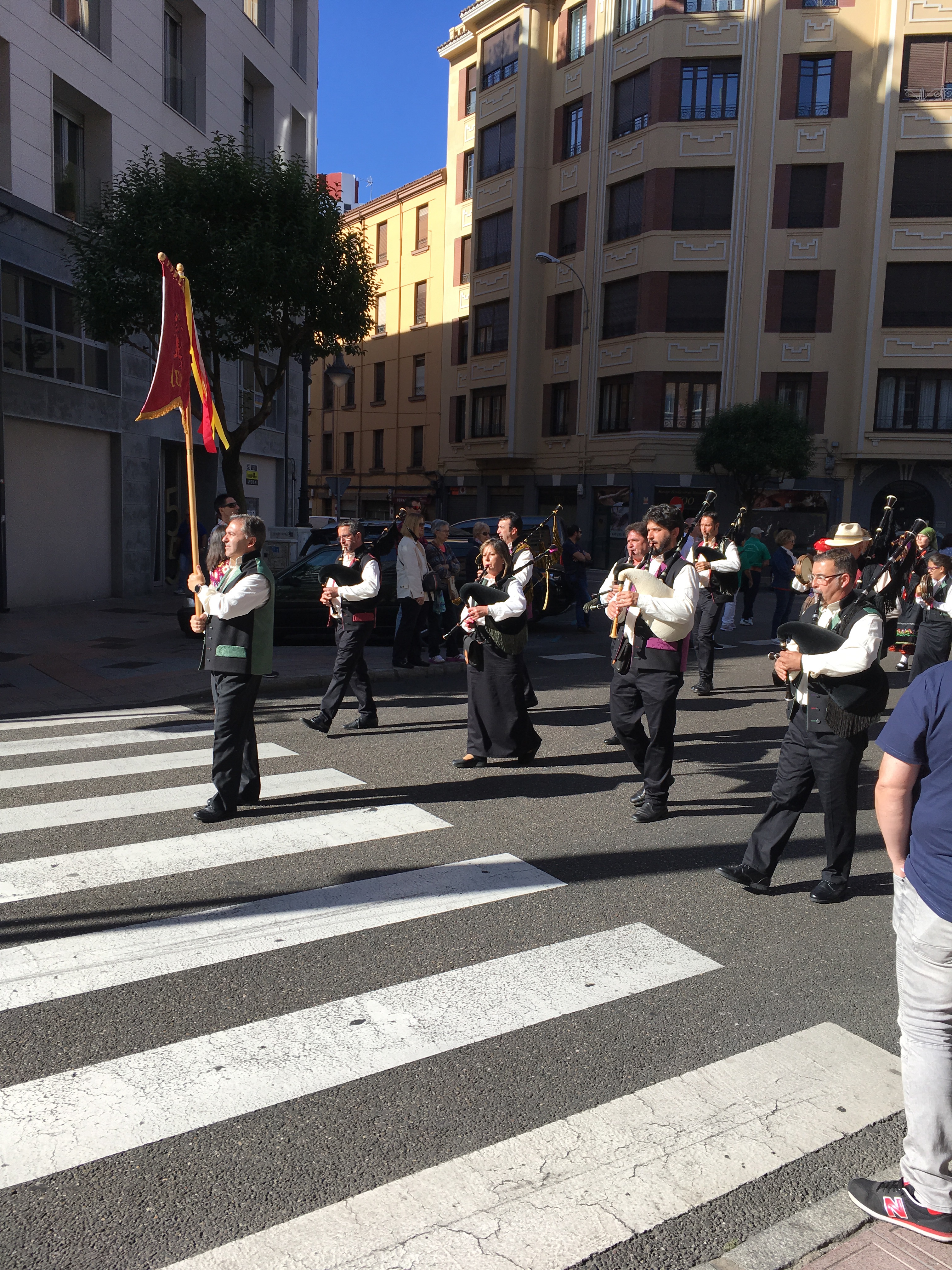
Some groups had coordinated outfits, including women in very traditional dress, with castanets. Some had musicians with them:
This group included Spanish bagpipers!
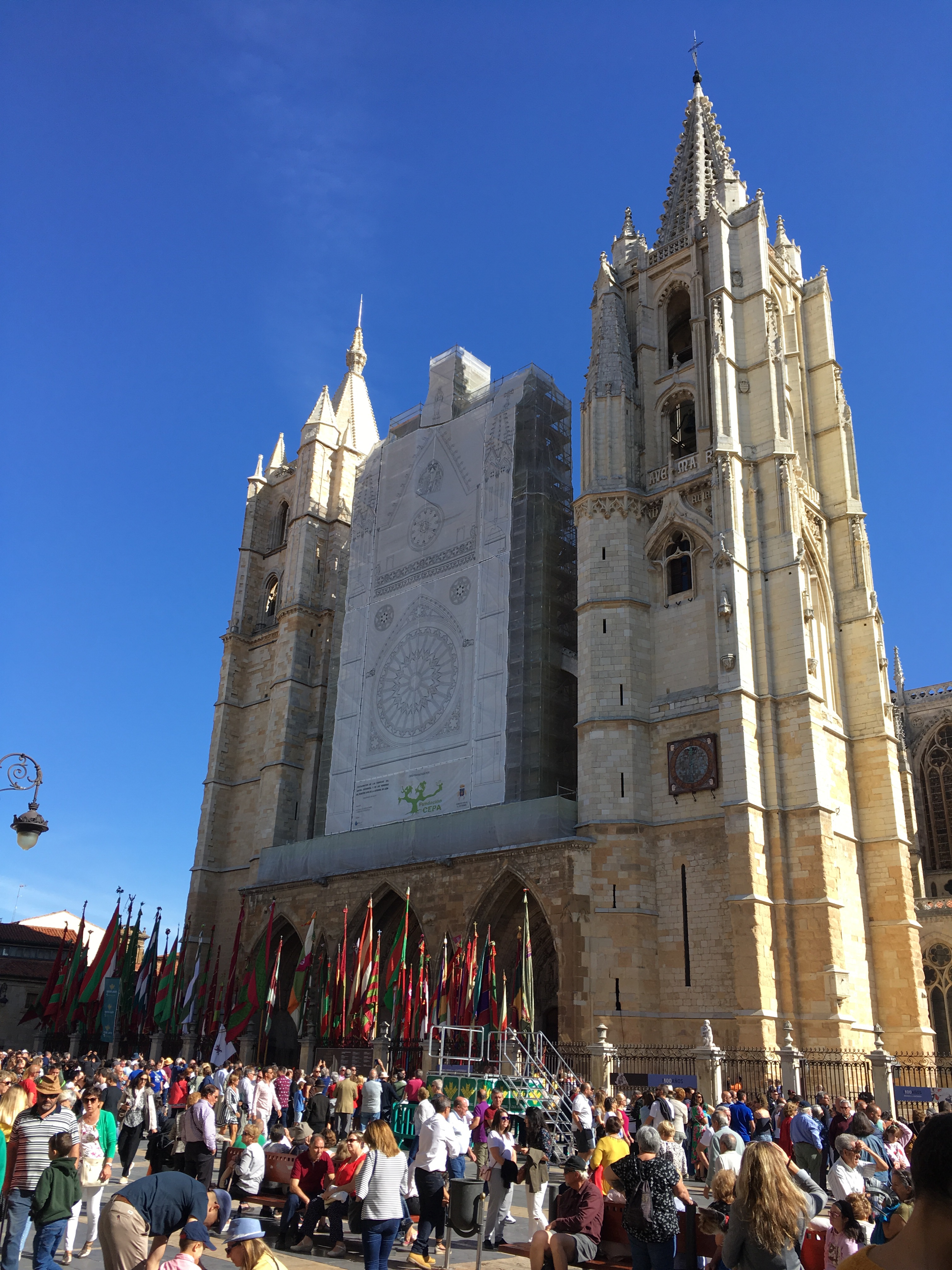
The parade went on for hours and I finally decided to see where they were going. I followed the jammed sidewalks down to the huge cathedral, where the banners were being presented and displayed.
Picture doesn’t give a clear idea of how jammed the plaza was
Once you get into the Camino frame of mind, being in a big city is somewhat disconcerting. I was happy to leave Leon behind the next morning and get back on the Camino path.
It’s rare, but every now and then a hotel, hostel, or albergue will offer a breakfast buffet, and we hit the jackpot before we left for Atapuerca:
All the usual Camino breakfast starches plus eggs, sausages, and bacon. Claude was in Protein Heaven. Our happiness lasted until we left the hotel side door and saw the stiff uphill ascent out of town that awaited us.
When the path finally, finally leveled off and I stopped seeing spots, and the sun was finally up, my walk took me through quiet forested lanes, dappled with sunlight. Claude fell back to chat with some fellow Canadians for a while.
The Camino seems to attract pilgrim-philosophers and some leave their wisdom behind for others:
Kathy Dunn, I think this was meant for you. Or WAS it you?
It’s not all fun and games, though. Periodically we see a path-side shrine to someone who has died on the Camino. The one above celebrates a Spanish cyclist. The Camino route for cyclists is often separate from the one for walking pilgrims, but sometimes they’re the same and cyclists come barreling by you on the path, without a hint of warning. The Spanish are great cycling enthusiasts and the Camino offers a great workout for mountain bikes, so add them to the traffic we walkers encounter.
We enjoyed the beautiful, clear weather and relatively good path surface all day. That’s Claude up ahead of my shadow.
We walked just 14 Kms today, through San Juan de Ortega, disciple of the legendary Santo Domingo, and here’s the town church:
Then through Ages, and on to Atapuerca, home to the famous archaeology sites that trace humanoids back 800,000 years.
And we’re off to Villafranca Montes de Oca, with a dry 52 F starting out our 13 Km walk.
Apparently we’re making progress. Systems Check: Claude’s ankle is nearly 100%, my blisters are healing nicely, and neither of us is popping pain killers for a change. Yay!
Once again, we’re walking through rolling farmland with acres of wheat and dried sunflowers. The panorama is gorgeous.
Walking pace is a very personal thing and can vary a lot. When we want to talk and solve the world’s problems, Claude downshifts from his usual military pace to match my slower stroll. Other times he speeds ahead and we rendezvous at the next town.
We made it to Villafranca Montes de Oca and the heavily over-decorated Hotel San Anton Abad in good time. Here’s the view from our room of the local church
As I mentioned earlier, there are water faucets along the trail, like this one in town:
However, we usually prefer a different beverage after checking in and getting the pilgrim routine out of the way:
Speaking of which: “Craft” beer, as we know it, on tap is non-existent on the Camino. The Estrella and Ambar found everywhere on draft is basically a pale lager around 4-5% ABV and 25 IBUs. In larger cities, there are bottled beers and some may be craft but I haven’t tried any. In smaller towns, there’s this, and a non-alcoholic version, and a radler (beer + lemonade) on tap and that’s it. Slim pickin’s, indeed.
Some of our walk today was beside the N-120 highway, a busy two-laner with a lot of trucks. Most of the time, we’re on a path, separated from the highway but not always.
One of the things I’m often reminded of while walking is that pilgrims have walked this path, through these hills, fields, and towns, for over 800 years. It’s kind of cool to now be part of that.
Claude and I left Recedilla del Camino before sunrise, once again navigating the path for the first 30 minutes using headlamps. It was a little warmer (58F) and dry but very windy. We walked 11Km directly into a steady 20mph wind, with gusts to 26, which is surprisingly tiring, and arrived in Belorado quite early, at 11am. Our walk took us, again, through rolling farmland with acres of wheat and dried sunflowers. Mercifully flat.
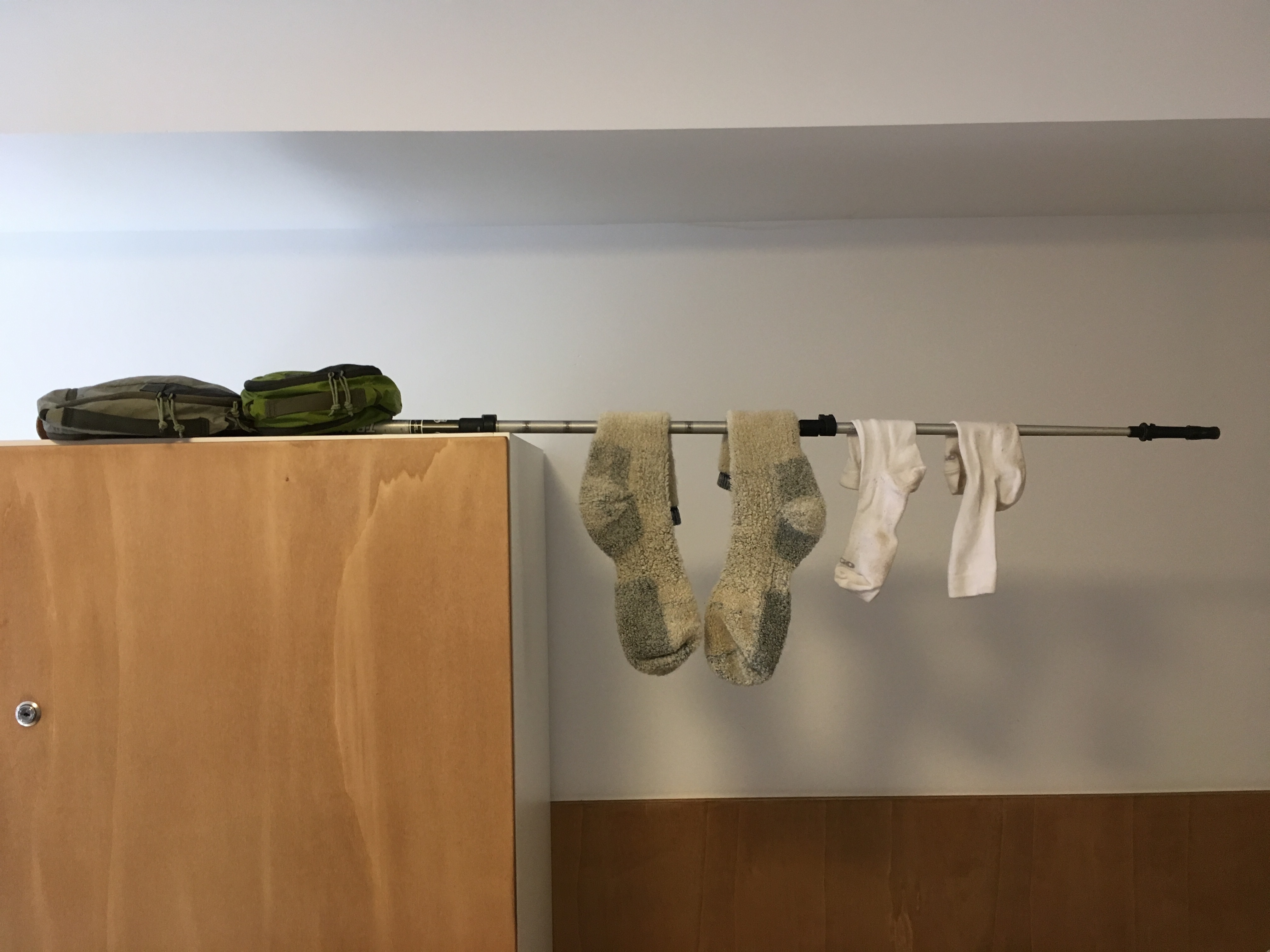
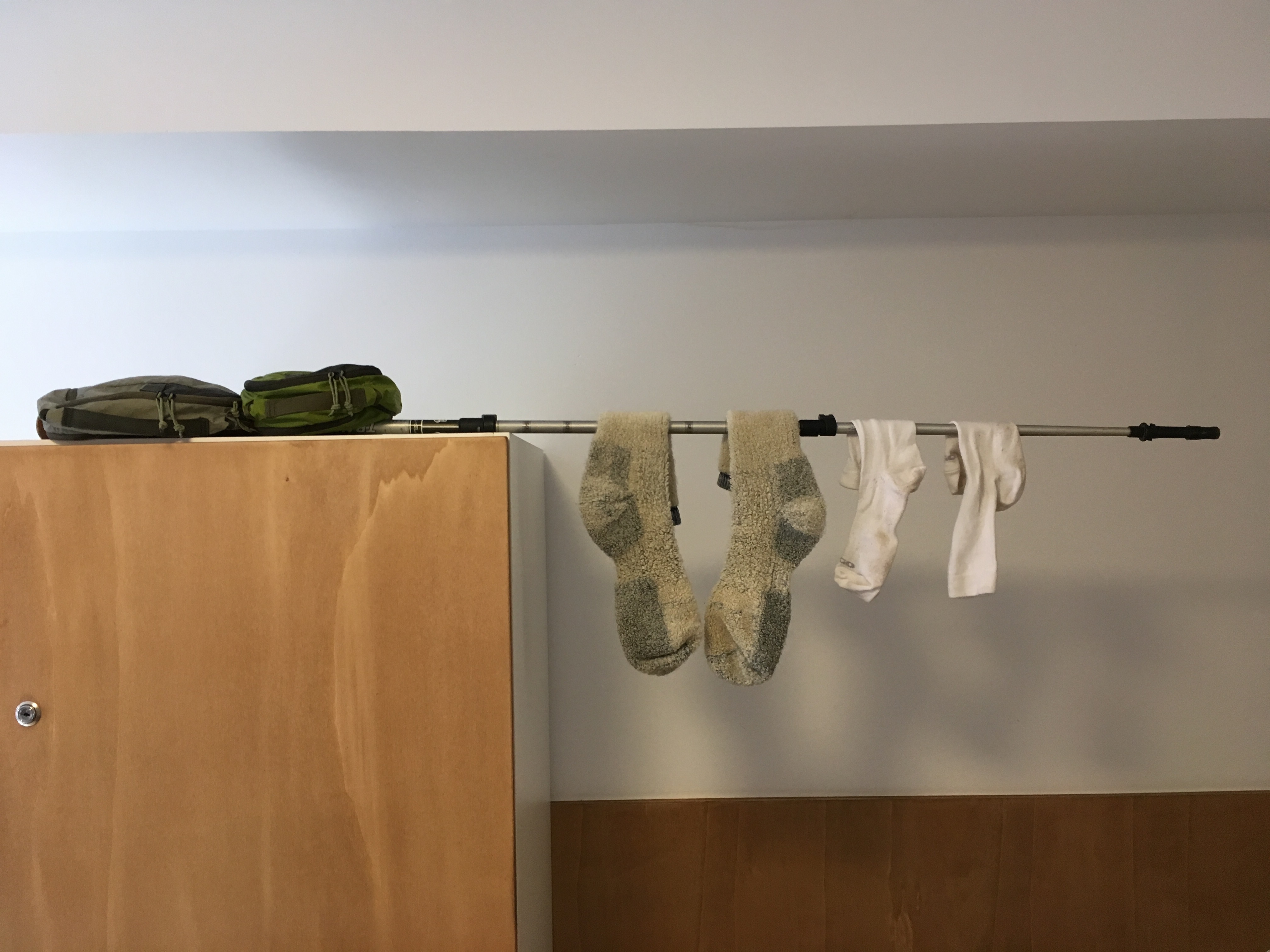
We checked into a good albergue, Hostel Punto B, which had a lot of nice facilities. I took the opportunity to pay to have my laundry done but the socks weren’t quite dry. Never underestimate a pilgrim’s ingenuity when it comes to rigging a clothesline!
The ever-versatile trekking pole repurposed.
We went out into town to find a farmacia, an ATM, and something to eat, and were successful with the first two. The siesta shut down all restaurants, though, and we had to settle for tapas and Sangria for lunch.
To be honest, I’m getting a little tired of the beer-wine-tapas diet (yes, folks, you heard it here first). The breakfast albergues and hostels offer is always coffee and toast or croissant, no protein, and lunch is often tapas or a salad (at least there’s usually tuna and egg in a salad). Dinner is usually something we make, like a sandwich, based on our forays to the local super mercado (no, nothing at all on the scale of an American supermarket) but there ain’t much variety in that. We usually pass on the Pilgrim Menu dinner because it’s too much food, too late. On the other hand, I got on the scale at an albergue (probably not too accurate) the other day, with my boots off, and it said 95Kg (209 lbs) which is around 20 lbs less than when I started my walk!
Traditionally, the Camino is a cash-only economy (though many hostels and hotels take plastic now), so you need to manage your cash carefully and, of course, only Euros are accepted. A lot of small towns do not have banks nor ATMs, so planning is important. The good news is that the Internet is very helpful in locating cajero automaticos.
Keyboard next to TV remote for scale
Inquiring Minds Want to Know, Part 2: What devices are you carrying? I’m carrying an iPhone 6 SE and the compact Bluetooth keyboard shown above, along with a recharging battery, and the usual charger cable and adapters. The keyboard folds up to become a lightweight 2” x 6” x 1” block and works very well.
I’ve spent the last nine months researching the Camino and place names like Zubiri, Logronio, and Belorado were the stuff of my dreams. Now when I find myself in these places, for real, I can hardly believe it. It’s very moving to actually be here.
We got an early start out of Ciruena, before dawn, using our headlamps to see the trail, for a 17 Km walk to Recedilla de Camino. It was a chilly 47-degrees F but dry and eventually became sunny and in the 60s. However, the wind started building throughout the day, eventually gusting to 18mph. No sign of das German ladies.
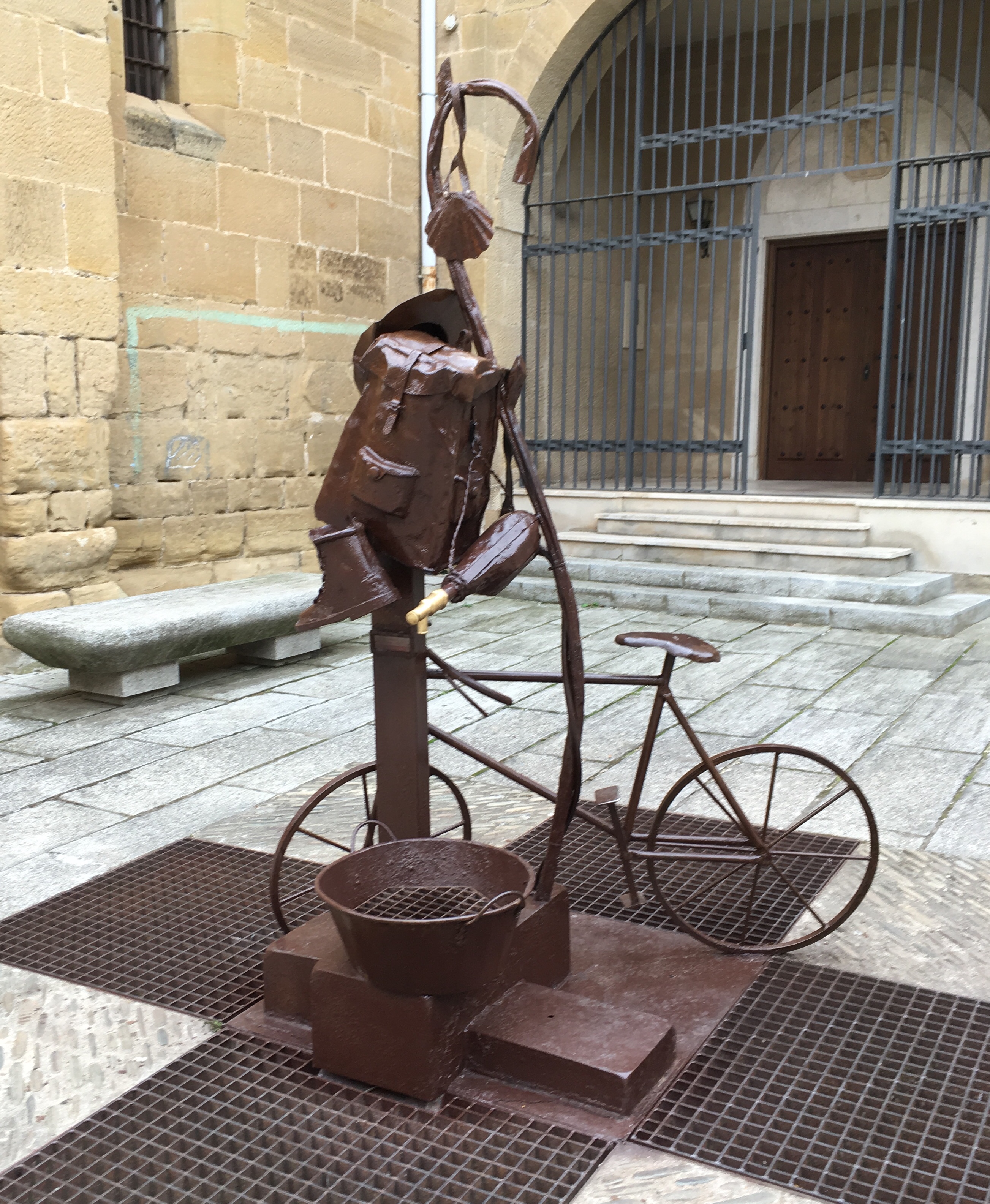
Our path took us through the larger town of Santo Domingo de la Calzada and we encountered this water fountain/art work in the old town. There are a lot of water fountains/faucets along the Camino for the benefit of pilgrims; some are marked non-potable and I’m leery of drinking water in the rural countryside from a funky-looking spigot anyway.
You may remember at the outset of this journey, I mentioned the Pilgrim Passport or credential that we get stamped along the way. The photo above shows my credential at this point.
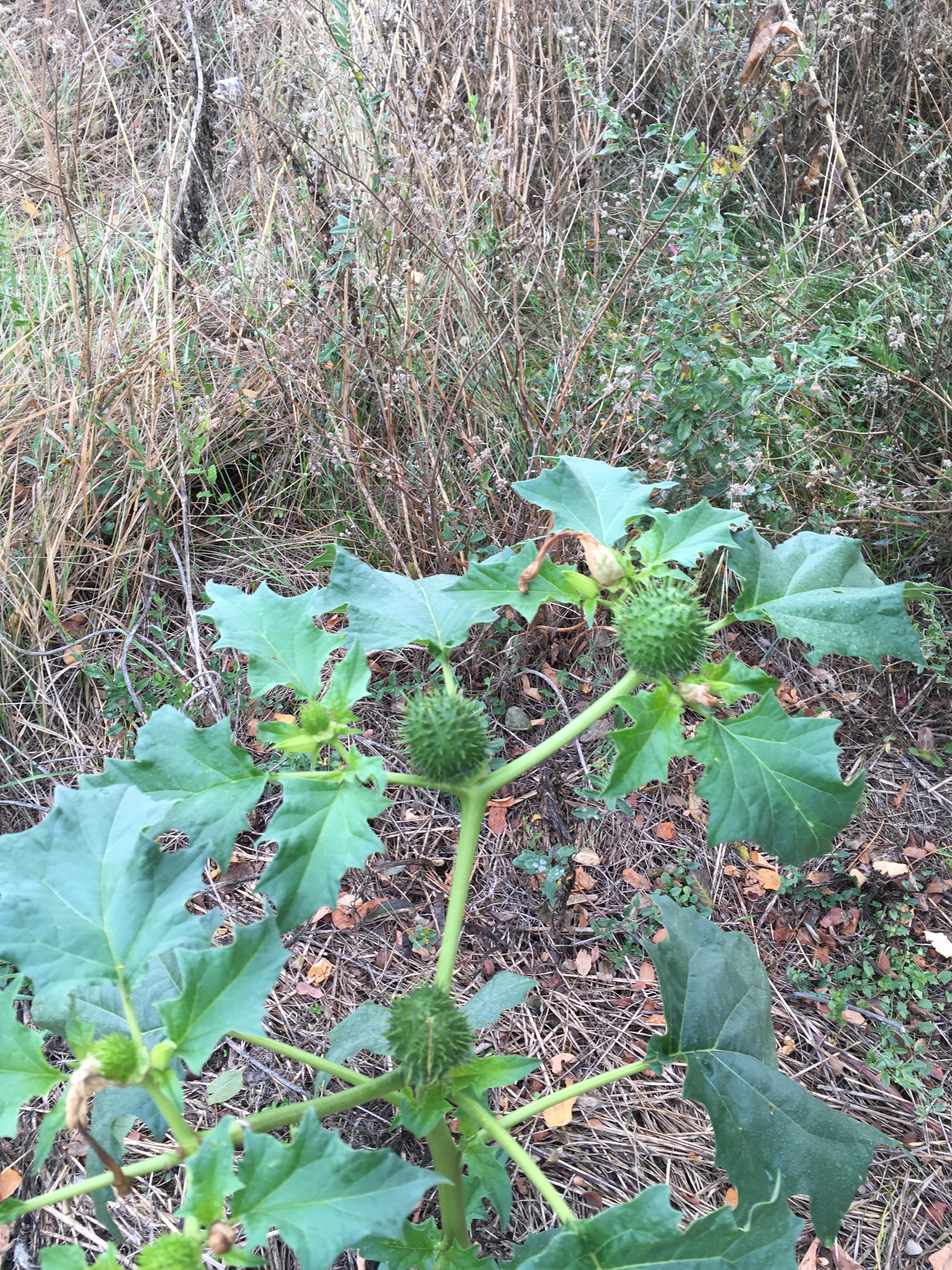
Alien pods?
As we pass farm fields, we see a lot of the invasive plant shown above. It has white trumpet-shaped flowers and that really menacing seed pod. After consulting a local expert at a bar, we discovered it’s datura stramonium, or Jimson Weed, a member of the Nightshade family, and quite toxic. Also possibly psychedelic. I think I may have heard about it in the 60s but can’t remember. The author Carlos Casteneda came to mind but he was the peyote guy, wasn’t he?
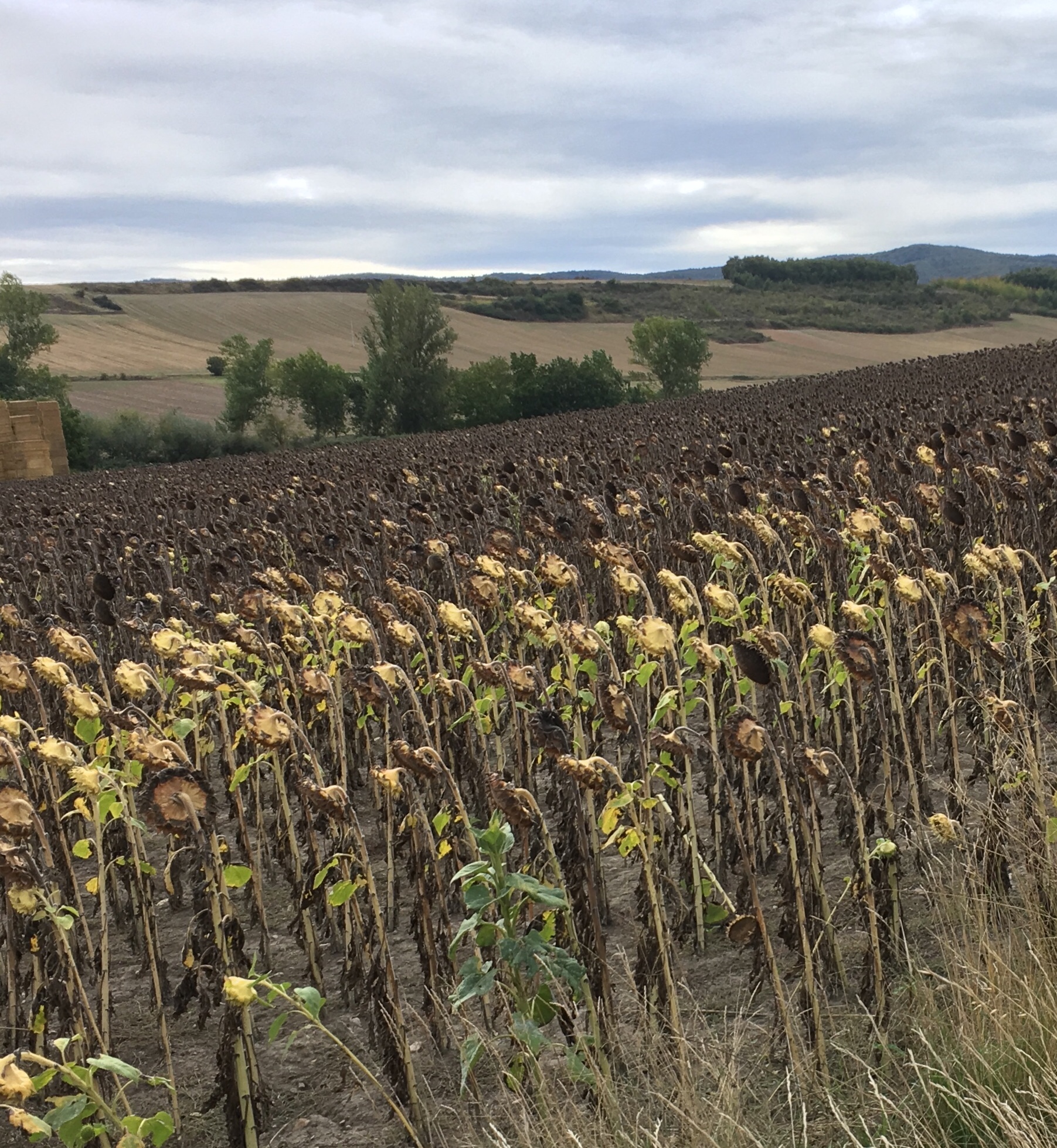
We passed through acres of sunflower fields, all dried up and ready to be harvested. I bet it’s quite lovely to see them all blooming and facing upward.
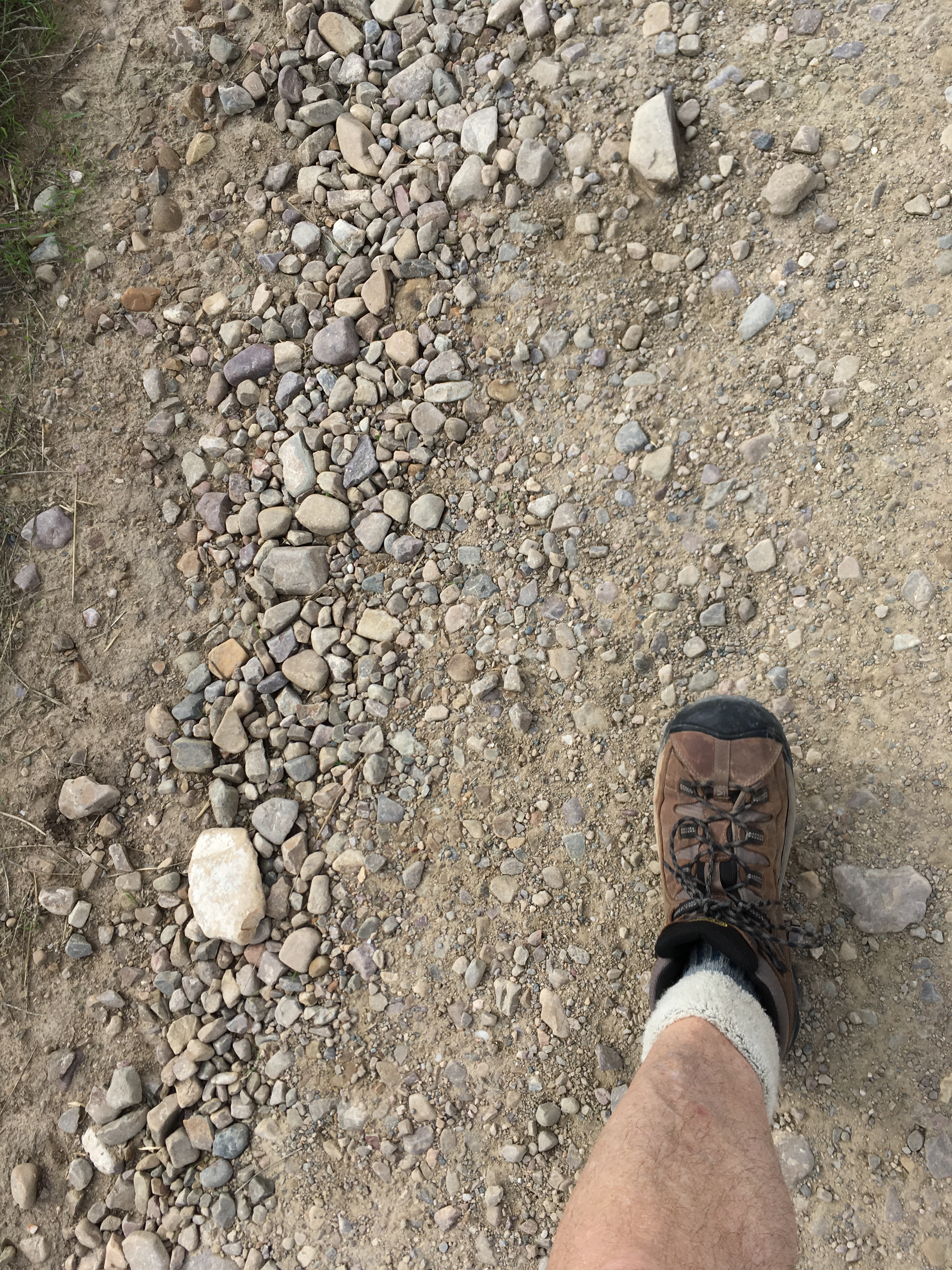
Today’s path surface is what you see here – packed earth and stones; not too hard on the feet but not the best either. The good new is that my blisters are healing up and my feet are generally improving.
Recedilla de Camino is a tiny town and so is the albergue we booked into – just 10 bunk beds. The hospitalero is very nice but also maybe just a little nutty – too long on his own, maybe. Nonetheless he cooked us a really nice dinner and breakfast, both including bread he baked.
Among the guests were two young guys who were hauling all manner of digital devices (laptops, iPads, phone, cameras, stands, chargers) and insisted on videoing everything, even the serving of the soup. They also came crashing into the dorm room about two hours after we’d turned out the lights, waking everyone up. They may be the next Rick Steves, but that was bad albergue etiquette.
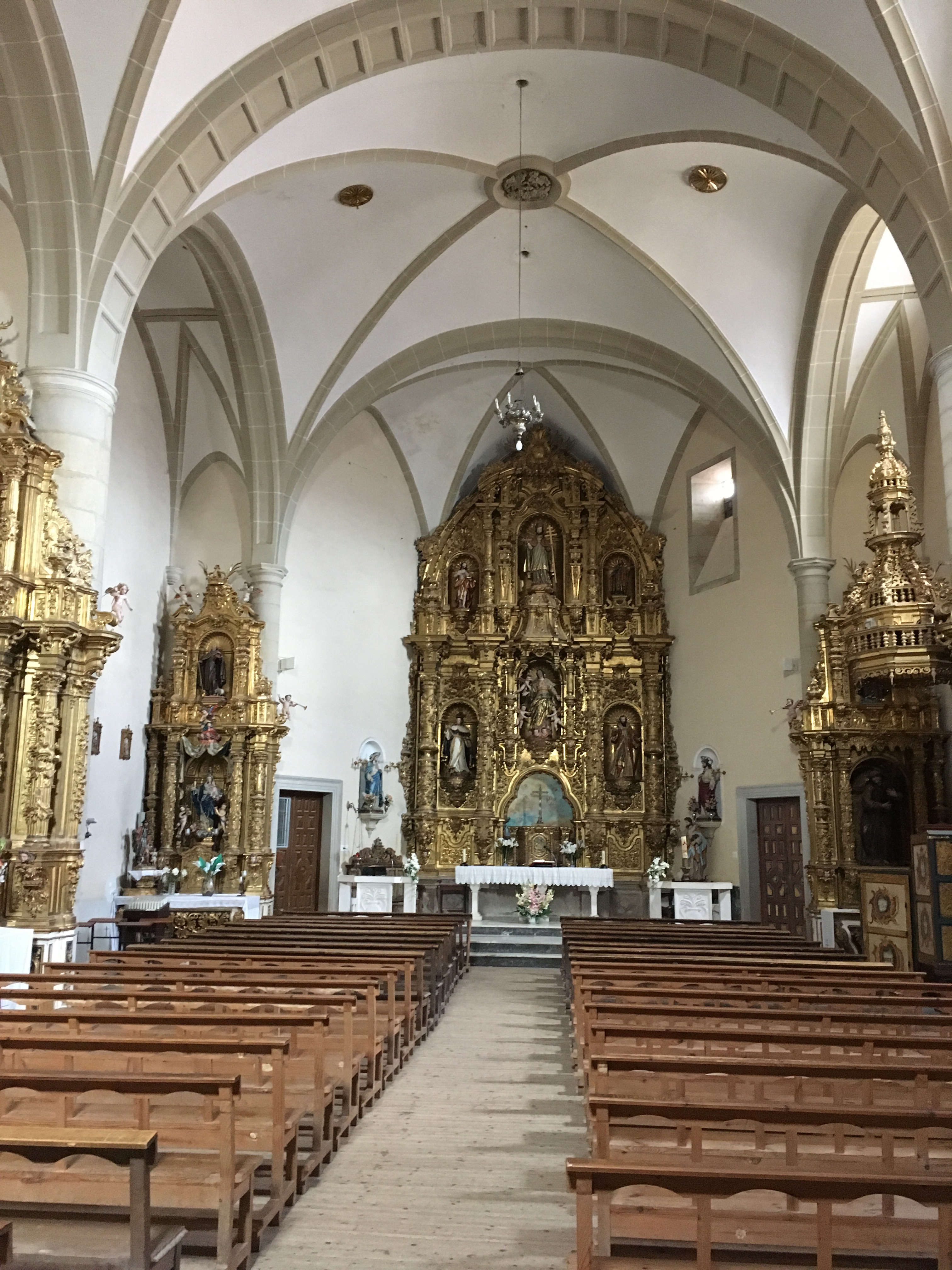
Tiny or not, the town did have a nice bar (run by an Ecuadorean who goes home in the winter months) and the required medieval church drenched in gold leaf.
A special howdy to Jack, Verne, Anthony, Brad, Cindy, and everyone else at 1-to-1 Fitness: thanks for following the blog. If I had to assess my training efforts now, I’d say I didn’t do enough cardio and did too much walking on smooth surfaces. I hope everyone is well.
Lastly, Inquiring Minds Want to Know, Part 1: Why are these posts a week behind? There are several reasons. Early on, I was just too exhausted to write them after walking all day and then doing the usual pilgrim routine (shower, laundry, eat). Then later I discovered that the “free WiFi” (pronounced “wee fee”) promised at most (but not all) lodging is a relative term. Some WiFi is unsecured and dangerous to use, some doesn’t work at all, and some is so slow (especially with everyone on it at once) it’s unusable. I’ve been trying to catch up in bursts when I get to a safe, fast network, so bear with me.
My blisters and Claude’s ankle continue to improve, along with our spirits. This morning we departed Najera in the pre-dawn darkness, headlamps in place, with 56-degrees and a light drizzle, for a 15 Km walk.
Naturally, we start with a nice uphill climb out of town, just enough to get your heart really going and to develop a good sweat inside your rain gear. Later, after jettisoning the rain gear, we have a very nice day, passing through rolling farmland with acres and acres of grape vines, ready to harvested.
We had a lively discussion about how the grapes might be harvested – do the locals do it? Or is there a migrant community of pickers, like there is in the U.S., that does the job? It’s also funny that many towns are having their harvest festivals, seemingly before the harvest.
Camino trail markers get more varied
We encountered a group of about 20 women, German-sounding, all fairly attractive, with a guide, stopping at various shrines and statues, even praying at one of them. There’s nothing that puts a little more energy in your step than being overtaken, repeatedly, by these fit women. I guess the Camino hasn’t subdued Manly Pride, yet.
We finally made it to Ciruena, which is a strange place. There’s a nice, pretty new golf course there (in use) and street after street of modern apartment blocks (all empty). It has the air of a retirement resort gone bust. Claude called it a ghost town.
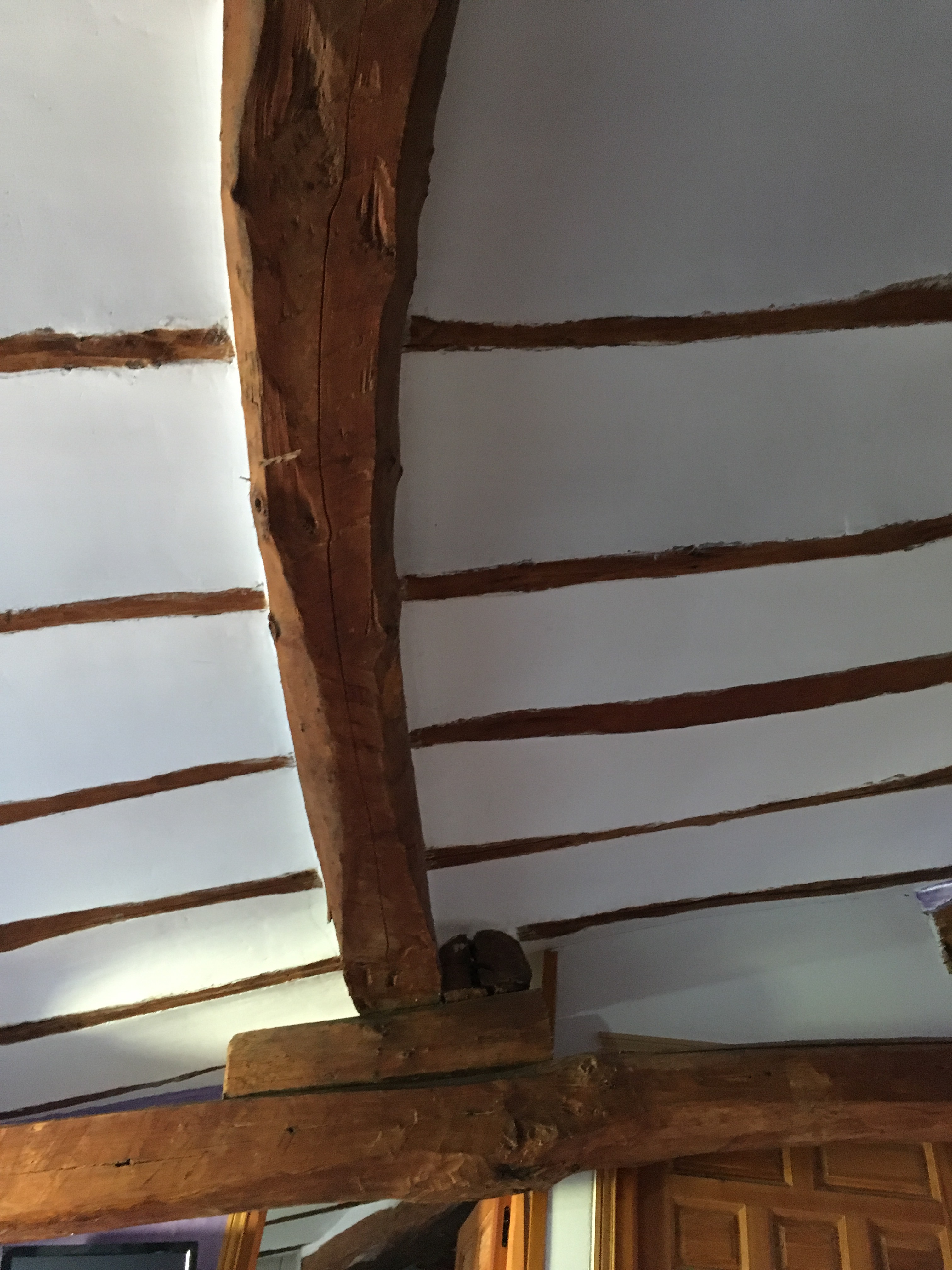
After the German ladies left us in their dust one last time, we crossed through town to our ancient hostel. How old was it? You can see the hand-hewn ceiling beams in our room in the photo above. Old perhaps, but clean, with good mattresses, and a good shower, so I was happy. It also had a nice sunny terrace, and a clothesline in the sun – bonuses.
I’ve not said much about laundry yet. If you have to hand wash, you do it in whatever sink is available, then hang it out to dry, hopefully in a nice warm, sunny, spot with a breeze. Most albergues and Camino hotels provide sinks and clotheslines. Some provide washers and dryers (3eu each) and I’ve even hand washed stuff then put it in the dryer if conditions were not conducive to air drying.
We all carry clotheslines and sometimes you have to get creative
Tomorrow looks to be dry but windy, as we’re off to Redecilla del Camino.
My feet are feeling pretty good after yesterday, so today’s walk will be a little further, 16 Kms, to Najera.
We’re walking through endless acres of wheat fields now, sometimes on a dedicated Camino path, sometimes on a farm road. We met an Australian family, pushing their 5-yr old daughter in a three-wheeled jogging stroller (no small feat), accompanied by their nanny, all with backpacks. The child emerged now and then to walk, using her own tiny trekking poles, and to inspect fascinating trailside flora and fauna. Amazing.
Traditional shepherd’s rest hut
Najera is a large and very old town and negotiating our way through some of its streets, dodging traffic where buildings were built right out to the curb, was interesting. We finally found our small albergue, Nido de Ciguena, which had four private rooms, and ten bunk beds. Our room did not have a lock nor lockable storage, so we had to take all our valuables with us when we went out to find food.
Here’s a weird thing about albergues: after lights out at 10pm, there’s no one from the property on site until the next morning. So you’re on your own if something happens in the middle of the night. In our case, a guy living across the street starting hollering loudly and whistling for his dog at about 2am, waking us all up. Buen Camino!
Logronio was about to launch its big week-long wine festival and, sadly, we saw it being set up as we left town. With some trepidation, I dropped off my big backpack at an albergue, tagged with the JacoTrans backpack transfer company envelope, and crossed my fingers. It turns out that JacoTrans does a great job for 5eu and it couldn’t have been easier to arrange.
Thus began a week-long run of walking with a partner and sharing a room with him, too. That also worked out very well.
For one thing, when you’re walking with someone else you can get your picture taken on the path pretty easily. The trail became less rocky, which was a relief, and our various injuries seemed to take to the short 13Km distance without getting worse.
So let’s talk trekking poles: I use two and find them to be invaluable going up and down hills. Especially when there are a lot of loose rocks on the path, just waiting to deliver a Camino-ending twisted ankle or knee. There’s a bit of a technique to using them but it’s easily and quickly learned on the path. When not in use, I collapse mine and tuck them into one of my pack shoulder straps, so I don’t have to hold them. If I’m using them a lot, I have a pair of fingerless, kayak-paddling gloves I put on to ensure that no hand blisters form.
We made it to Navarette without any issues and, hooray, my backpack was waiting for me. The photo above shows the view out our hotel window Ah, yes, “hotel” – we’re able to stay in hotels now by virtue of sharing a room. Still not the most economical choice (Albergue bunk bed: 6-10eu, hotel room 15-25eu each) but it does mean you don’t have to listen to snoring in the bunk room, and you’re using a private bathroom.
Here’s another interesting cultural fact: lots of bars and restaurants in Spain are closed from 2-5pm, so forget it if you’re starving and want a salad at 3:00 in a small town. The previously mentioned Pilgrim Menu dinner, which many places offer, may not be available until 7:00 or later. Claude and I have become adept at finding an open market and buying the makings for our own picnic lunch.
Tomorrow we’re off to Najera, through more vineyards.