Pamplona: Casa Ibarrola and Pinchos

13 Sep 2019

I planned a rest day in Pamplona and by dumb luck wound up staying in Casa Ibarrola, an exceptionally well-planned and -run albergue.

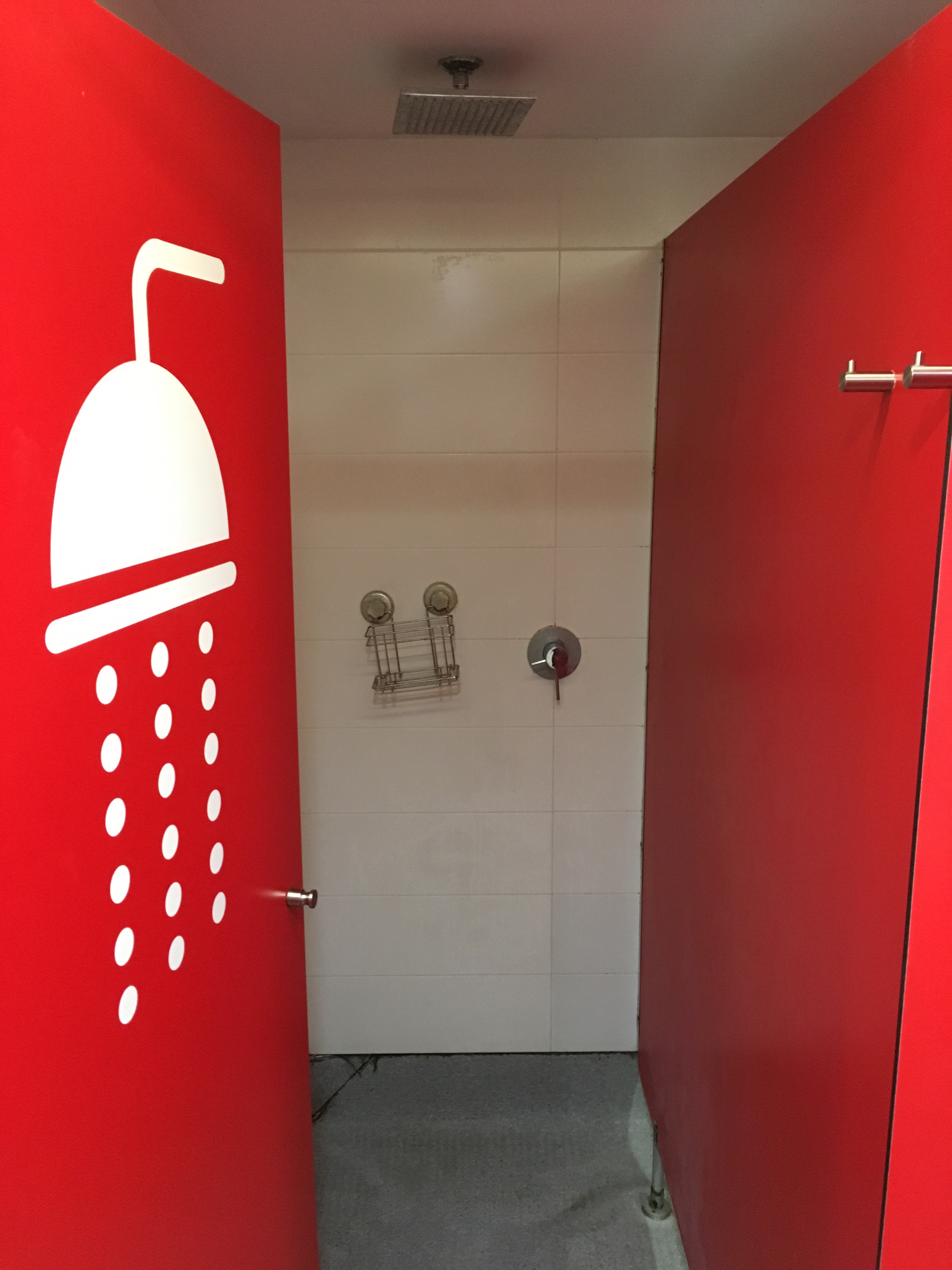
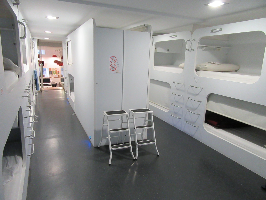
Two brothers came up with this albergue’s design and implemented a bunch of clever ideas. One of them was to locate the bunkroom a floor above the showers and toilets, which keeps noise and smells away from the beds.

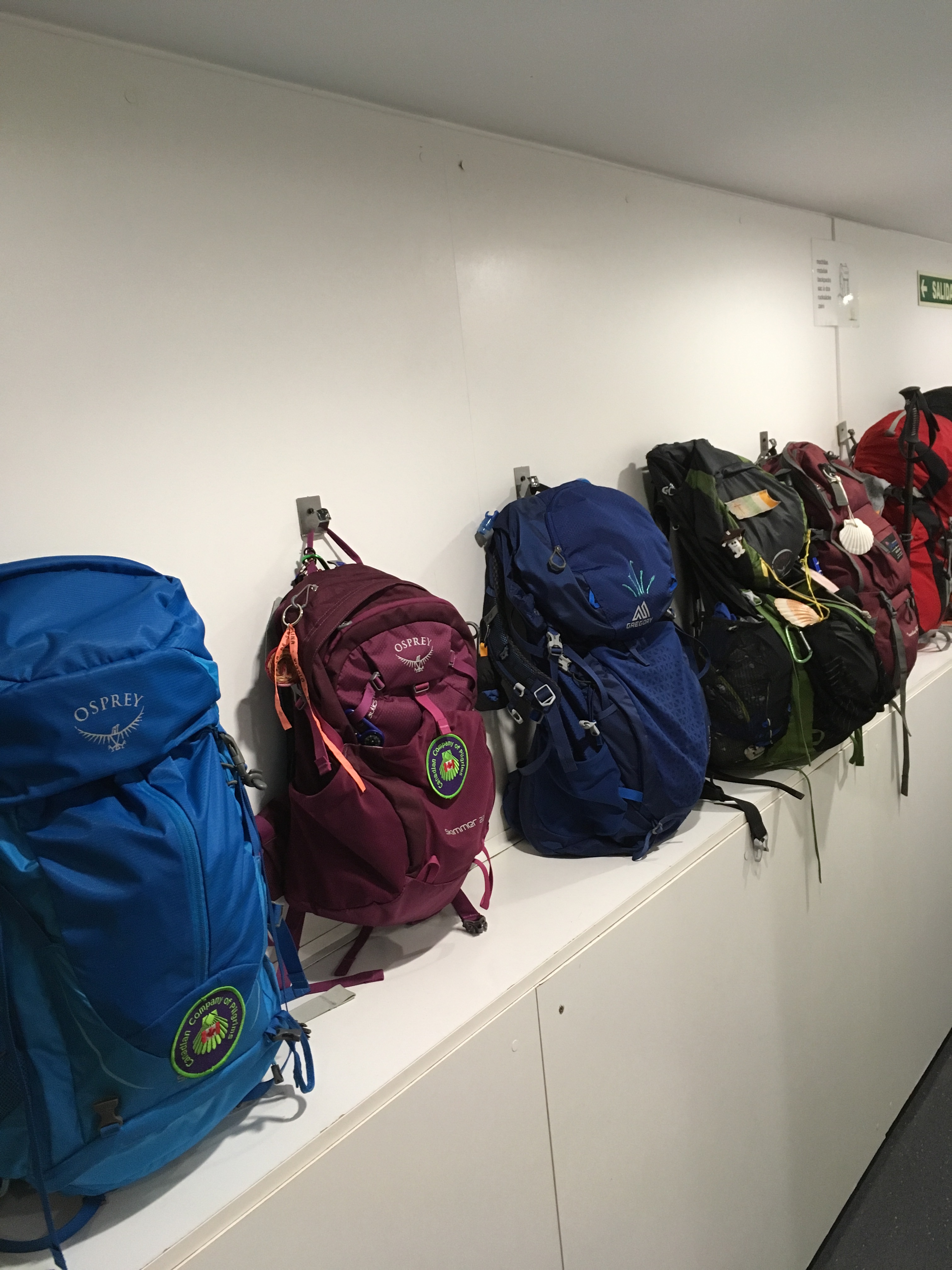
The backpack storage area, shown above, keeps them off the floor and easy to access, but away from the bunks. Unlike your boots, you can take your pack to your bed, but you’re asked not to leave it there long term, reducing potential floor clutter.

The albergue sleeps only 20 and has separate showers and bathrooms for men and women. All fixtures and hardware are very high quality.

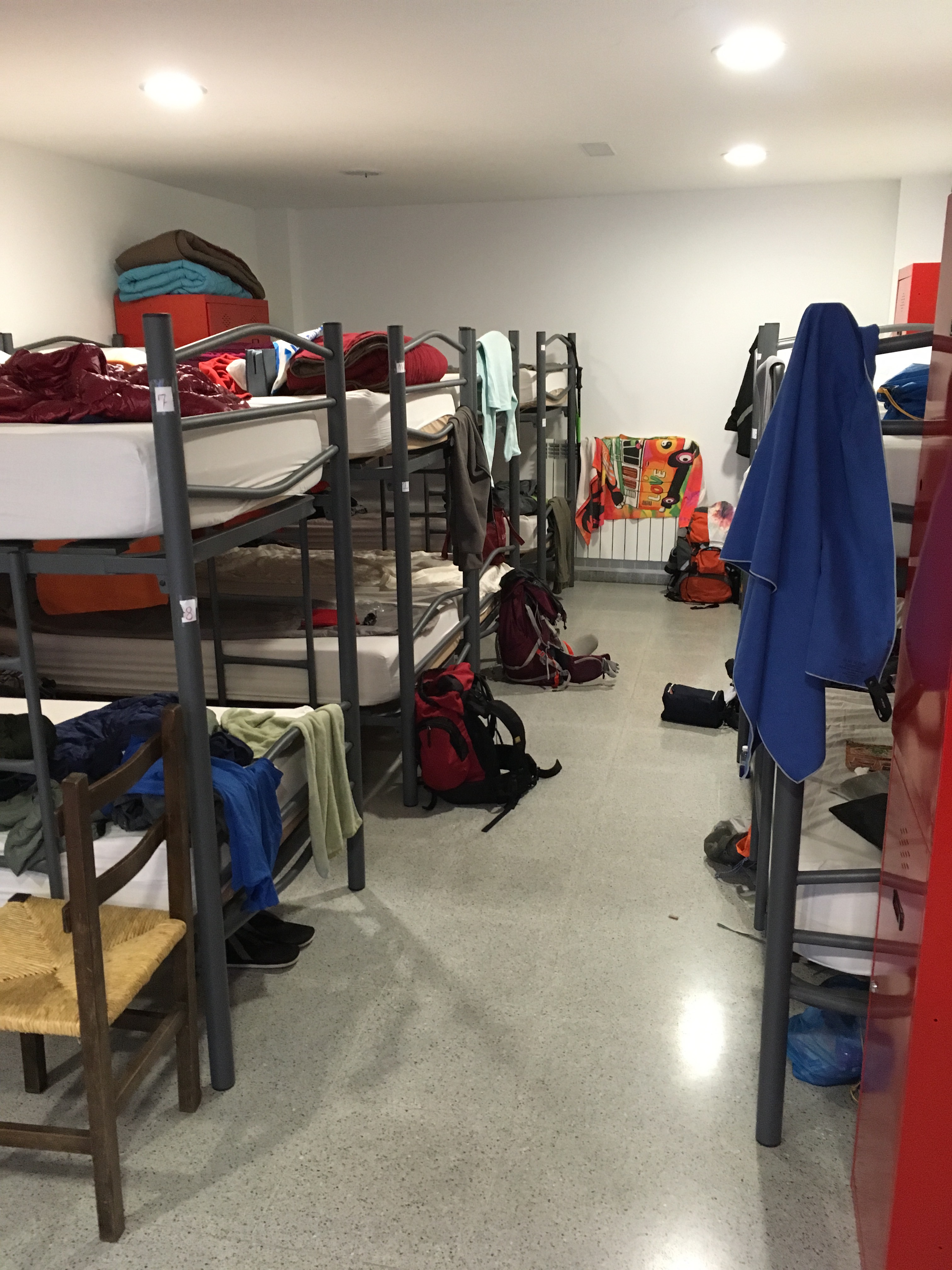
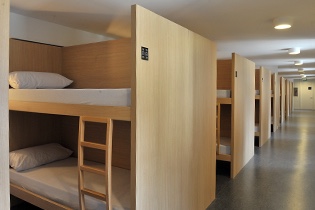
Perhaps the most interesting items are the modular bunks. Each bunk includes a lockable storage cabinet inside the sleeping area, a light, several power outlets, a shelf above the pillow, and a privacy shade. Really well done, unusual, and comfortable.

Hospitaleros Caesar and his brother have done a great job in creating the place and they could not be kinder or more helpful in dealing with every situation. I was delighted to have stayed there.


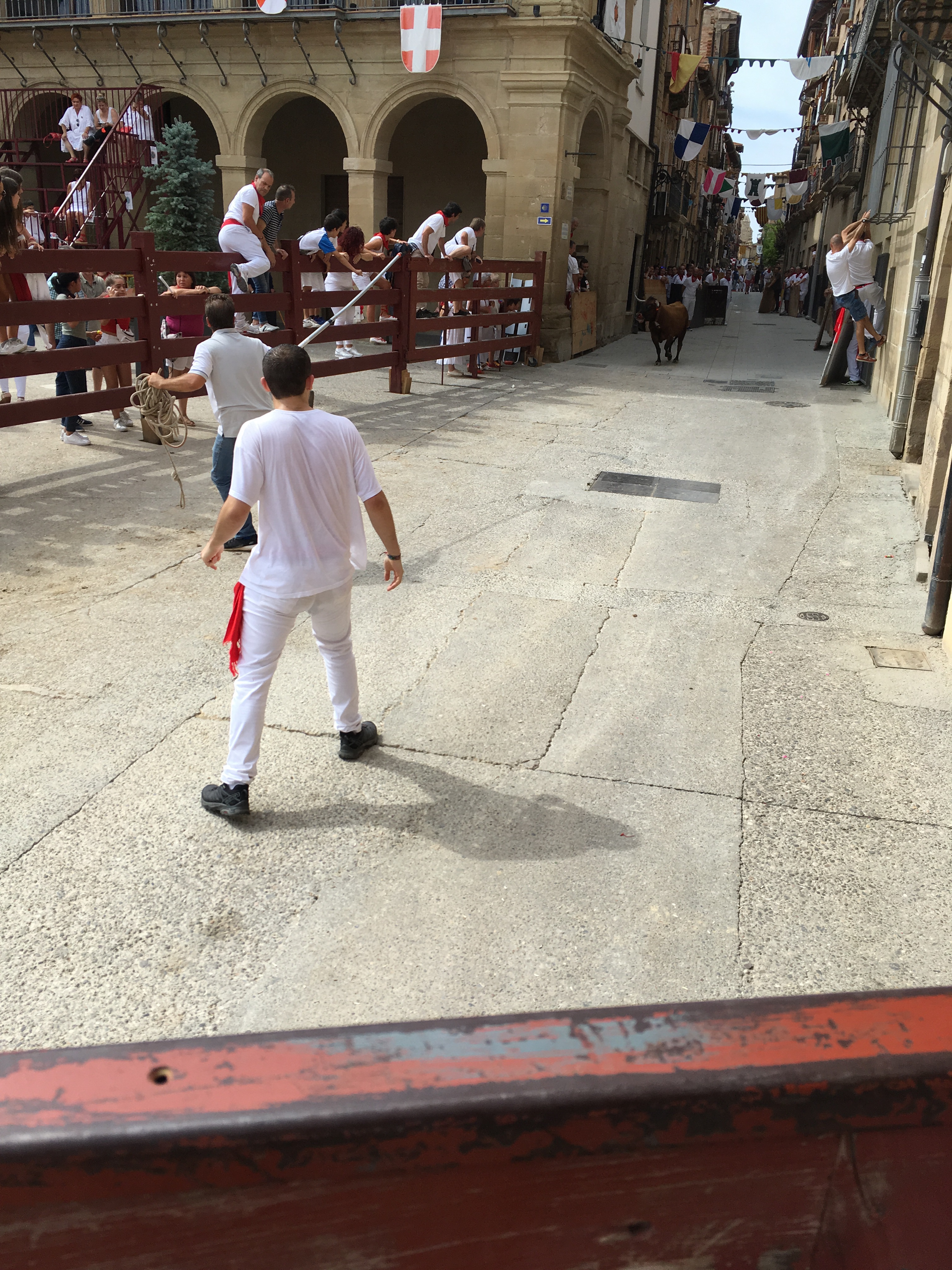
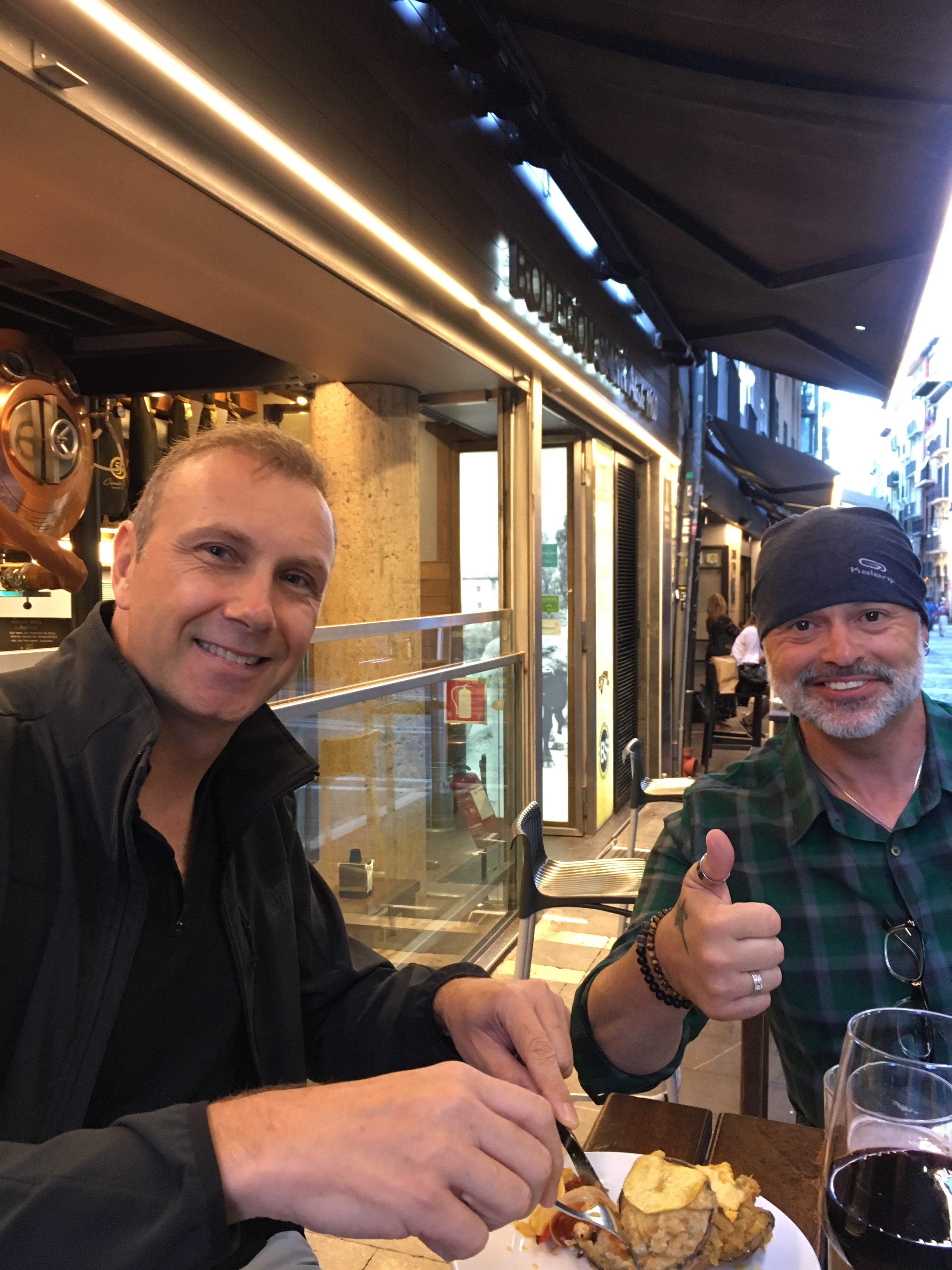
Pamplona itself is charming and is, of course, famous for its “running of the bulls” festival. I ran into two fellow pilgrims in Pamplona that I’d met in Orisson, Laurent and Claude:

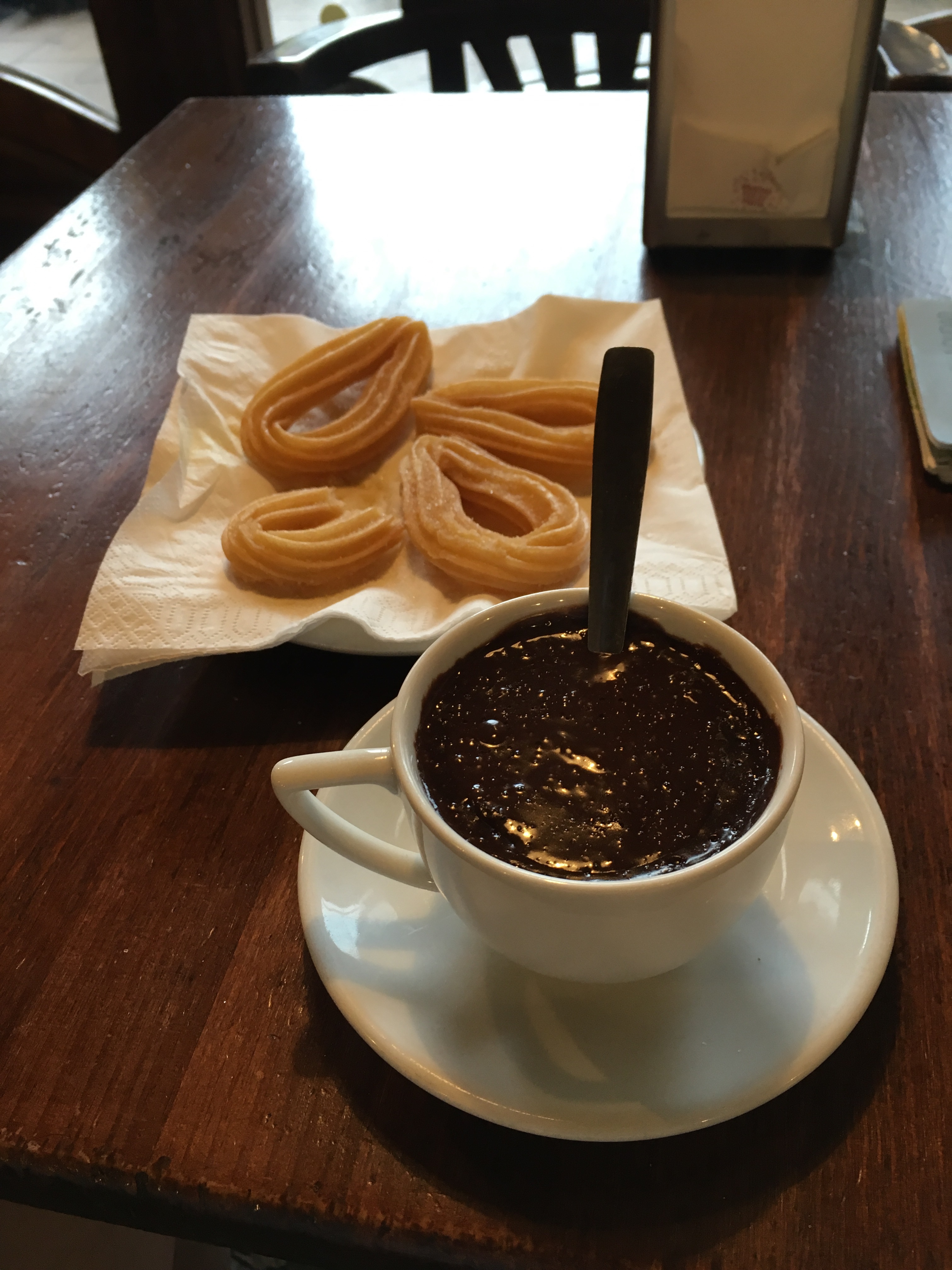
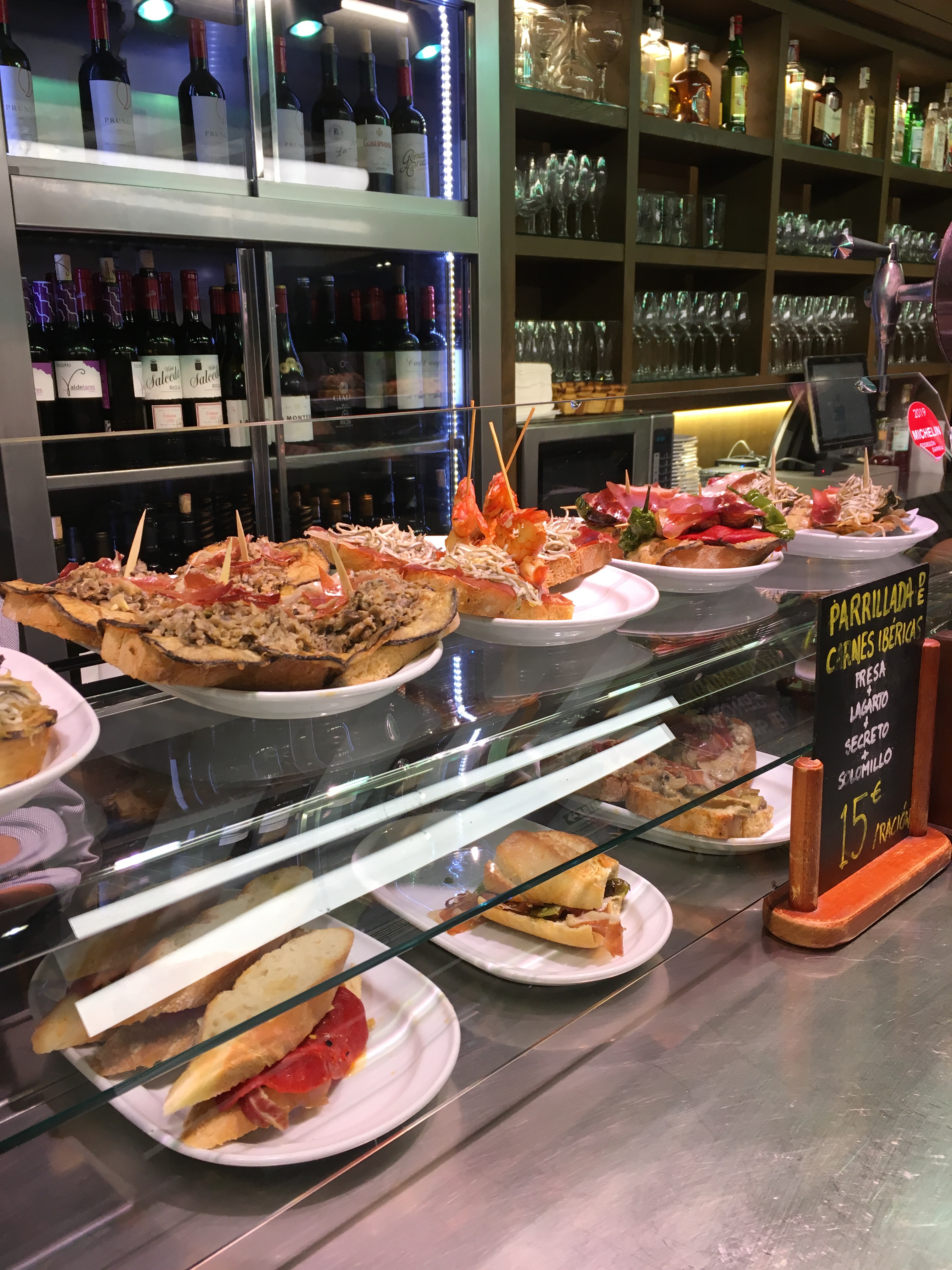
And we made a night of going to Estafeta Street, on the bull run route, and popular for its pinchos (tapas). The drill, supposedly, is to make your way down the street, having one pincho and small glass of wine, at several establishments. In my mind, this assumes that the pinchos are small hors d’oeuvres. They’re not:

In fact, they’re very large and some are works-of-art. In addition, the wine serving is not the thimblefull that would enable you to wander from bar to bar for hours.

Most pinchos are only 3-4eu (including the wine) so it’s hard to go broke. We had fun on a limited scale and everyone survived the night.

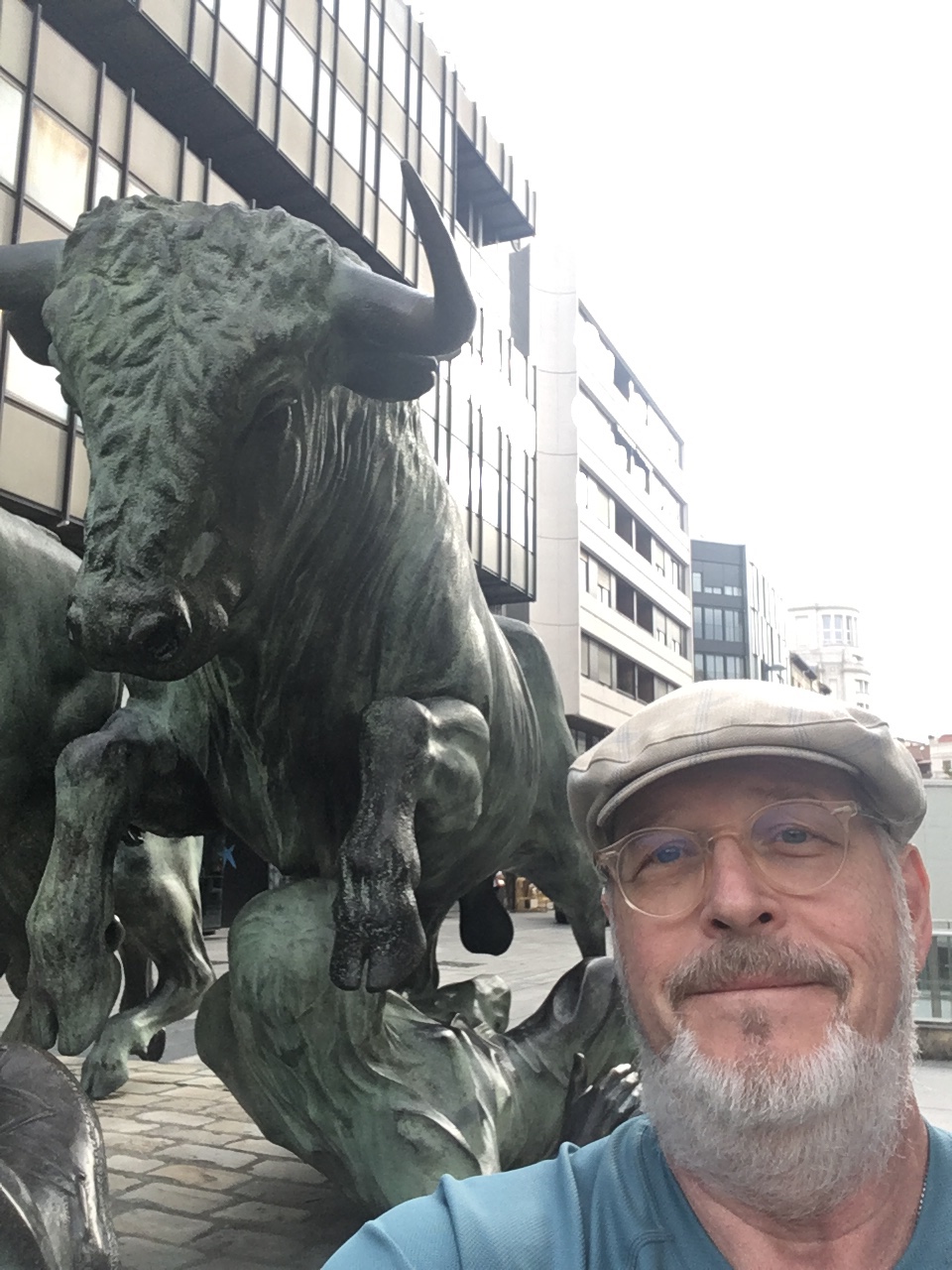
The next day, I did manage to locate, and get a selfie with, the famous running bulls statue:

Pamplona is a very pleasant city, with lots of parks and plazas, and was a nice, temporary break from the Camino.

Stage 4: Zubiri to Pamplona

12 Sep 2019 – 21 Km

The loudly snoring Spaniard across from me kept me awake most of the night, despite wearing ear plugs. The woman in the bunk above him gathered up her stuff in great disgust in the middle of the night and went out to sleep in the dining area. So it goes.

My legs and knees seem to be recovering nicely overnight, and I’m careful to stretch before going to bed and before setting out in the morning.

The general pattern of the albergue (hostel) routine is taking shape: arrive mid-afternoon and check-in, plead advanced age in order to get a bottom bunk, leave your boots and trekking poles in the Boot area, find your bunk, empty your pack and lay out your sleeping bag, get your shower kit and take a shower, get your laundry kit and do your laundry (usually by hand), have a snack and/or take a nap, have dinner and meet people, go to bed around 8:30pm. Get up at 6:00am, wash your face, pack your stuff, have breakfast if available, put on your boots and get out by the required 8:00am. Rinse, wash, repeat.

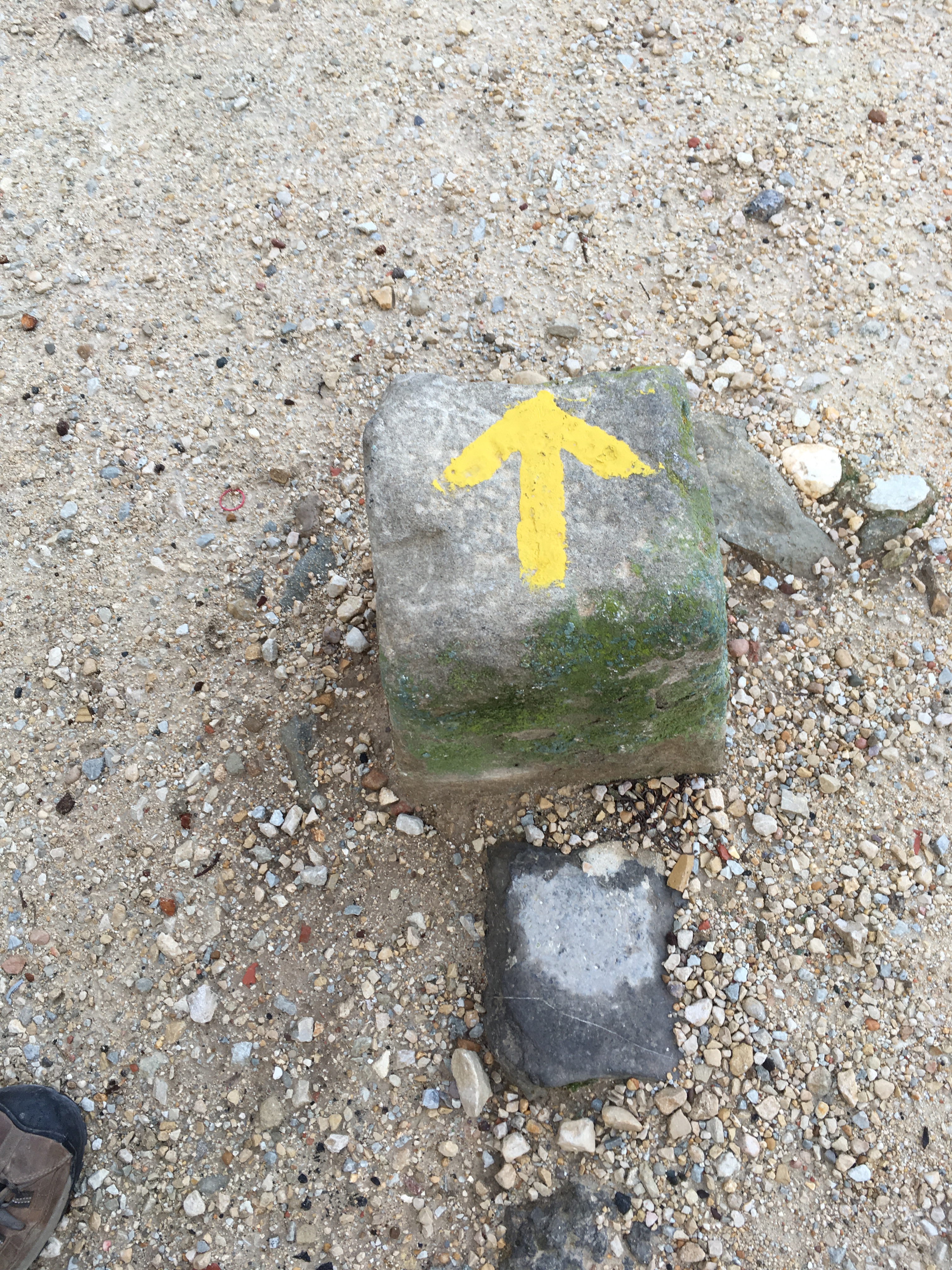
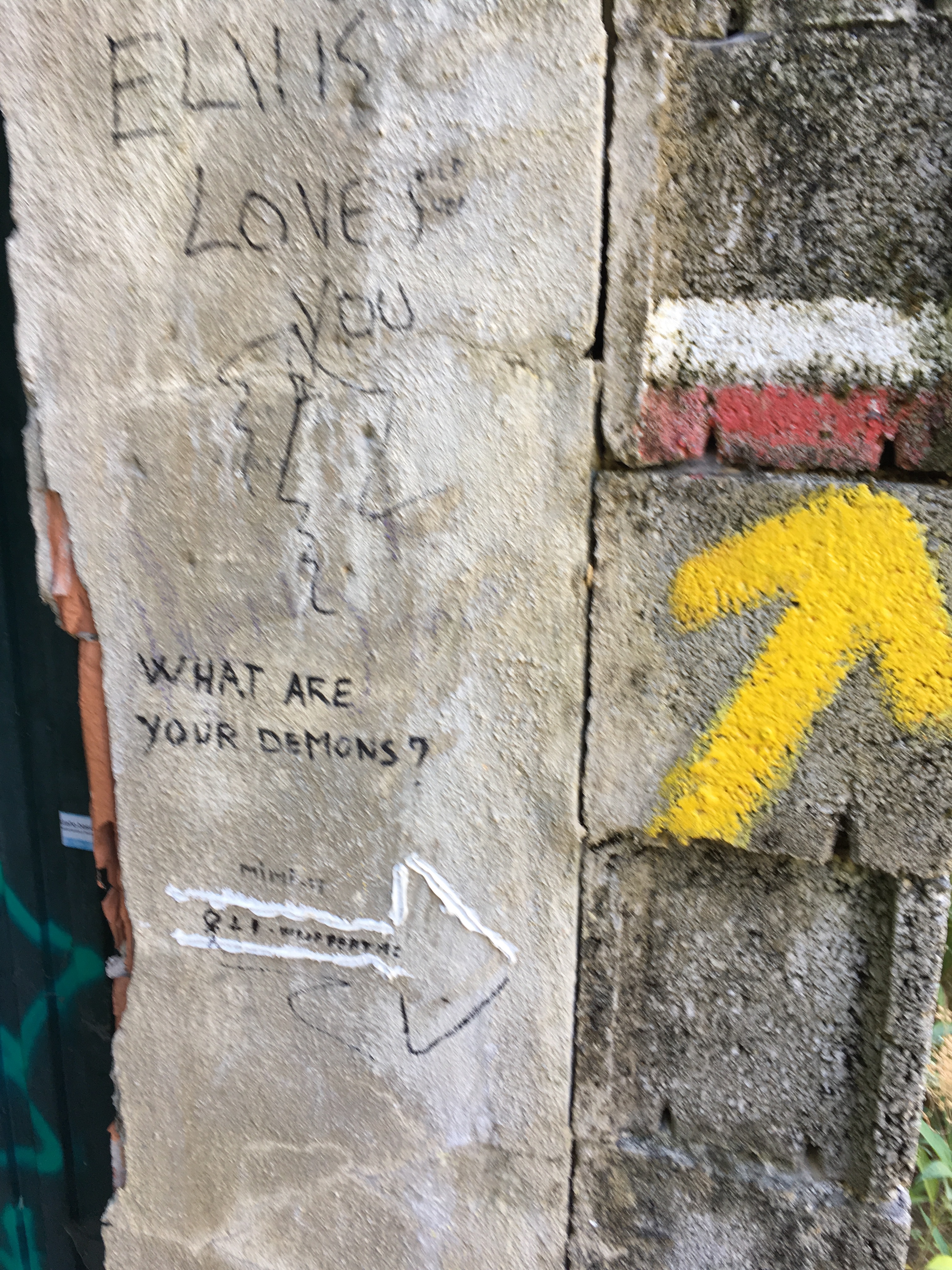
Secondary system of yellow arrow markers often includes interesting remarks

The security of your valuables (cash, credit cards, passport, and mobile phone) is paramount and you never go anywhere without them. Even into the shower. I have a waterproof tote bag that I load with clean clothes, shower stuff, my camp towel, and my valuables, and it goes right into the shower stall with me every time.

Albergues do not usually provide: sheets, towels, shampoo, hand soap, hand towels, or laundry soap. Lucky for us, toilet paper is provided. All that other stuff, you must bring with you.

Unusual hiking gear spotted on the Camino

Zubiri to Pamplona was a nice, dry, sunny walk, not too hot, and with plenty of shady intervals. Also plenty of rock-strewn path sections going sharply up and down. It’s amazing how quickly you learn to spot the flatest, least-rocky part of any path and get your feet onto it. After the horrible descent into Zubiri, these 21 Kms seem somewhat easier.

Zoom in to appreciate the rocky surface

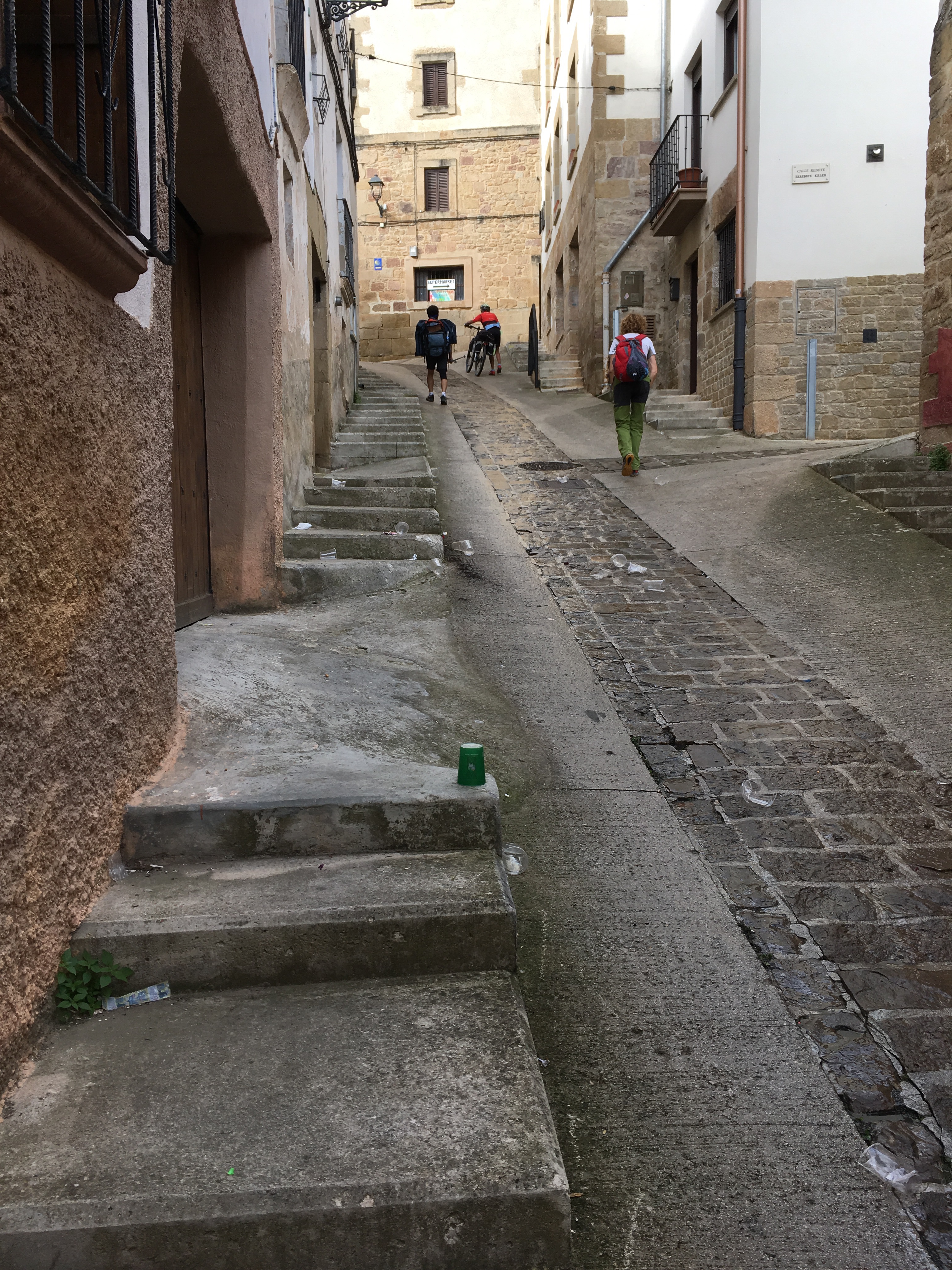
Nonetheless, I was really exhausted when I reached Pamplona and, of course, after winding through a few kilometers of city streets there was a very steep, cobblestone lane up into the old town at the end. I was really excited to find my albergue waiting for me at the top and, bonus, the bunk room was air-conditioned. More about this unique and well-run albergue, Casa Ibarrola, in a future post.

Today’s expenses:
– Breakfast: 4eu, Snack 3eu
– Casa Ibarrola: 32eu (for 2 nights)
– Round of pinchos (tapas) for me and friends: 24eu

Stage 3: Roncesvalles to Zubiri

11 Sep 2019 – 22.3 Km

I slept in a bunk cube at Roncesvalles with two Italians and a young French woman. While the lavatories and showers were segrated by gender, the randomly-assigned bunks were not.

There’s quite a lot to be said about the vagaries of albergue life. Roncesvalles, for example, had a full “laundry service” in the basement, where staff would wash, dry, and fold your laundry for 3.5eu. They also had a nicely-equipped kitchen where you could cook your own meal (assuming you hauled the ingredients in with you), a large room with tables and outlets (the digital device use room), and a lending library, all quite modern.

The two friends I made at Orisson the first night, Claude from Quebec and Laurent from Miami, met me for a beer last night and we compared sore leg muscles.

Lights out at 10pm was signaled first by the playing of recorded soft Gregorian chants (it’s a monastery, after all). In the morning, they were played again starting at 6am, in increasing volume. A nice touch, I thought. We all had to be out of the place by 8:30am.

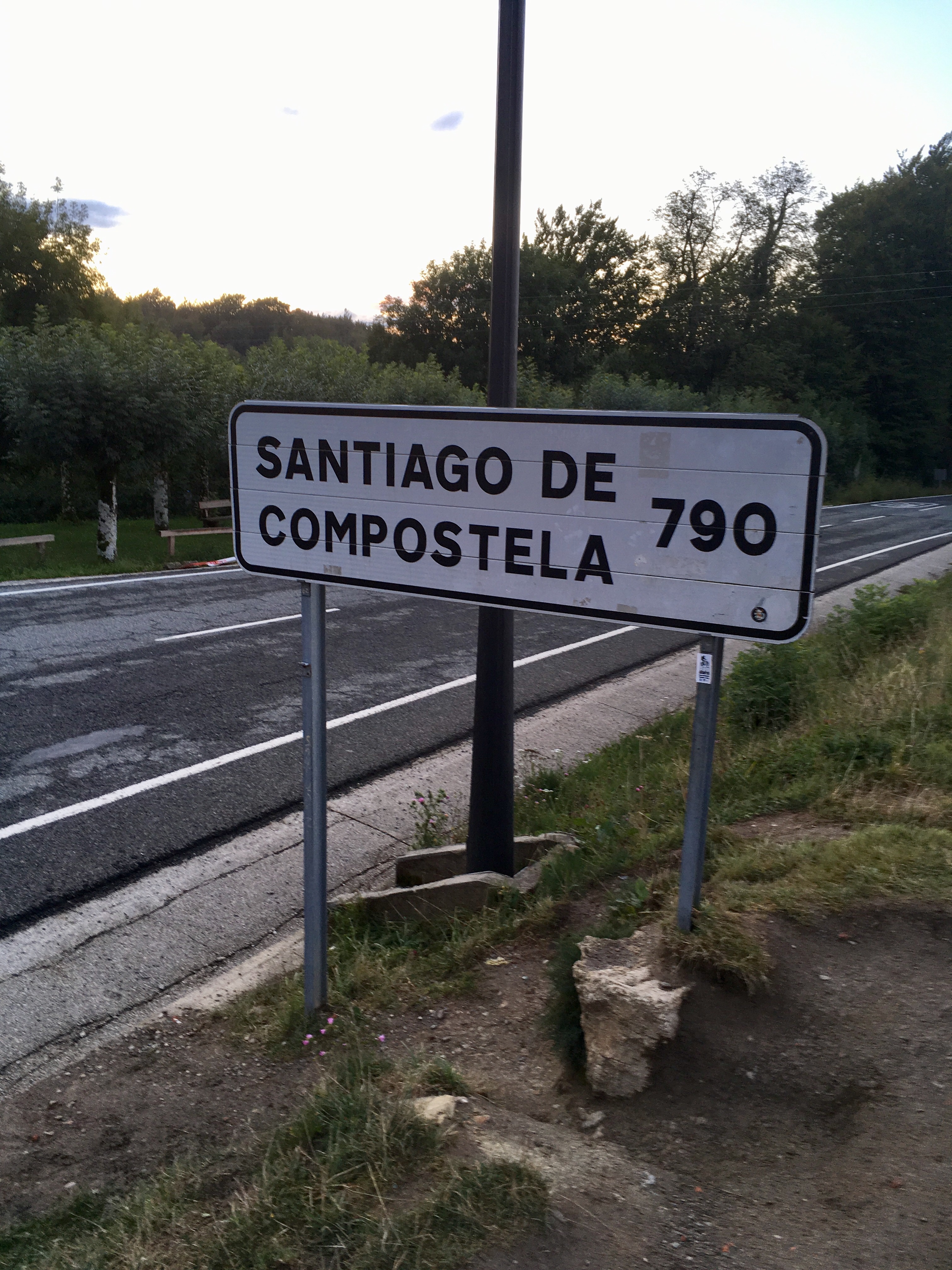
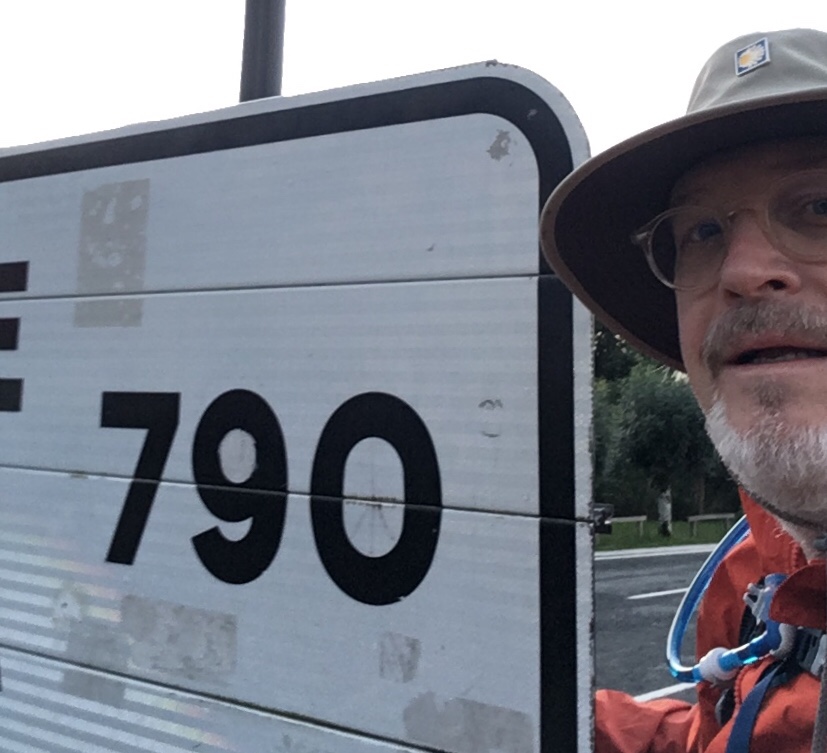
The Famous 790 kms sign..
…so having covered 24 Kms, I have only 790 more to go. Piece of cake!

The 22 Km walk to Zubiri is today, and it’s “relatively” flat. Meaning bottled oxygen will likely not be necessary, but there will be some heart-pounding inclines and some knee-killing descents. At least there was no rain and the temperature was comfortable.

Local art encourages pilgrims

There are a lot of interesting art installations, public and private, along the Camino and I’ll try to show you more of them.

This is one of the markers that guides us as we go along. There are also a series of painted yellow arrows. They give you confidence that you can always find the Camino route.

Municipalities also help mark the route…
… and so do local property owners.

The last part of the day features extreme descents down paths created from jutting rocks and flat rock formations. Really, really treacherous, even with trekking poles for extra support and balance. I was reduced to going down sideways, one leg at a time in places, for a hundred yards. This is where Camino-ending injuries like twisted or broken ankles happen. Talk about tired legs!

I finally reached Zubiri after nearly seven hours, dead beat. I was very happy to easily find my small albergue and get myself installed. As an official “Viejo” or Old Guy, I continue to get a coveted bottom bunk.

How I Feel: Everything hurts, legs and feet exhausted. I’m concerned about my legs and knee tendons, which are quite sore. Trapezius (shoulders) aching, clearly backpack is too heavy. All other systems seem good, although I again feel like I was too tired to sleep properly. Wondering if I can really do this, and when (if) I’ll get a good night’s sleep.

Expenses today:
– Coffee, mid-morning snack: 4eu
– Albergue Zaldiko: 10eu
– Dinner: 5eu

Stage 2: Orisson to Roncesvalles

10 Sep 2019 – 16 Km

I awoke the next morning, stiff and tired, but in a self-congratulatory mood for having made it this far, to a light drizzle and 46-degree conditions.

There would be no sunny walk over the mountain for us today.

Off we went at 7:30am, a wet, brightly-colored stream of rainsuits and ponchos, gamely going ahead despite lousy conditions and more inclines.

For the next seven hours, it rained (quite hard at times), shrouded us with fog, drove the temperature down into the 40s with winds, and flooded the trail.

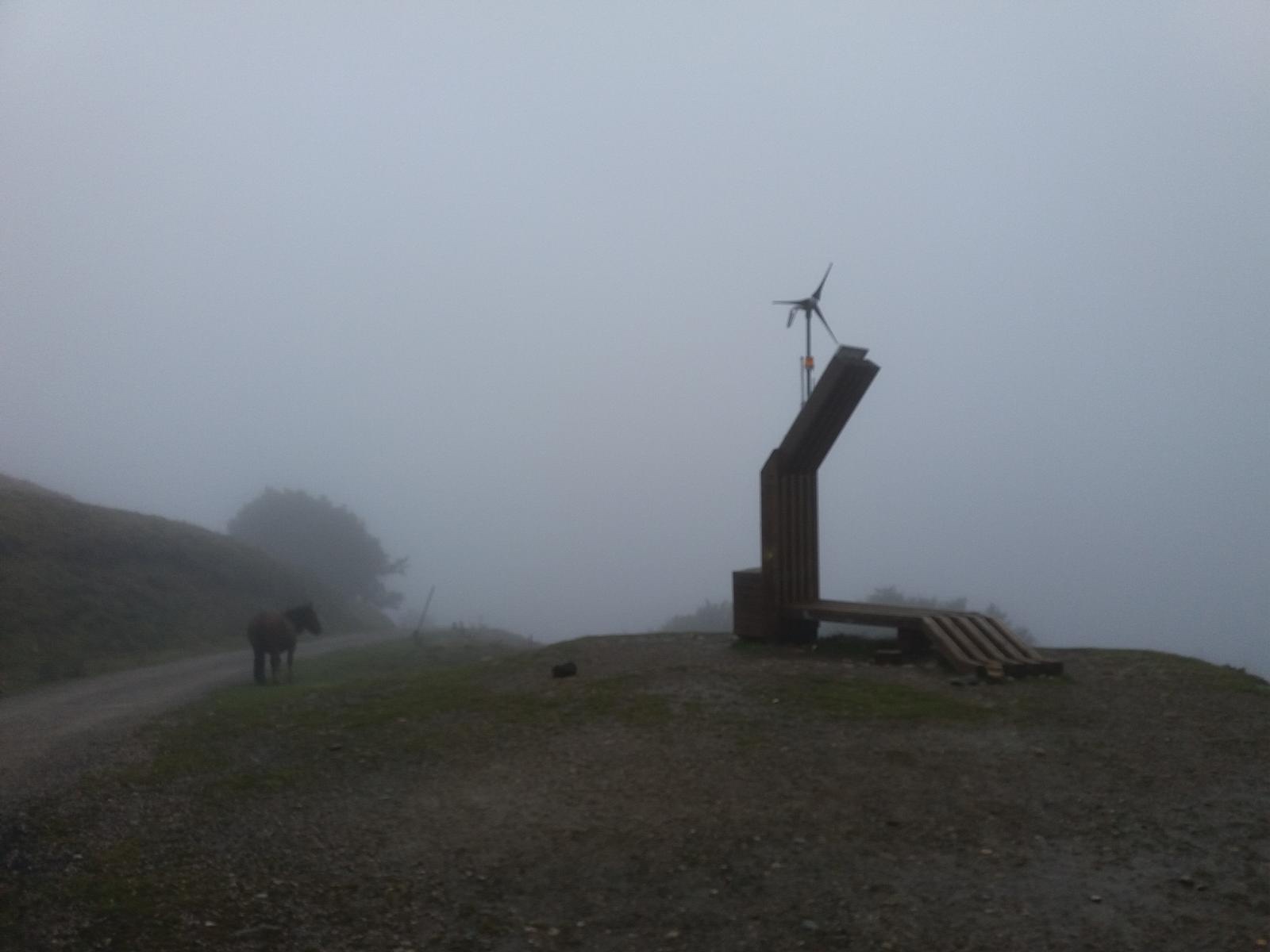
Unbelievably, there were folks up there in shorts, tennis shoes, poncho, and no headcovering (mostly stout, resilient youngsters). I was in a hooded rain jacket, rain pants, and waterproof gloves, with layers underneath, and I was still cold at times. It was often hard to see ahead and I rounded one curve to find four huge horses nibbling brush along the path, looming out of the fog before me.

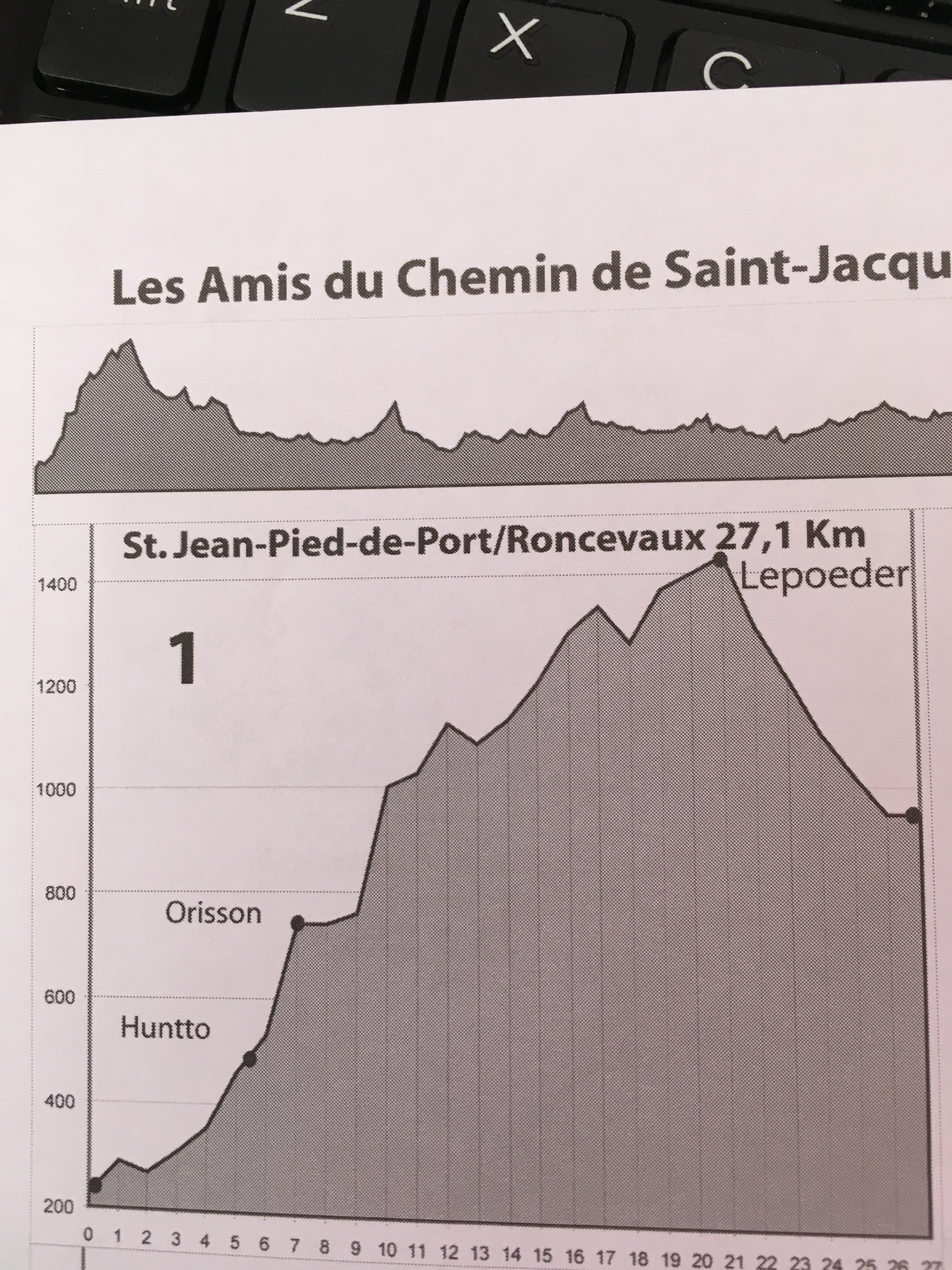
The elevation change, from Orisson to Roncesvalles, for reference

Our highest elevation was 1429 m/4689 ft and it had an affect on stamina. Once over the peak, descending was slippery at times and also hard on the legs and especially the knees. Young folks streamed by me on occasion like they were heading for homeroom.

At the top, with strong winds

I soon established that I’m a slow hiker and nearly everyone will pass me. That’s OK but it’s occasionally discouraging.

And I established that putting important route instructions inside a pants pocket inaccessible while wearing rain pants is not a bright idea, as I almost missed the important turn off at the weather station above.

We also established a Camino fact: just as you think you’re about to reach your destination and your weary legs begin to rejoice, another kilometer of hard ascent or descent will appear, giving you a final kick in the teeth.

Taking those final exhausted steps to the Albergue, on some sunny day

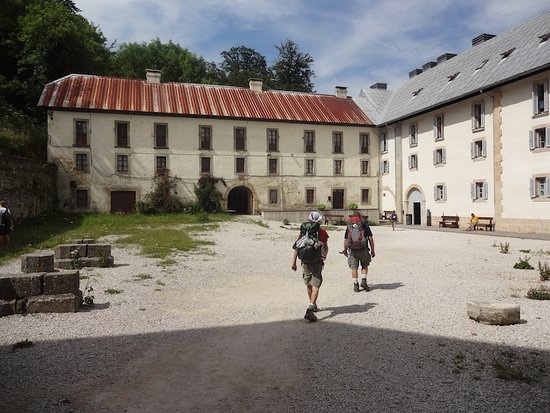
Arriving at Roncesvalles was like reaching the Promised Land and I imagine pilgrims hundreds of years ago rejoiced at seeing it almost as much as I did.

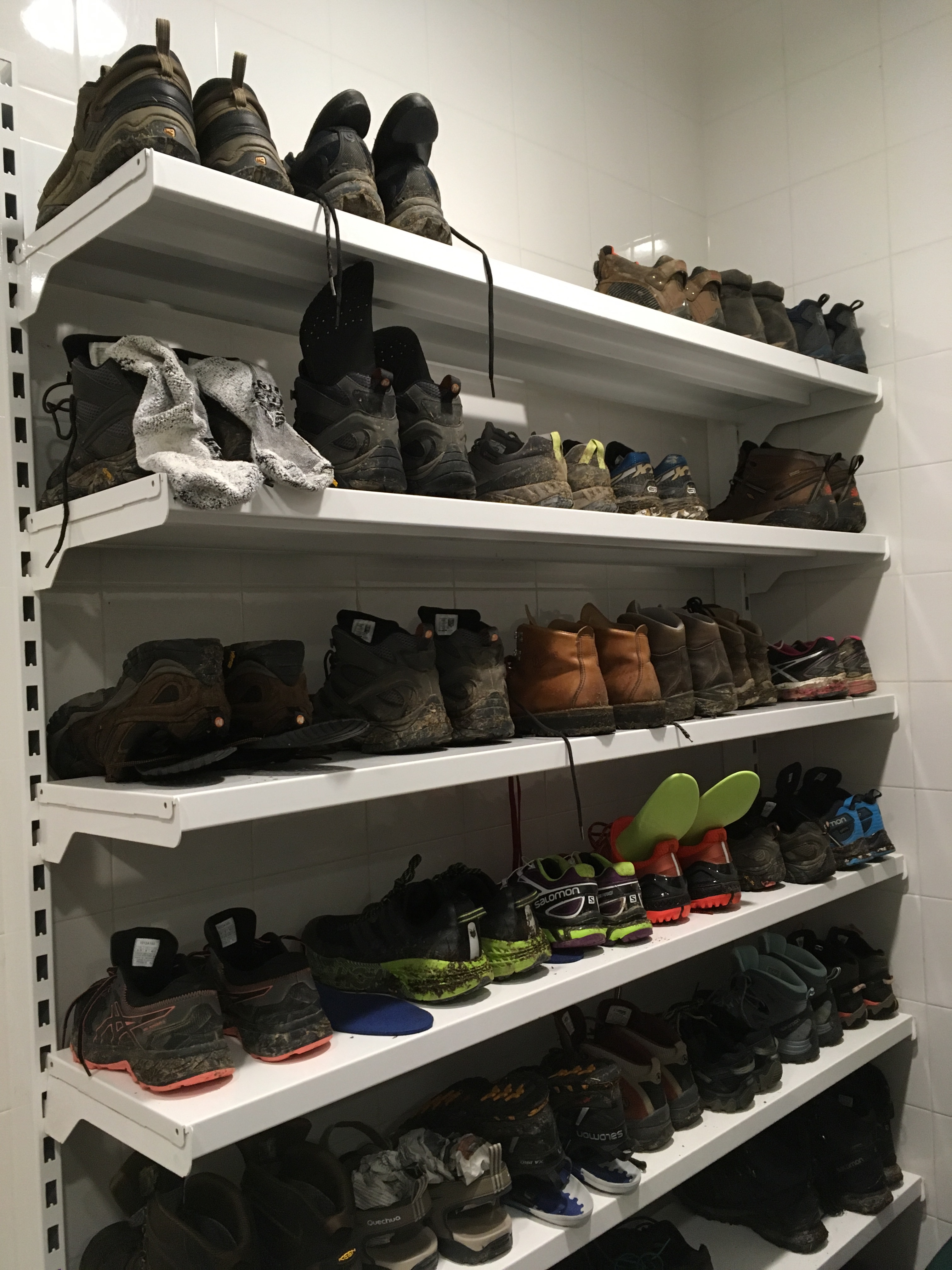
First Stop: The Boot Room

Boots and trekking poles are deposited in a special room, to keep the stink and dirt away from living spaces.

Ultra-modern bunk modules

Though the monastery and albergue are ancient, they have updated the interior nicely and can sleep 180. The bunks are separated into modules of four beds and each bed has a lockable, backpack-sized locker. Nice showers, too.

Dinner was offered at a nearby bar and hotel. More later about the “Pilgrim Menu”, an exhausted sleep-of-the dead is calling my name.

Expenses today:
– Snack: 1eu
– Beer: 4eu
– Alberue Roncesvalles (incl dinner/breakfast): 28eu

Stage 1: Saint Jean Pied-de-Port to Orisson

9 Sep 2019, sunny and mild – 8 Km

Looking back on my expectations of this day, I had no idea how difficult it and the next few days would be.

I chose to break the traditional Stage 1 walk into two parts and spend my first night at Refuge Orisson, a small lodge perched on the side of a mountain. There are no other establishments nearby. I’m absolutely amazed that some people do the whole traditional Stage 1 walk (24km/16m) in one day.

I left St. Jean at 8:30 am, anticipating a 4-hour hike to cover 8km. As soon as I left the town, walking along a road, the incline began. Within 20 minutes, I was shedding clothing layers. Passing through rolling farm lands, but ever upward, it was interesting to see how sensitive my legs became to (and rejoiced at) even the slightest hint of a flat, or less-steep, road section.

Still smiling at this point

The Camino path headed up numerous steep roadway switchbacks, and occasionally there were very steep “short cuts” that cut across them, sometimes at an incline of maybe 60-degrees. As I climbed, the views became spectacular.

However, despite training a lot for five months for this, I was often aerobically exhausted and had to pause to get my breath and let my pulse come down.

By 2:00, I wasn’t sure how much further I could go; I was stopping every 25 yards to rest. Then I rounded a bend and voila! Orisson! Never was a sight so welcome.

Orisson has 38 beds in several different bunk rooms. I was in a room with five other fellows, including two Israelis, two Canadians, and a Belgian. That has been the beginning of a “Camino Buddies” friendship with several of them. Orisson’s staff was great to us and quite funny.

Across the road from the lodge there’s a patio stuck to the hillside, which offered cocktails along with a fabulous view.

We had a communal dinner that evening, and carried on the post-meal tradition of standing and introducing yourself. Very nice, with Americans in the minority.

Getting a sound, exhausted sleep that night was tempered by the knowledge the 16kms were ahead of me the next day and that the weather forecast was for Cold and Rainy.

Expenses today:

– Lunch: 9eu
– Beer: 4eu
– Refuge Orisson (plus dinner/breakfast and sandwich for lunch tomorrow): 39eu

A Quiet Day Before I Launch

Allow me to introduce Crystal Hartford, a ballerina profiled a few years ago by the Washington Post in a story about the difficulties artists face in getting work.

I find this picture amazing because she made this stunning leap not on stage, not with a running start, but in her apartment! And yet, her execution is perfect. My immediate thought was “Nothing is impossible!”

And so this photo has been one of my inspirations in walking the Camino. I’ve kept it over my desk for years and have it with me here now. I’ve never met her, but thanks, Crystal.

It’s been another beautiful day here, and I watched this morning’s pelegrinos set out, wishing them the traditional “Buen Camino” greeting.

My hotel is just down from the official Pilgrim Office, where volunteers from all over the world provide guidance, weather forecasts, and encouragement. I got some good advice from a Canadian volunteer.

It’s also where I got my first stamp, or sello, in my Pilgrim Passport, or credencial. We carry this booklet and get it stamped at various stops along the way as proof of our walk. The Cathedral office in Santiago requires it before they’ll issue a completion certificate and it’s our admission pass to many of the pilgrims-only hostels on the route.

As my time here comes to a close and I prepare to launch on my Camino, here are a few random observations:

  • I ordered a cappuccino and was presented with a cup of coffee with whipped cream in it. Very odd.
  • I see many women, of all ages, heading out on the Camino, alone and in pairs. Bravo!
  • I’ve seen backpacks worn in all sorts of odd ways: with the waist belt unbuckled, lift straps completely loose, etc. The staff at REI would be aghast.
  • In general, I’ve seen a lot of people smoking (yes, even pilgrims) but no e-cigarettes.
  • I’ve seen a lot of pilgrims on bicycles, including electric-assisted bikes.
  • The only motorcyclists I’ve seen have been on the regular streets and they have all worn the full kit: leathers or protective clothing and full-face helmets.

Tomorrow morning after breakfast I’ll top up my pack”s hydration reservoir, check out of the hotel, and start my personal pilgrimage. I hope you’ll come along by reading these posts and that we’ll have a “Buen Camino”.

At The Camino Gateway

SAINT JEAN PIED-DE-PORT, FRANCE – I arrived in this ancient town after a pleasurable high-speed train (250kph/155 mph) journey from Barcelona to Pamplona. You have to credit the Spaniards for operating a top-notch rail system – clean, comfortable, on time to the minute, and with a movie shown during the trip.

In Pamplona I met my pre-arranged taxi for a somewhat nerve-wracking, 1:45 ride over the Pyrenees to St. Jean. I literally lost count of the number of switchbacks we went through because the scenery was so spectacular, but they seemed never ending. My driver must have had an ealier career at Le Mans as we took those curves at quite a rate, and in fact I arrived with a touch of motion sickness.

It seems you can do all the research you want, look at plenty of maps (including Google), as I did, and still miss the essential facts. After exiting the cab a bit shakily, I put on my pack and discovered that my hotel was in the ancient, pedestrianized, cobble-stoned area, and several blocks away up a very steep street. Oh Joy, I thought halfway up, I’ll be the first dumb hiker in history to have a heart attack before he even reaches his hotel.

I survived, though, and was rewarded with this view from my window at Hotel Ramuntcho. That blue mountain range at the left of the picture is the ridgeline I’ll soon be crossing.

I decided the right thing after a near-death experience was a rejuvenating beverage, which luckily I was able to find quickly.

The town is a tourist mecca and the “base camp” for the Camino route known as “The French Way” or Camino Frances. There are six other major routes, from Lisbon, Madrid, along the north coast, etc. Ten percent of peregrinos opt to start here.

A note on language: I’m now in France and am now experiencing “language schizophrenia” due to having just dusted off my Spanish in Barcelona. In Spain, a pilgrim walking the camino is a peregrino, but here in France we’re called pelegrinos. Until I figured that out, I was wondering why so many shops seemed to be advertising mineral water.

Touristy or not, the town is really scenic and is a photographer’s delight. Shown above is the river that runs just outside the town’s walls.

This is the gate in the old town walls through which all pere/pelegrinos pass to officially begin their hike (coming toward us), passing over a bridge and then up the cobbled road out of town. That will be me on Monday morning.

France and Spain recognize the historic importance of, and significant tourist dollars brought in by, the Camino. The authorities that maintain the Camino routes work hard to ensure that the way is well-marked, in towns, cities, and the countryside, as you will see in the next six weeks.

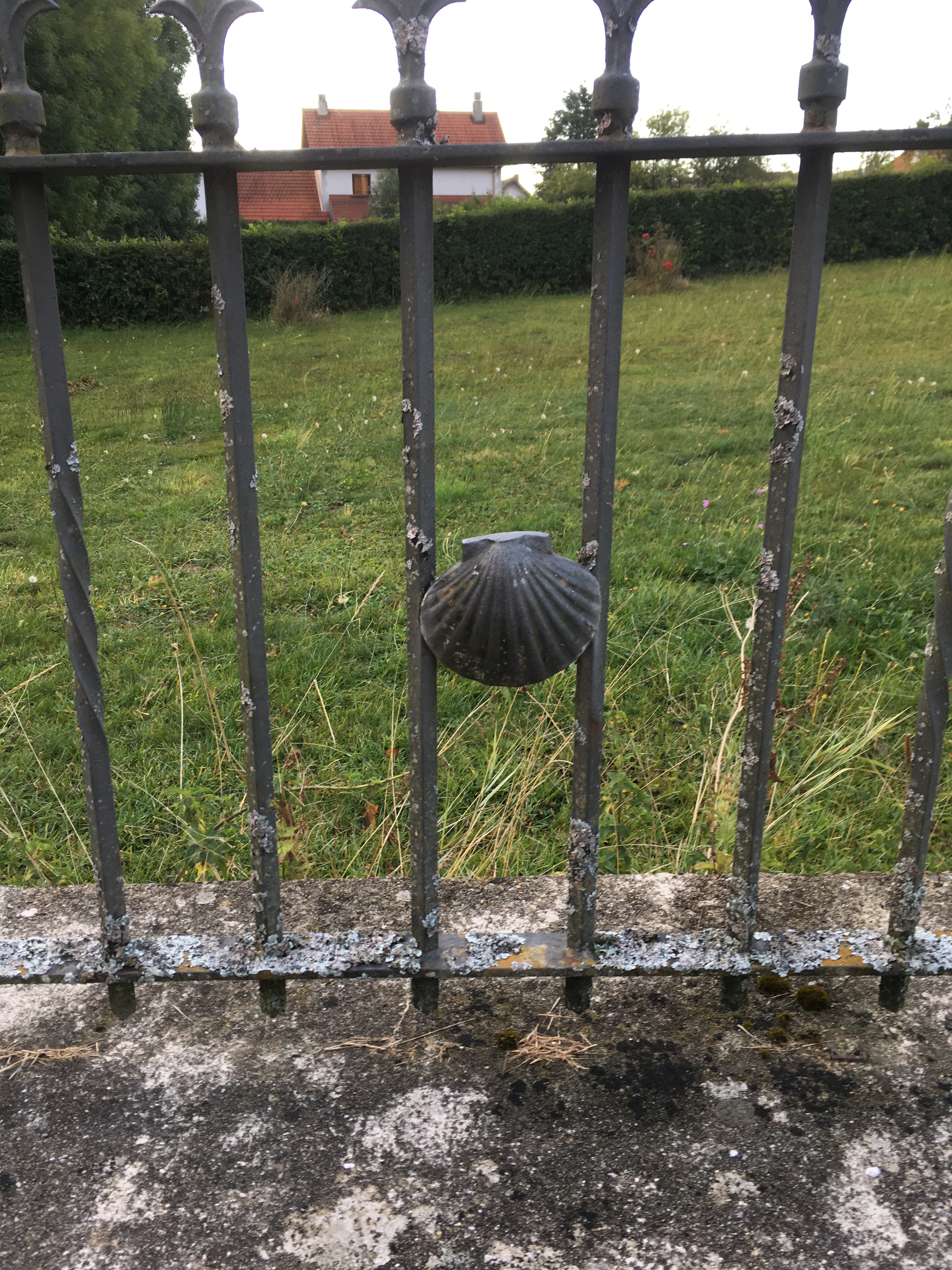
The photo above shows a marker set in the pavement here. The scallop shell is the most iconic symbol associated with the Camino. It’s seen everywhere, from churches and distance markers to pavements and backpacks. How exactly did this meager mollusk become associated with the Camino?

Like many Christian symbols and practices, the association of the scallop shell with the Camino predates the arrival of St. James and Christianity in modern-day Galicia. In Roman Hispania, there was a route known as the Janus Path used by pagans as a born-again ritual and ending just beyond Santiago de Compostela, in Finisterre. Its starting point? The Temple of Venus, Roman goddess of love. Venus is said to have risen from the sea on a scallop shell, as depicted in Botticelli’s famous painting The Birth of Venus, and is associated with fertility rituals practiced along the route.

Say what!? Well, you may rely on me to promptly investigate and report any such rituals I encounter!

And on that happy note, we’ll see what Sunday in St. Jean brings tomorrow.

What To Pack?

BARCELONA – It’s no small task deciding what to take along in your backpack on the Camino. Great attention must be paid to everything, its utility, its necessity, and especially its weight.

The most popular guidebook even recommends that you cut out its own introductory pages to lessen its weight.

The general guideline is that your pack should weigh no more than 10% of your body weight. So no U.S. Army-style 75-lb. packs here.

This is my Gregory Zulu 40-litre pack which, when loaded, weighed in at 23 lbs. – my perfect 10%. With two liters of water in its hydration bladder, I’ll be over weight by two pounds. Que sera, sera. Those who walk the Camino are “pilgrims’, or peregrinos in Spanish, and apparently a favorite peregrino pastime is jettisoning stuff they packed, don’t need, and don’t want to carry any further. We’ll see if I leave a trail of castoffs as I go along.

Here’s what’s in my pack:

  • Hat, Keen H2 sandals, selfie stick/tripod
  • Fleece shirt, down jacket, rain jacket, hardware bag (iPhone charger, Anker battery, carabiners, etc.)
  • Clothes bag #1: convertible hiking pants, SPF50 quick-dry shirt
  • Clothes bag #2: underwear, SPF 50 tee shirt, hiking sox
  • Water bag: contains filter and accessories for the hydration bladder
  • Toiletry bag: Lush shampoo bar, razor, other usual stuff
  • Laundry bag: detergent, clothesline, clothes pins
  • Travel tote bag, for clothes while showering, shopping, etc.
  • Microfibre camp towel
  • (Not shown): Ultralight sleeping bag in compressor sack, rain pants in stuff bag, pack rain cover

It’s really not much stuff. I’ll be wearing a shirt, hiking pants, u-trou, socks, and Keen hiking boots. Laundry needs to be done every day.

Keep in mind that I’m 6′ 2″ x 230 lbs, wearing a size 14 shoe. I read a lot of travel packing guides that were obviously written by/for smaller people. I can assure you that XXL clothing and size 14 shoes take up a lot of space when packing.

In addition, I have my iPhone, sun glasses, a buff, croakie, paddling gloves (for use with trekking poles), Maglite mini, and stuff like chapstick, suntan lotion, etc. I decided against bringing my iPad (too heavy and something else valuable to worry about losing/being stolen).

I also have two trekking poles, which are terrifically helpful when the trail goes up and down.

I have to send out a big Thanks to the staff at REI in Tysons Corners, Virginia, whose experience and wonderful advice were instrumental in getting all this gear sorted and understood. Thanks Tanner, Karen, and everyone else.

Camino History and Fun Facts

The Camino de Santiago is a set of 13th Century religious pilgrimage trails, all leading to Santiago de Compostela, a city of 100,000 in northwest Spain. The destination of the “Way of St. James” is the town’s Catholic cathedral, a UNESCO World Heritage Site.

On the Camino

The route I’m taking is the Camino Frances, a 500-mile, six-week walk that starts in southern France, crosses the Pyrenees mountains into Spain, and then goes west across northern Spain almost to the Atlantic.

The Camino Frances Route

Towns along the route have had in place for hundreds of years a system of hostels, so that the peregrinos (pilgrims) can readily find shelter and food. In 2018, over 300,000 pilgrims made the walk, including 60,000+ over the age of 60, and 18,000+ from the U.S.

The Destination

Notice how sunny and nice these photos are? Well, the reality is that the walk goes over mountains, through farmers’ fields, over rivers, and through towns large (like Pamplona) and small. It can be hot, it can rain, and then there are the cattle and sheep and territorial dogs on the trail. As romantic as I’d like to be, I know this walk will be a challenge and a wonder.

Why am I going? I’m not terribly spiritual generally but this is my way of making a sharp break from too many years working with computers and software, of disconnecting from our increasingly hectic and shallow society (U.S.) and launching into what, at 68, will probably be the last chapter of a varied and interesting life.

I intend to provide posts along the way and I invite you to come along with me on the Camino, and perhaps be inspired or moved. My pilgrimage starts September 9th.

Vamos!

2018 Trip Wrap Up

Falls Church, Virginia – My flight back to the U.S. on Virgin Atlantic went smoothly and I emerged from Dulles Airport into even hotter weather. A third day of temps in the high 90s with humidity making it fell like 103-105. Welcome to Virginia in the summer. I was very happy to discover when I opened my front door that my AC was working well.

As usual after my trips, there are a few days of unpacking, sorting through, laundry, and the other things required to get back to home life. And there’s the writing of this post, which is drawn from a collection of random notes I make during a trip.

– Sign seen in the Deacon’s Cafe in Edinburgh: “We Have No Wi-Fi, We Talk to Each Other”  Bravo!

– The Hilton Paddington was closed, refurbished, and re-opened more than a decade ago and the rooms are showing their age a bit. But it’s still a great hotel; it still has a retractable clothesline over the bathtub and an extension phone next to the toilet. Does anyone really use the room phone anymore?

– From a Smile to Stone: What happened to the cheerful and friendly barmaid’s face at The Maltings in York when I asked if they offered a discount to CAMRA members. It was almost comical.

– I like the system in pubs generally where you pay at the bar when you order drinks and/or food. You take the drinks with you and they deliver the food to your table. When you’re done, you get up and go – no waiting around for the check and perhaps waiting again for your change.

The 2018 Beer List

My promise to you: at least one pint, and sometimes several, of these were consumed:

– Boltmaker (Timothy Taylor – 4%)
– Yorkshire Terrier (York Brewery – 4.2%)

img_1851


– Cream Ale (Roosters – 4.7%)
– Minster Ale (York Brewery – 4.2%, made with three American hops)
– Birdman (Roosters – 4.3%)
– Black Sheep Bitter (Masham – 3.9%)
– Yorkshire Sparkle Pale Ale (Treeboom – 4%)
– Boss Hog (Gibsons – 4.1%)
– Cragg Vale Bitter (Little Valley – 4.2%)
– Edinburgh Gold (Stewart – 4.8%)
– Pale Ale (Nicholsons – 4%)
– TBA Best Bitter (Sherfield Village – 3.9%)
– 6X Best Bitter (Wadworth – 4.1%)
– Jet Black Heart (Brew Dog – 4.7%)

9DF59B0B-14A9-4E59-A126-EB028D059621
– Extra Special Bitter (ESB) (Fullers – 5.5%)
– Abbot Ale (Greene King – 5%)
– Tribute (St. Austell – 4.2%)
– Doom Bar (Sharp’s – 4.2%)


img_1899


As always, thanks for following along. Cheers!