
Since you asked, planning for my Camino started last year and is fairly complicated. Let’s look at what’s involved.
One begins by deciding which Camino you’re going to walk. I’ve always walked the Camino Frances, one of the longest and hardest routes, but there are over a dozen recognized routes to Santiago from all over Spain, France, and Portugal. Naturally, the time of year when you plan to walk and the amount of time you have to do so are also factors. Many routes include optional side trips to nearby historic or scenic sites (which can add multiple kilometers/days of walking). Luckily, as a retiree, I’ve always had as much time as I’ve needed and I prefer to walk in September and October.
Once I know where I’m going and when, I create a plan that breaks the walk into manageable segments or stages, based on my personal preferences and fitness level. As you can see below, Excel spreadsheets are very useful for this.
Like many pilgrims on the Camino Frances route, I work with the Brierley Pilgrim’s Guide, the classic guidebook now in its 23rd edition. Its maps and other pages provide a wealth of information. I ask myself how far will I walk on any given day? Can I mix up short and long days? Can I take a day off periodically? This year’s walk averages around 18 kms (12 miles) per day, with a max of 24 kms. Before you pooh-pooh that mileage, consider that three mountain ranges are involved and there are many ascents and descents. For example, one day in 2024 I walked almost 40,000 steps.
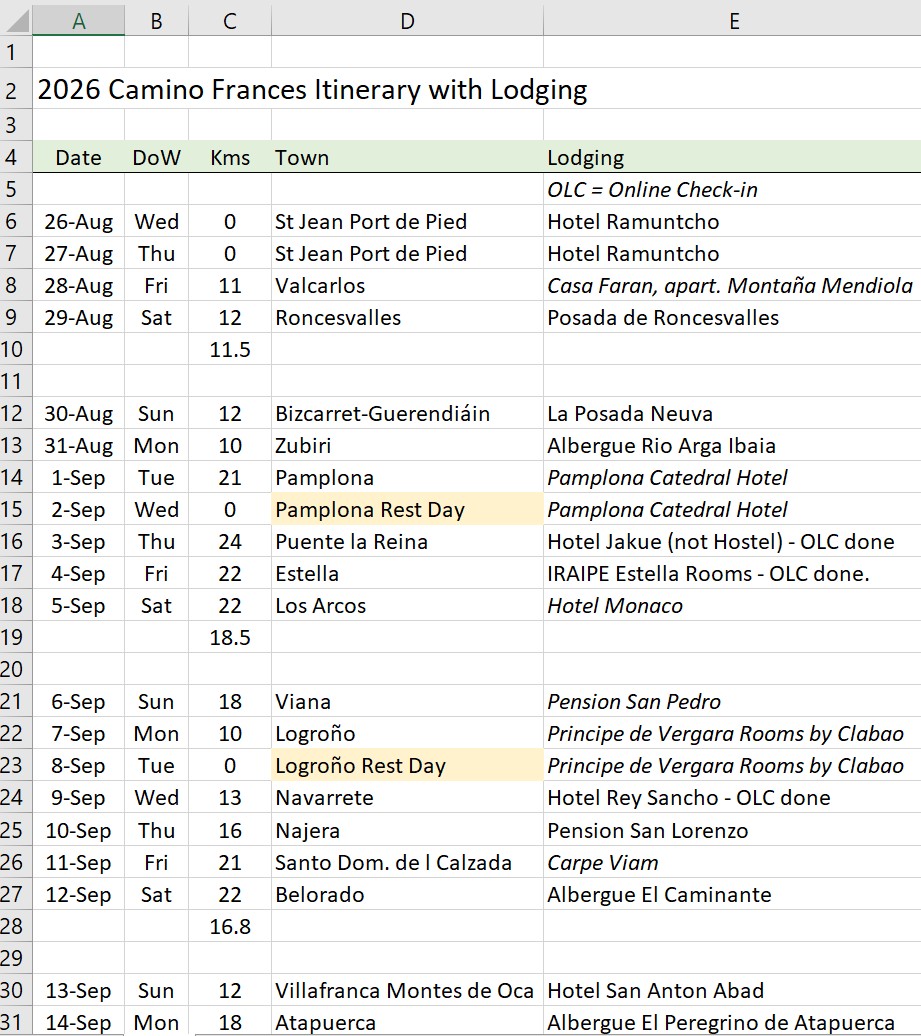


I prefer to be very organized about all this; but many pilgrims are not; they take a far less structured approach, walking as far as they want/can on a daily basis and getting lodging wherever they can when they arrive at a stopping point. This gives them a lot of flexibility but no security – they may arrive in a town to find all the beds/bunks are taken and they must continue on to the next town to (hopefully) find a bed. The weather can also be a factor when winging it. Still, the capriciousness and freedom of it all are part of the lure of the Camino for many (and was for me, the first time).
Camino lodging choices range from hostels (bunk rooms) to B&Bs and hotels (private rooms). Some folks mix it up, getting the occasional private room to take a break from the bunk rooms. I’ve tried them all over the years and now stay in private rooms. Reserving private rooms is an organizing extravaganza involving online bookings, and emails and phone calls in Spanish (which I speak, luckily).
Once all that is in hand, I turn to the Brierley Guide and markup its stages to show my route, as shown in the example from 2024 above.
I keep notes year-to-year, so I know where there are good cafes and food trucks, where the necessary pit stops are, and which are the tough sections. I also break each long day into 3-4 parts, so that I can take rest breaks and possibly change socks. Once again, all this planning assumes lovely weather but can be (and often is) disrupted by storms, heat, torrential rain, wildfires, etc. (just the usual Camino events). One downside of my strict planning means I have to get to my destination each day to use my reservation.
And so it goes, in just two weeks from tomorrow we’ll see how well my planning serves me. Thanks for coming along!
Cheers!


c’moooonnn