At The Camino Gateway

SAINT JEAN PIED-DE-PORT, FRANCE – I arrived in this ancient town after a pleasurable high-speed train (250kph/155 mph) journey from Barcelona to Pamplona. You have to credit the Spaniards for operating a top-notch rail system – clean, comfortable, on time to the minute, and with a movie shown during the trip.

In Pamplona I met my pre-arranged taxi for a somewhat nerve-wracking, 1:45 ride over the Pyrenees to St. Jean. I literally lost count of the number of switchbacks we went through because the scenery was so spectacular, but they seemed never ending. My driver must have had an ealier career at Le Mans as we took those curves at quite a rate, and in fact I arrived with a touch of motion sickness.

It seems you can do all the research you want, look at plenty of maps (including Google), as I did, and still miss the essential facts. After exiting the cab a bit shakily, I put on my pack and discovered that my hotel was in the ancient, pedestrianized, cobble-stoned area, and several blocks away up a very steep street. Oh Joy, I thought halfway up, I’ll be the first dumb hiker in history to have a heart attack before he even reaches his hotel.
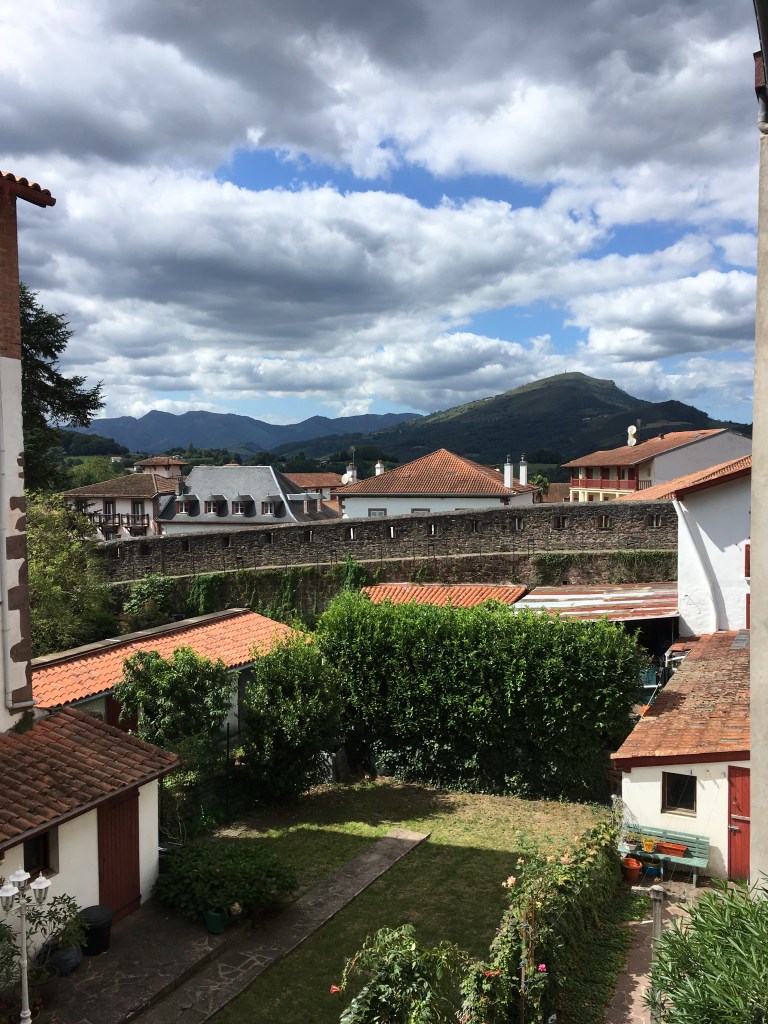
I survived, though, and was rewarded with this view from my window at Hotel Ramuntcho. That blue mountain range at the left of the picture is the ridgeline I’ll soon be crossing.

I decided the right thing after a near-death experience was a rejuvenating beverage, which luckily I was able to find quickly.
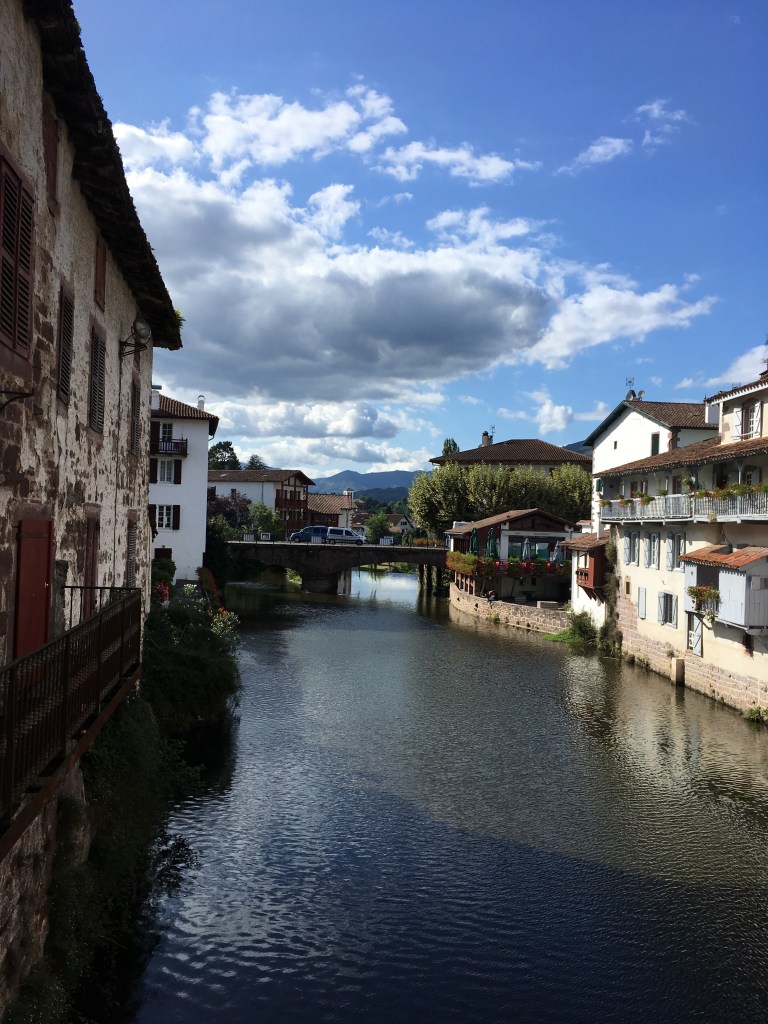
The town is a tourist mecca and the “base camp” for the Camino route known as “The French Way” or Camino Frances. There are six other major routes, from Lisbon, Madrid, along the north coast, etc. Ten percent of peregrinos opt to start here.

A note on language: I’m now in France and am now experiencing “language schizophrenia” due to having just dusted off my Spanish in Barcelona. In Spain, a pilgrim walking the camino is a peregrino, but here in France we’re called pelegrinos. Until I figured that out, I was wondering why so many shops seemed to be advertising mineral water.

Touristy or not, the town is really scenic and is a photographer’s delight. Shown above is the river that runs just outside the town’s walls.
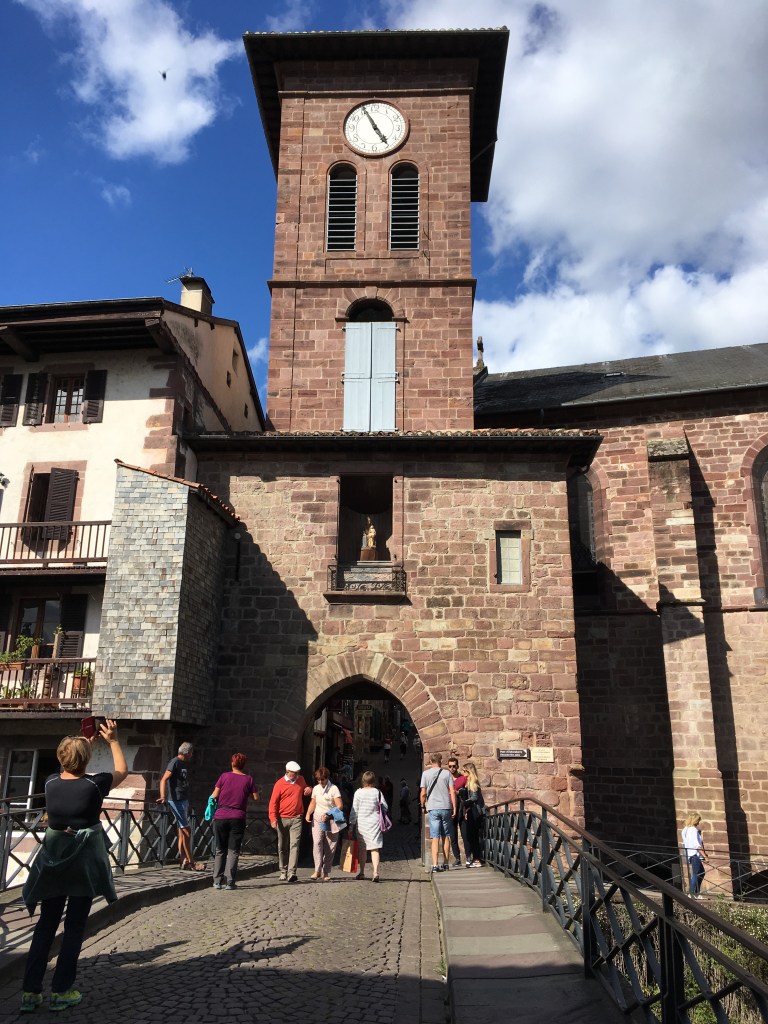
This is the gate in the old town walls through which all pere/pelegrinos pass to officially begin their hike (coming toward us), passing over a bridge and then up the cobbled road out of town. That will be me on Monday morning.

France and Spain recognize the historic importance of, and significant tourist dollars brought in by, the Camino. The authorities that maintain the Camino routes work hard to ensure that the way is well-marked, in towns, cities, and the countryside, as you will see in the next six weeks.

The photo above shows a marker set in the pavement here. The scallop shell is the most iconic symbol associated with the Camino. It’s seen everywhere, from churches and distance markers to pavements and backpacks. How exactly did this meager mollusk become associated with the Camino?

Like many Christian symbols and practices, the association of the scallop shell with the Camino predates the arrival of St. James and Christianity in modern-day Galicia. In Roman Hispania, there was a route known as the Janus Path used by pagans as a born-again ritual and ending just beyond Santiago de Compostela, in Finisterre. Its starting point? The Temple of Venus, Roman goddess of love. Venus is said to have risen from the sea on a scallop shell, as depicted in Botticelli’s famous painting The Birth of Venus, and is associated with fertility rituals practiced along the route.

Say what!? Well, you may rely on me to promptly investigate and report any such rituals I encounter!

And on that happy note, we’ll see what Sunday in St. Jean brings tomorrow.

What To Pack?

BARCELONA – It’s no small task deciding what to take along in your backpack on the Camino. Great attention must be paid to everything, its utility, its necessity, and especially its weight.

The most popular guidebook even recommends that you cut out its own introductory pages to lessen its weight.

The general guideline is that your pack should weigh no more than 10% of your body weight. So no U.S. Army-style 75-lb. packs here.

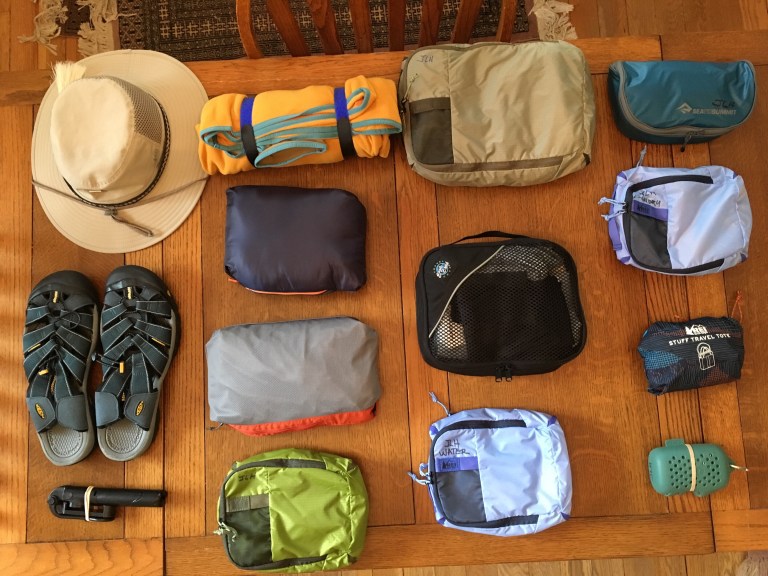
This is my Gregory Zulu 40-litre pack which, when loaded, weighed in at 23 lbs. – my perfect 10%. With two liters of water in its hydration bladder, I’ll be over weight by two pounds. Que sera, sera. Those who walk the Camino are “pilgrims’, or peregrinos in Spanish, and apparently a favorite peregrino pastime is jettisoning stuff they packed, don’t need, and don’t want to carry any further. We’ll see if I leave a trail of castoffs as I go along.

Here’s what’s in my pack:

  • Hat, Keen H2 sandals, selfie stick/tripod
  • Fleece shirt, down jacket, rain jacket, hardware bag (iPhone charger, Anker battery, carabiners, etc.)
  • Clothes bag #1: convertible hiking pants, SPF50 quick-dry shirt
  • Clothes bag #2: underwear, SPF 50 tee shirt, hiking sox
  • Water bag: contains filter and accessories for the hydration bladder
  • Toiletry bag: Lush shampoo bar, razor, other usual stuff
  • Laundry bag: detergent, clothesline, clothes pins
  • Travel tote bag, for clothes while showering, shopping, etc.
  • Microfibre camp towel
  • (Not shown): Ultralight sleeping bag in compressor sack, rain pants in stuff bag, pack rain cover

It’s really not much stuff. I’ll be wearing a shirt, hiking pants, u-trou, socks, and Keen hiking boots. Laundry needs to be done every day.

Keep in mind that I’m 6′ 2″ x 230 lbs, wearing a size 14 shoe. I read a lot of travel packing guides that were obviously written by/for smaller people. I can assure you that XXL clothing and size 14 shoes take up a lot of space when packing.

In addition, I have my iPhone, sun glasses, a buff, croakie, paddling gloves (for use with trekking poles), Maglite mini, and stuff like chapstick, suntan lotion, etc. I decided against bringing my iPad (too heavy and something else valuable to worry about losing/being stolen).

I also have two trekking poles, which are terrifically helpful when the trail goes up and down.

I have to send out a big Thanks to the staff at REI in Tysons Corners, Virginia, whose experience and wonderful advice were instrumental in getting all this gear sorted and understood. Thanks Tanner, Karen, and everyone else.

Camino History and Fun Facts

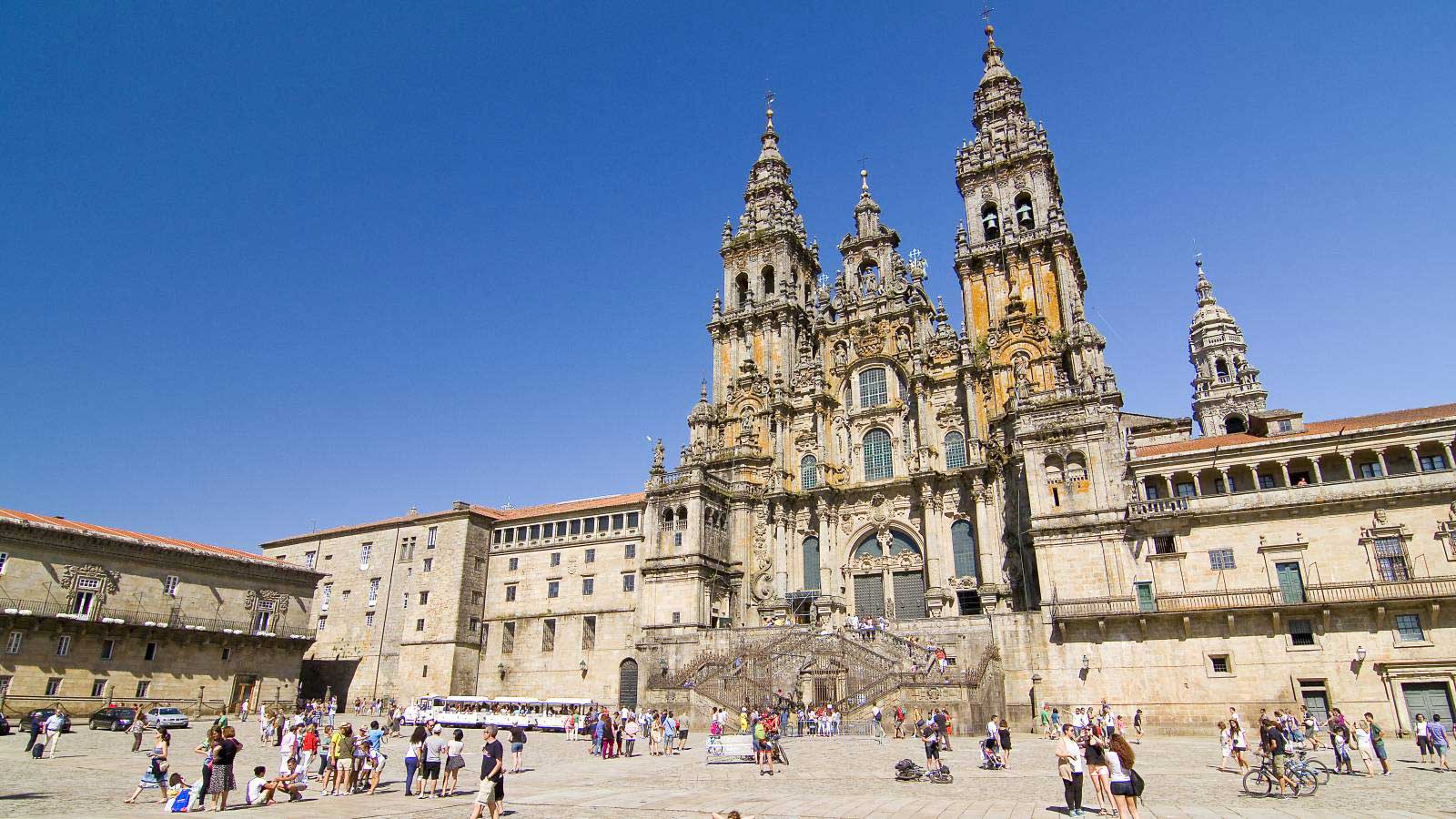
The Camino de Santiago is a set of 13th Century religious pilgrimage trails, all leading to Santiago de Compostela, a city of 100,000 in northwest Spain. The destination of the “Way of St. James” is the town’s Catholic cathedral, a UNESCO World Heritage Site.

On the Camino

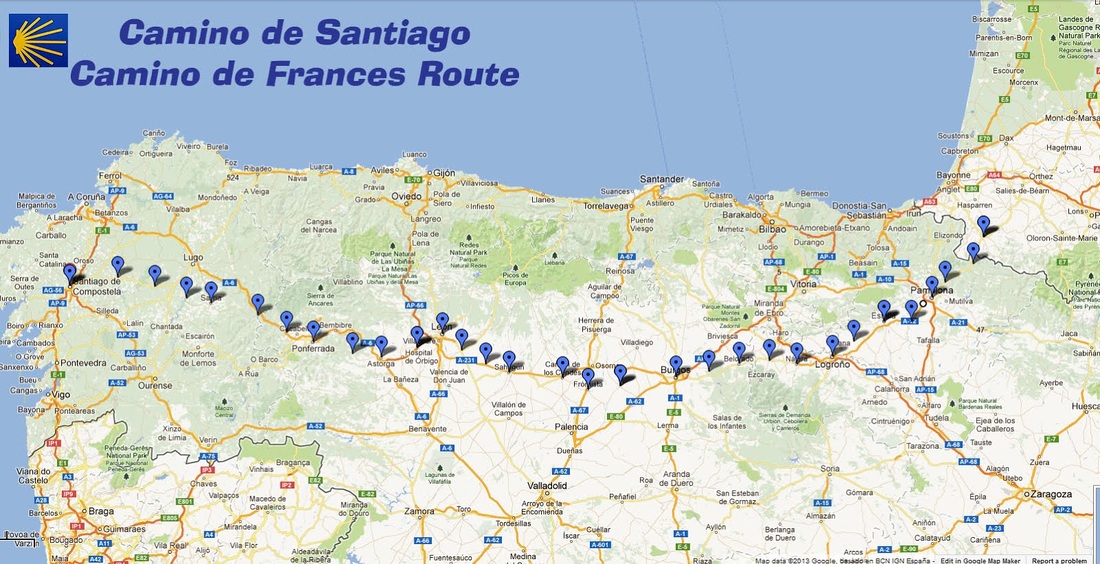
The route I’m taking is the Camino Frances, a 500-mile, six-week walk that starts in southern France, crosses the Pyrenees mountains into Spain, and then goes west across northern Spain almost to the Atlantic.

The Camino Frances Route

Towns along the route have had in place for hundreds of years a system of hostels, so that the peregrinos (pilgrims) can readily find shelter and food. In 2018, over 300,000 pilgrims made the walk, including 60,000+ over the age of 60, and 18,000+ from the U.S.

The Destination

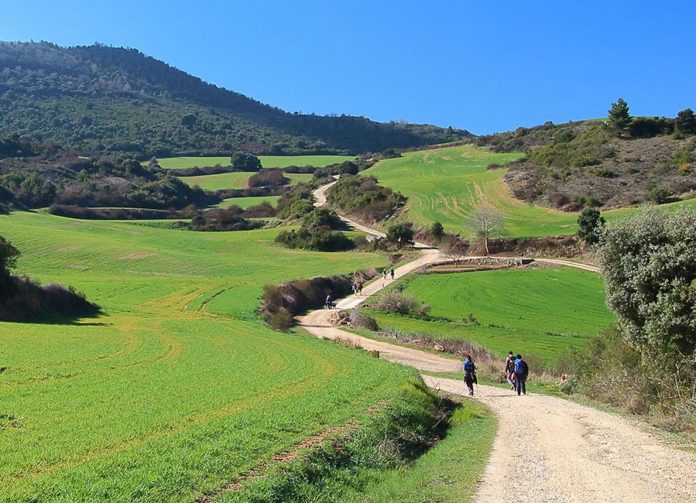
Notice how sunny and nice these photos are? Well, the reality is that the walk goes over mountains, through farmers’ fields, over rivers, and through towns large (like Pamplona) and small. It can be hot, it can rain, and then there are the cattle and sheep and territorial dogs on the trail. As romantic as I’d like to be, I know this walk will be a challenge and a wonder.

Why am I going? I’m not terribly spiritual generally but this is my way of making a sharp break from too many years working with computers and software, of disconnecting from our increasingly hectic and shallow society (U.S.) and launching into what, at 68, will probably be the last chapter of a varied and interesting life.

I intend to provide posts along the way and I invite you to come along with me on the Camino, and perhaps be inspired or moved. My pilgrimage starts September 9th.

Vamos!