I slept well and woke up feeling much better. The recuperative ability of the human body is amazing. I slept in and the hostel provided a nice buffet breakfast.
I’m spending today doing a little reprovisioning at the pharmacy and supermarket, and catching up on blog posts. I spent an hour outside a cafe with Renato, who I just stumbled upon, who stayed in Itero de la Vega last night, left very early this morning (“I could see the Milky Way”), and was here by 10:00AM.
Tomorrow, it’s back to the pilgrim routine: I’m off to Carrion de los Condes at first light, a 19 Km walk, which will put me at the halfway point of the Meseta.
I set off this morning fully prepared for the long day ahead of me. After a quick breakfast of cafe con leche and a chocolatine at my hostel, I started out along the Camino. This meant a 25-minute walk through the rest of the town. It appeared that I didn’t miss much by not venturing further into town the previous day.
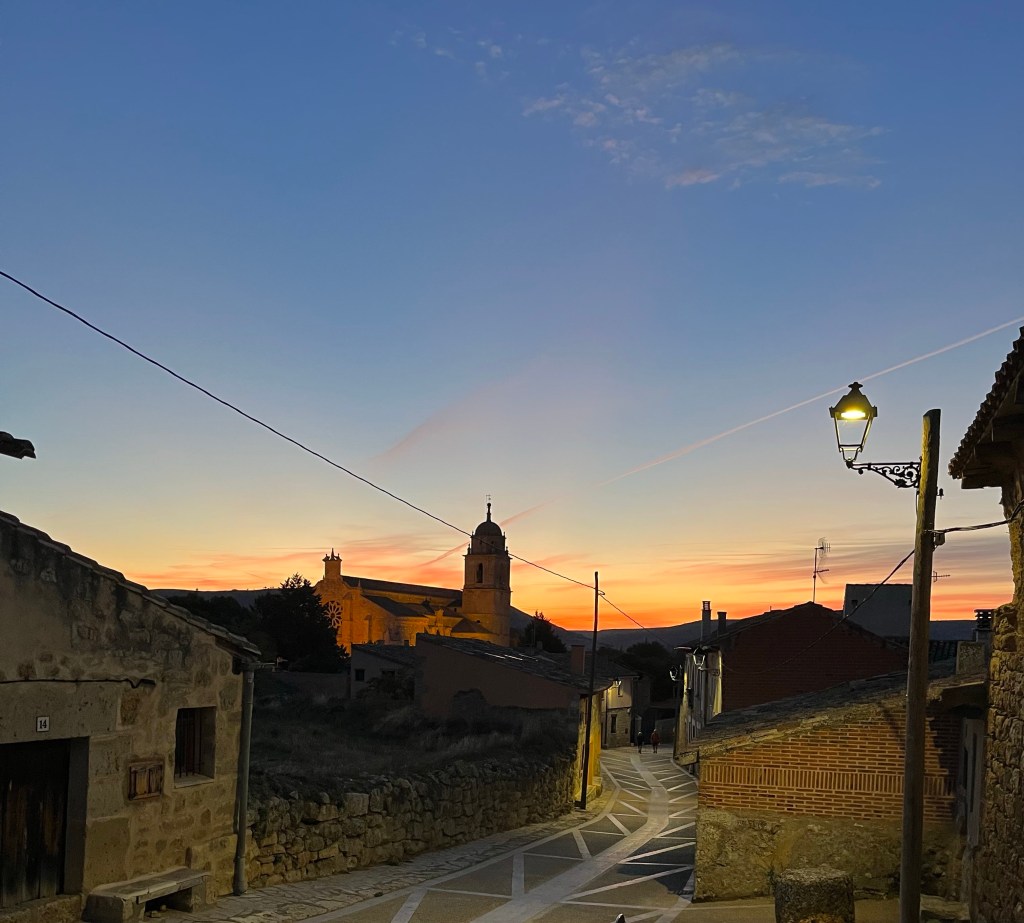
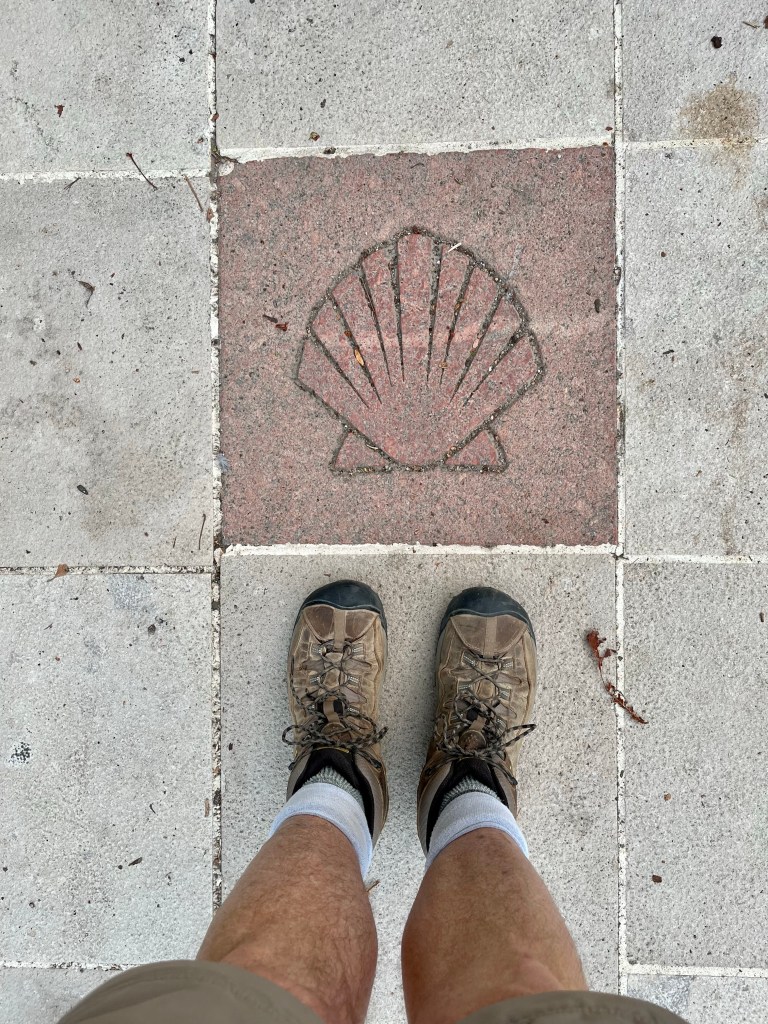
The Camino route through town has special paving
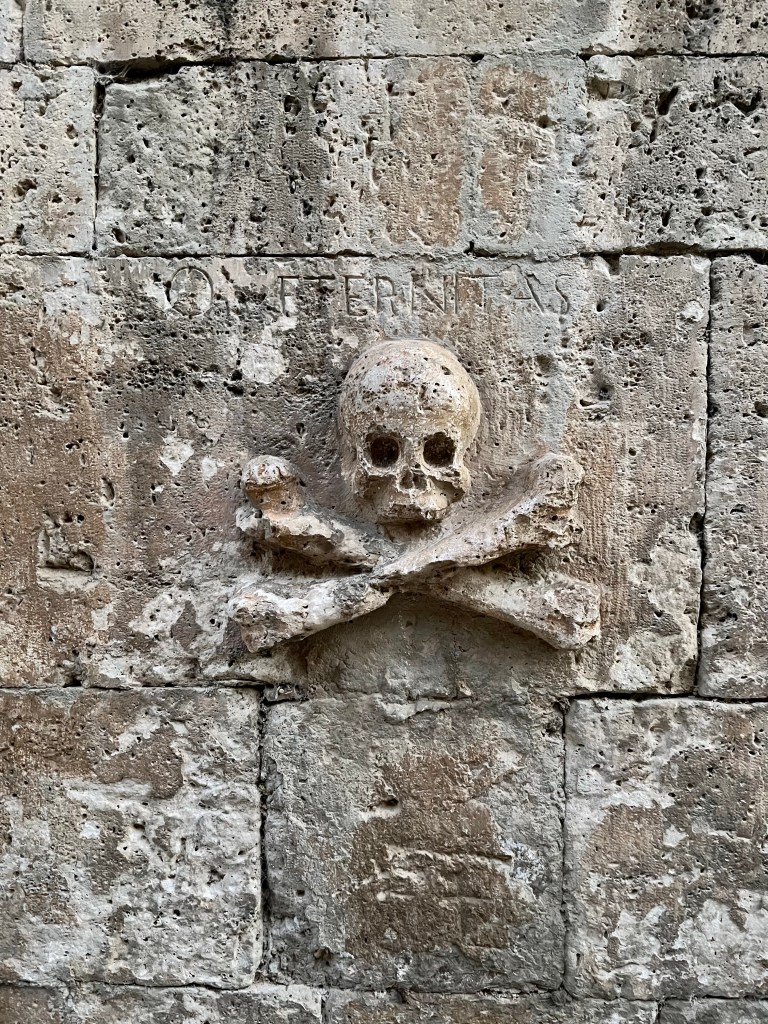
At one point I passed an ossuary, a “bone repository”, where disinterred bones would be placed to make room for new burials in the church yard. So much for the sanctity of burial.
The ossuary has its own unique wall decorations
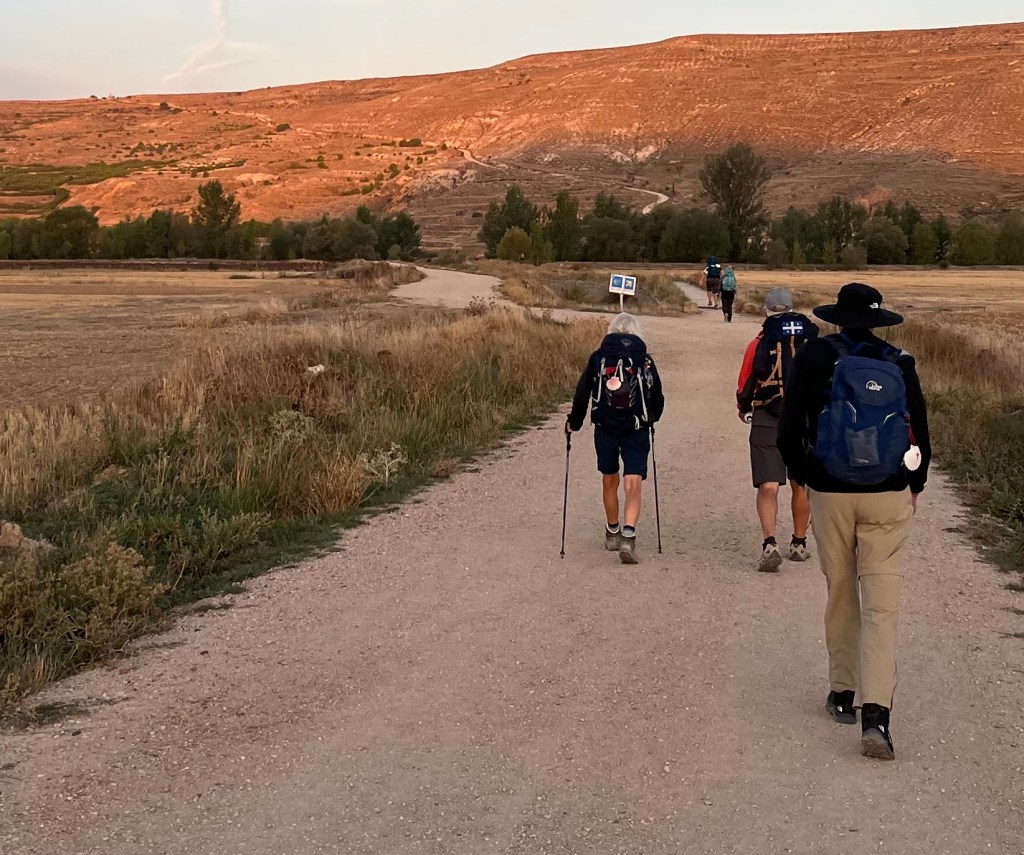
Before long I was joining others for the long, steep climb out of town. If you zoom the following image, you can see the trail top in the upper lefthand corner. Every now and then I think I see Grace or Wendy up ahead of me – if you’re reading this, ladies, you are missed.
There’s nothing like a hard, steady climb to get you going in the morningAnd, of course, the view back down the hill is exhilarating
And so another day of walking on the Meseta unfolds. One thing I haven’t mentioned before is the flies. Maybe it’s Spain’s policy on toxic pesticides, maybe it’s endemic to the rural areas I’m going through, but whatever the cause, there are just a lot of flies. Black “house” flies. And not just outside; the absence of window screens and air-conditioning means that doors and windows are frequently open. Hence, there are a lot of flies in restaurants, in rooms, in everywhere. I’ve taken to wearing a pretty strong bug repellent while walking, otherwise I’m spending half my time waving flies away from my face.
About two hours after leaving Castrojeriz, I headed down from the plateau towards Itero de la Vega. The angle of the descent was severe.
I headed down the steep descent and across the plain
At the bottom, I wound up walking with a fellow I’d met at breakfast this morning. Renato is a 59-year old gent from Geneva, Switzerland who started walking months ago from there, got to Saint Jean Pied-de-Porte in France, and was diagnosed with a stress fracture of the hip! He had to go home to get treatment and rest for a few months. Now he’s resumed his Camino and we spent a few hours walking together discussing, of all things, Classic Rock music. He’s an amateur jazz piano player and a huge Pink Floyd fan. He’s also about 6’ 6” tall; a big fellow. We discussed many things, including the return of vinyl and how grotesque the aged Rolling Stones look on stage now. It was nice to chat with someone and I’m sure our paths will cross again.
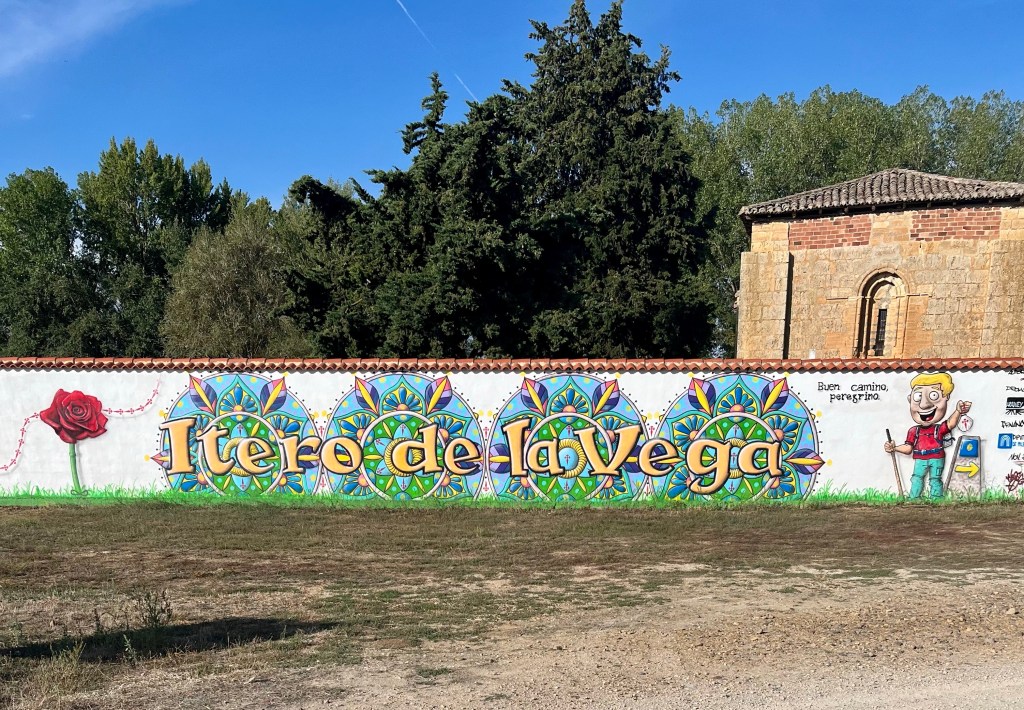
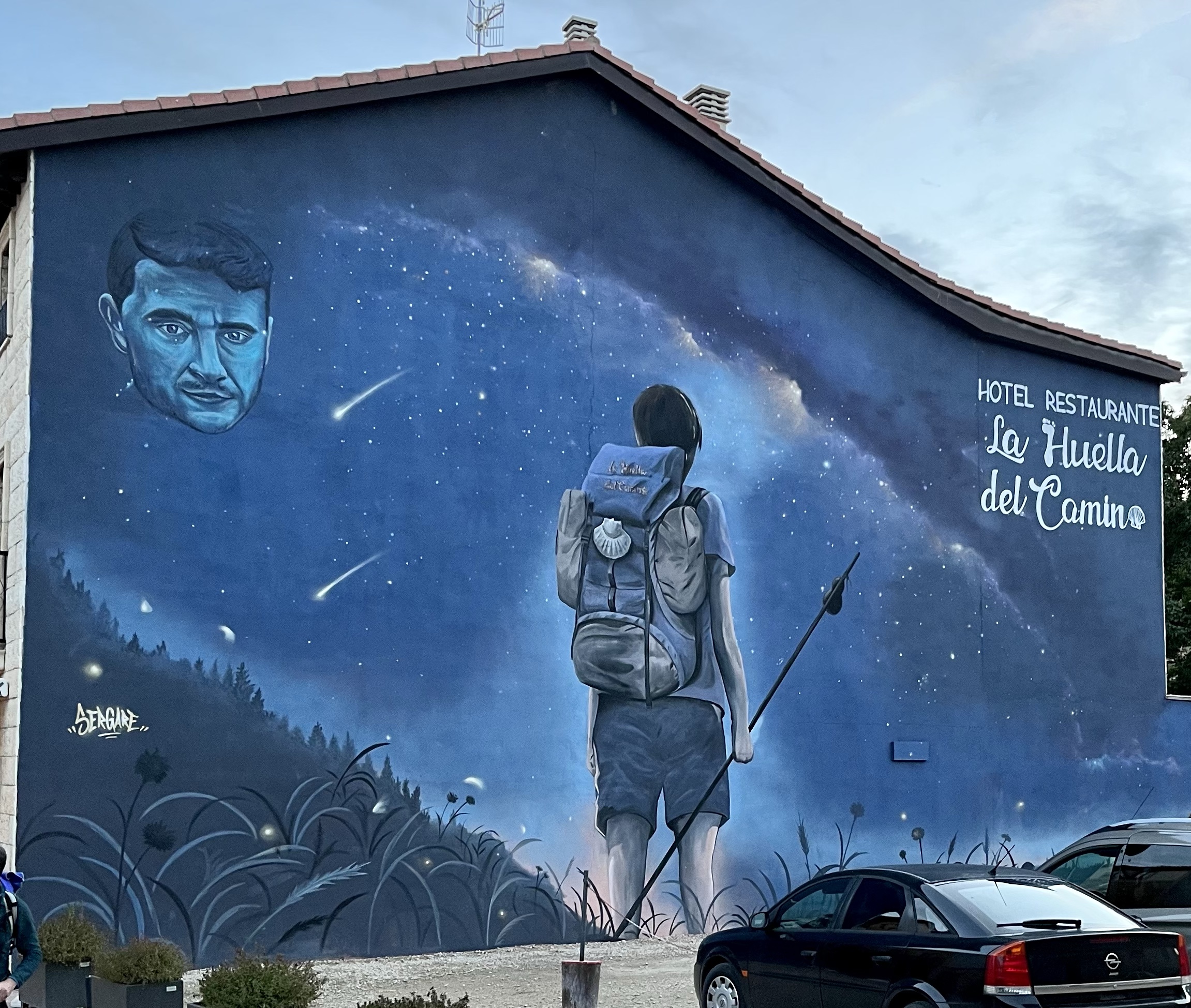
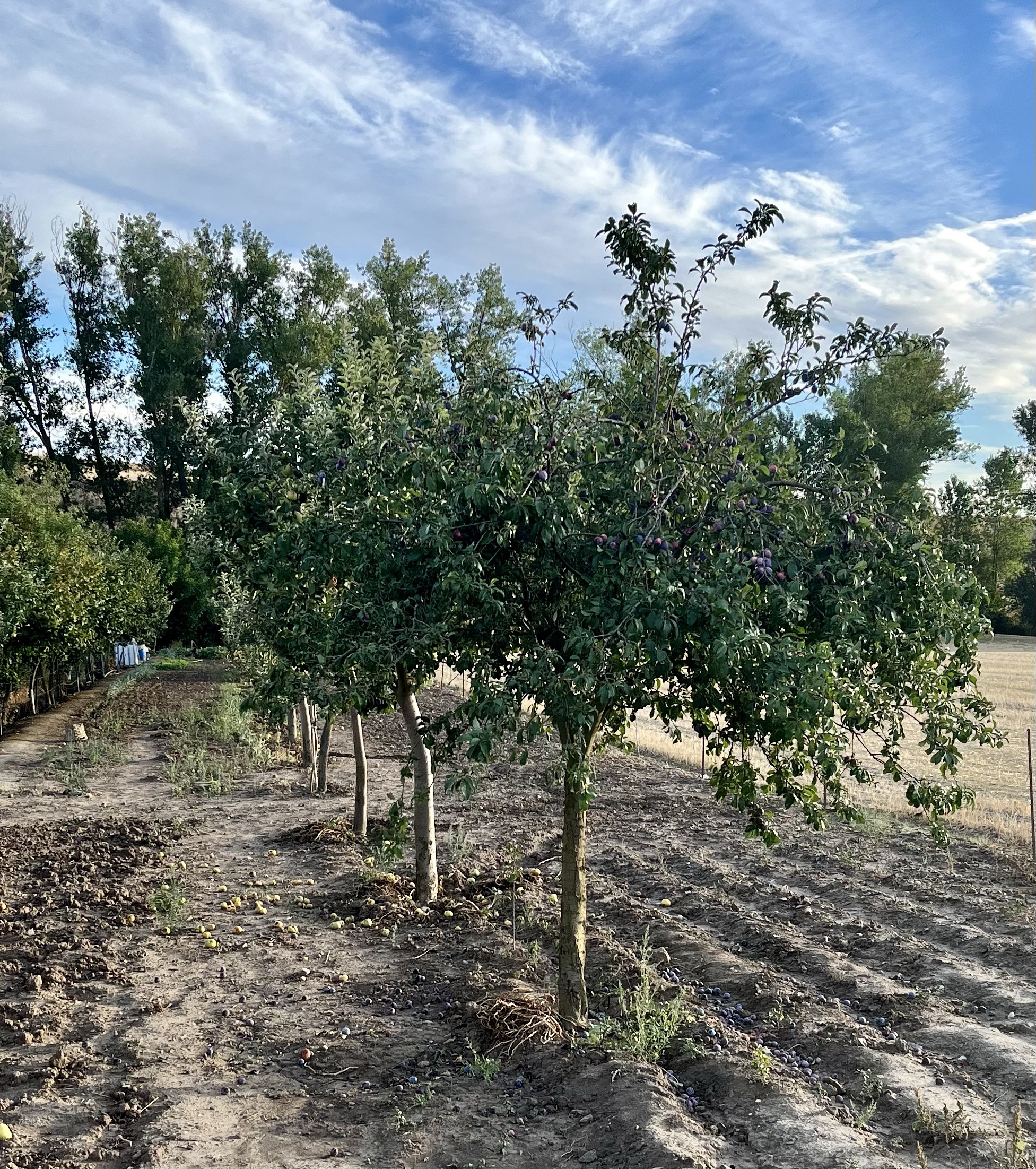
A nice tree farm outside Itero de la VegaA mural welcoming pilgrims to town
Itero de la Vega is a tiny town, population 50, and exists these days primarily because of the Camino. After walking 11 Kms, I entered the town and soon walked right by the albergue I was supposed to stay in tonight. It was closed up tight and there was no announcement or notice posted on the door about the owner’s death. I went by at 10:30 AM and I wonder if anyone coming along later, unaware of the situation, might have hung around waiting for it to open in the afternoon. It seems kind of irreponsible not to alert people who’ve made reservations that it’s closed. Oh well, I had a cup of coffee in town and set off on the second half of my walk.
Remember the 790 Kms sign in Roncesvalles? Here’s the remaining distance
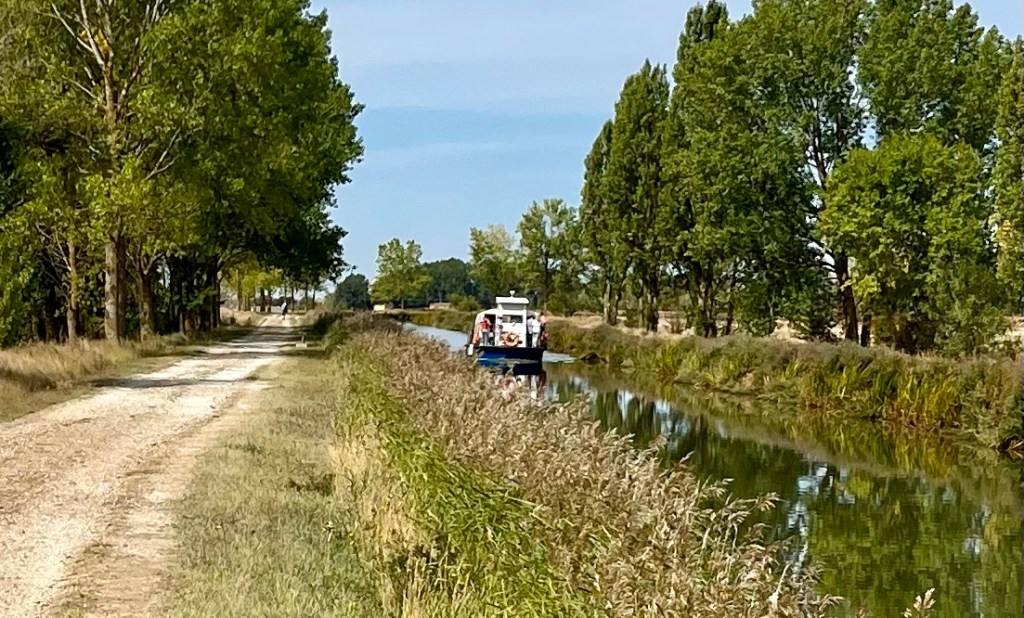
The sun came out and the temps went up and the next few hours, walking to Boadilla, were less pleasant than in the morning. The rocky path surface, while flat, was difficult. Then all of a sudden I found myself walking beside a large, tree-lined canal. What?! This most unMeseta-like feature ran on for miles and reminded me of the old C&O canal outside Washington, D.C. I was very grateful for the shade.
The shade was very welcome…… and then along came a boat full of tourists!
Apparently, the canal not only provides irrigation water to fields but is also an opportunity for canal boat rides. I’m sure we pilgrims are a phenomenon pointed out by the guide; the passengers all waved at me enthusiastically and called out “Buen Camino” as the boat passed.
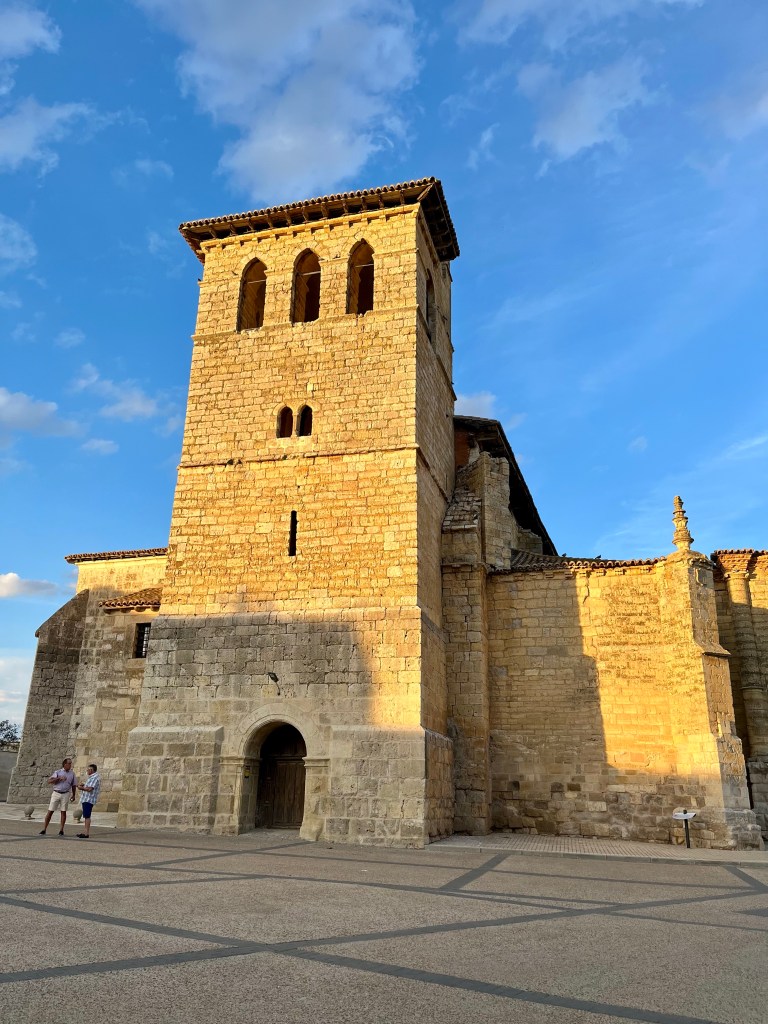
The 15th century Church of San Pedro, across from my hostel
I was very glad to reach my hostel, at about 1:45, and the landlady was true to her word: she had a two-night room all ready for me. I did my pilgrim chores (check-in, shower, laundry) and had lunch next door. I’m on a street with half a dozen albergues and hostels and lots of restaurants and cafes, so there’s no shortage of services for pilgrims.
So, how did I feel after 25Kms in the sun? Well, by the end of the day I was really tired and starting to get sore. I did some stretches but still felt like I’d been hit by a bus. But I slept soundly knowing I had a rest day in front of me and woke up the next morning feeling much better. Tomorrow: nada! I don’t have to go anywhere or do anything; what bliss.
Hornillos del Camino to Castrojeriz – 20 Kms, 25,697 steps
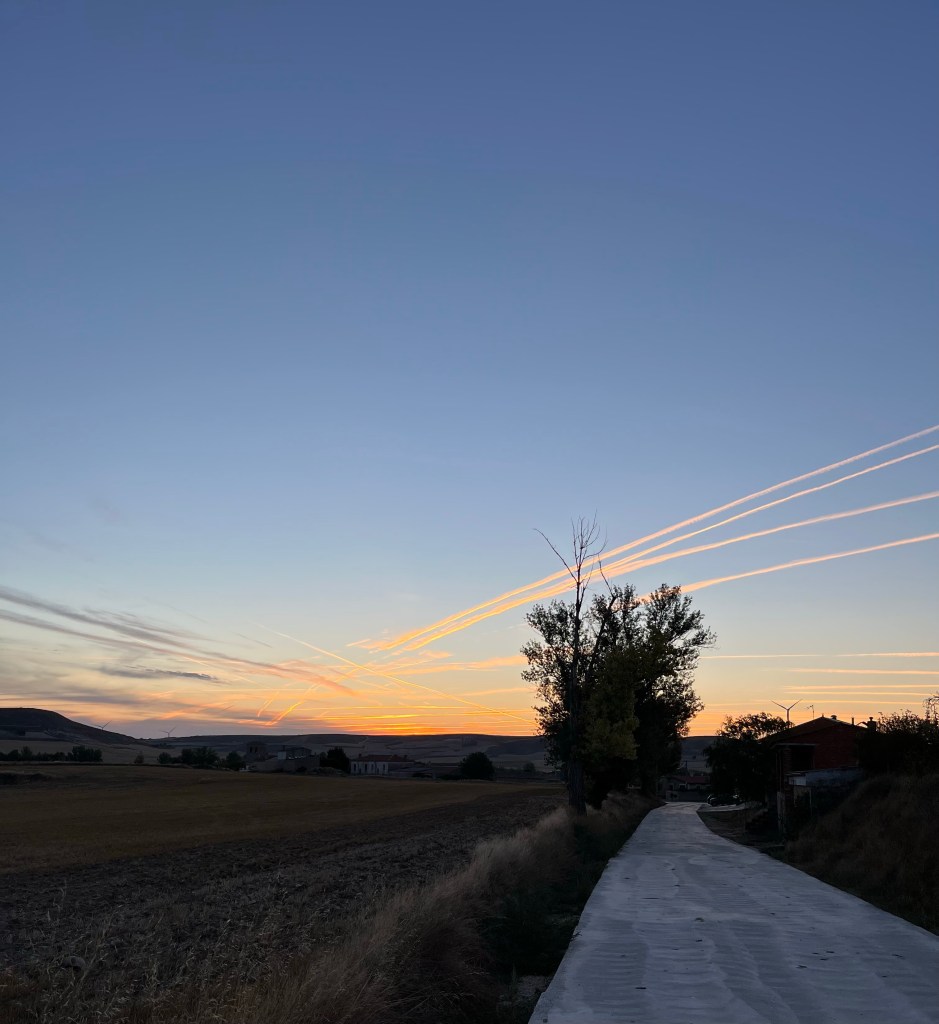
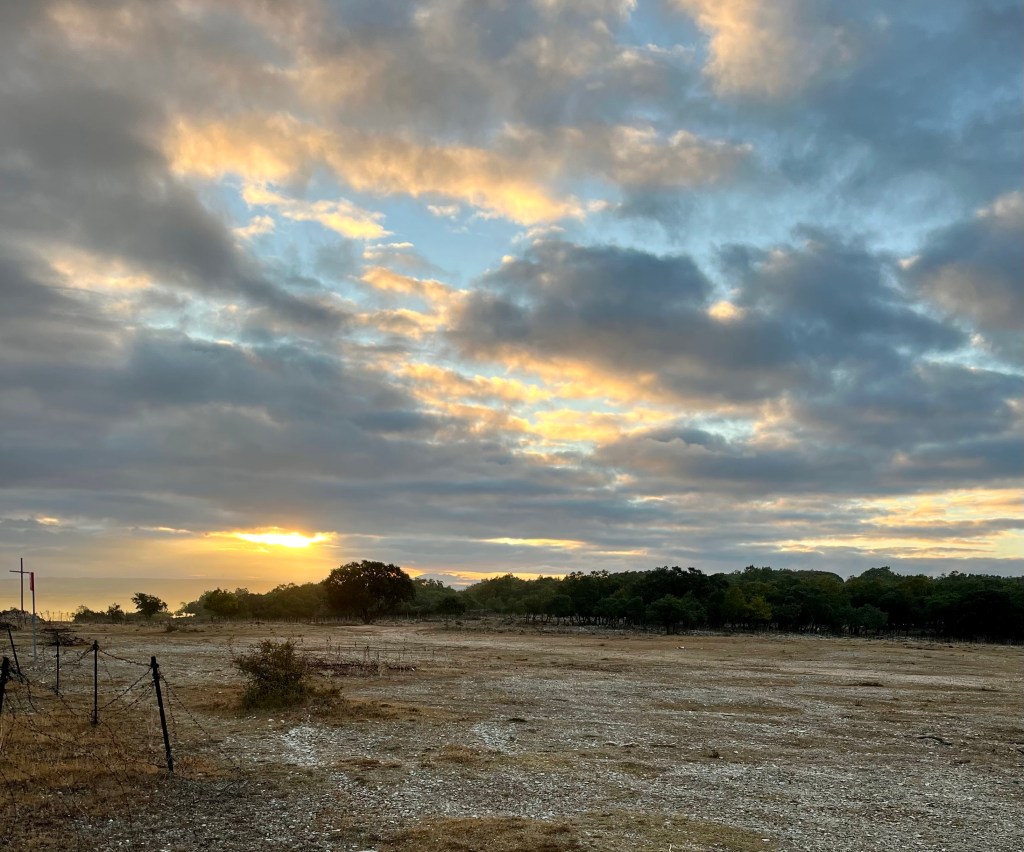
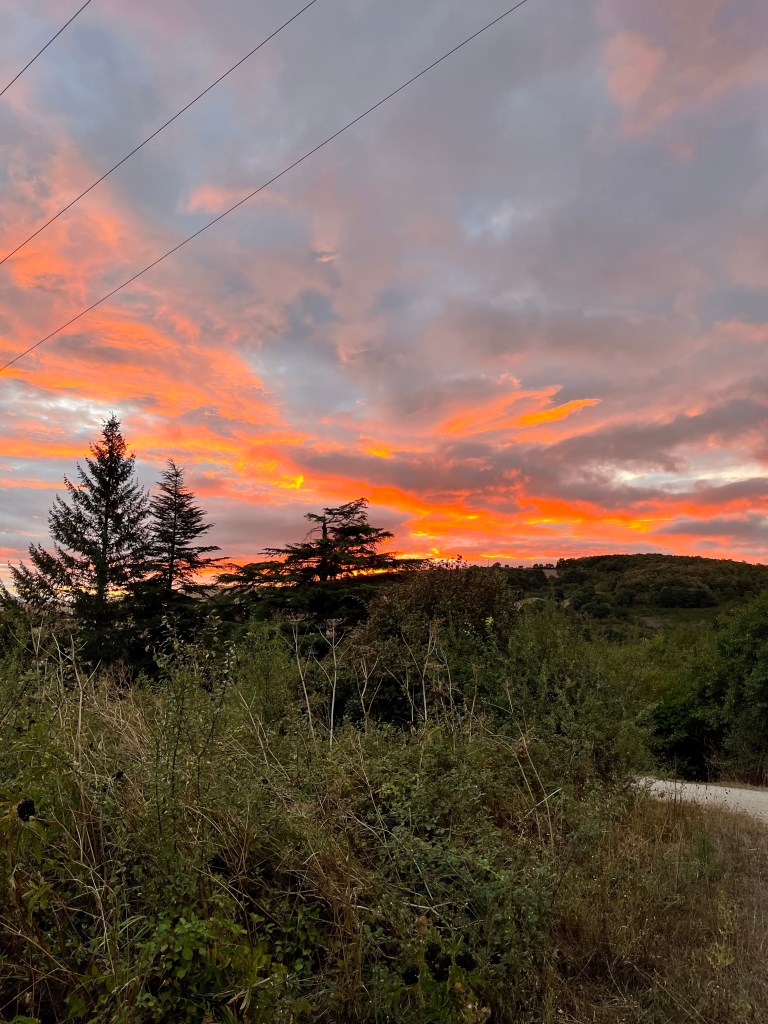
A beautiful dawn for my exit from town
Mornings at albergues are interesting. If breakfast is offered, as it was at Hornillos Meeting Point, it’s laid out the night before and there is no albergue staff there in the morning. Pilgrims help themselves to breakfast (which can be of varying quality) and often have to exit the building through a side door, because the front door is securely locked.
I ate, finished packing, and trooped out of town along with many others getting an early start. So far, I’ve managed to time it so that the pre-dawn light and other pilgrims show me the way, without having to resort to using my headlamp.
The relentless Meseta landcape
We climbed up out of town and I was on the Meseta an hour later. There were dry wheat and oat fields as far as the eye could see, along with the usual wind turbines. It was sunny and dry, with a little breeze, so it was good walking weather.
It’s been said that the landscape and monotony of the Meseta do strange things to time and distance. I haven’t noticed that yet, but I’m just two days in and I’m ready for the Meseta to be over.
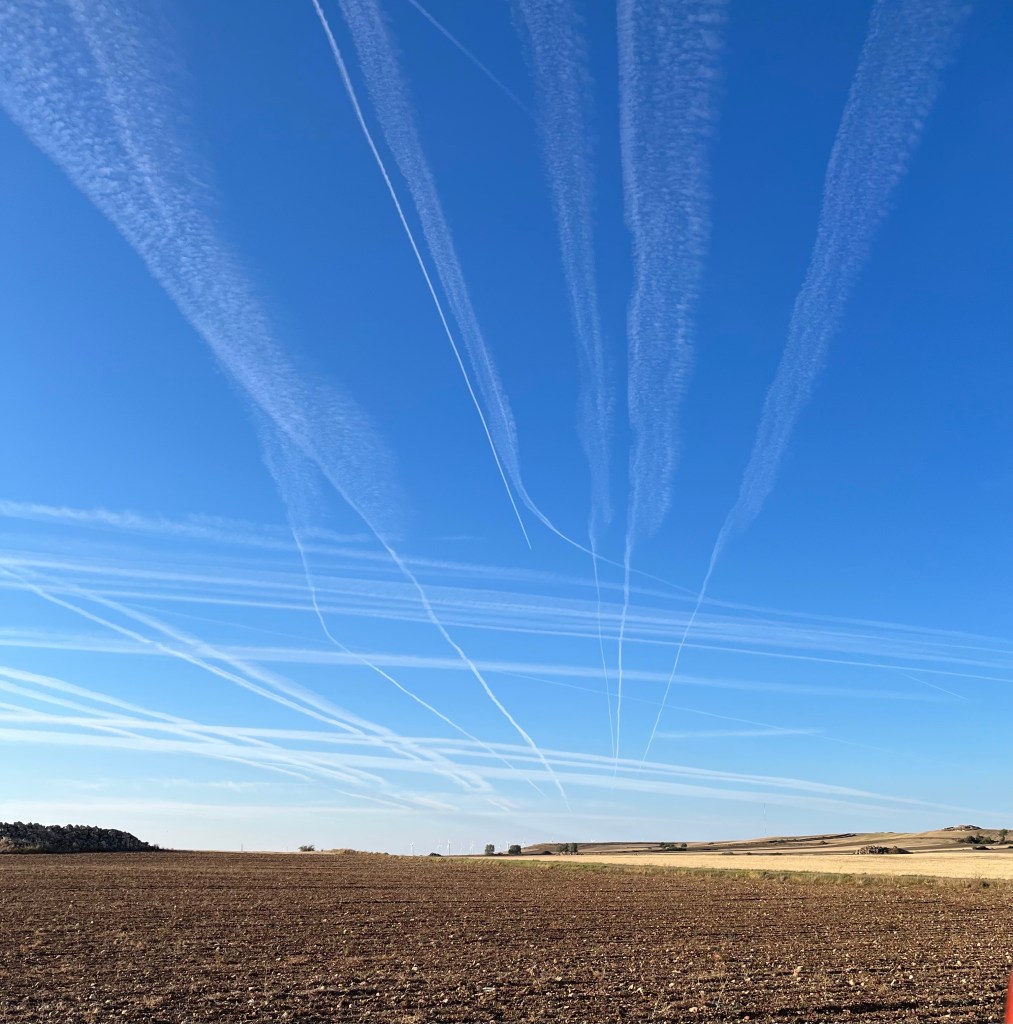
And they call Montana “Big Sky country”
As I plod along, I pass or am passed by many of the same people from one day to the next. Actually, there’s something telling in that sentence: I pass people. In the early days of this Camino, everyone passed me. I must be getting stronger.
There’s a Camino saying that the first third of the journey is physical, the second third mental, and the last third spiritual. I’m in the second third now and I confess to having a lot of thoughts, especially at night, questioning what I’m doing. It can be lonely and boring. I’m lucky that I have the support and affection of many people and that they encourage me daily. I wonder how it is for other pilgrims.
I pass a lot of interesting art work in small towns, speaking of encouragement, which urges pilgrims to continue. There are also some weird artworks, like this statue, seen in a private yard:
Not a pubic water fountain
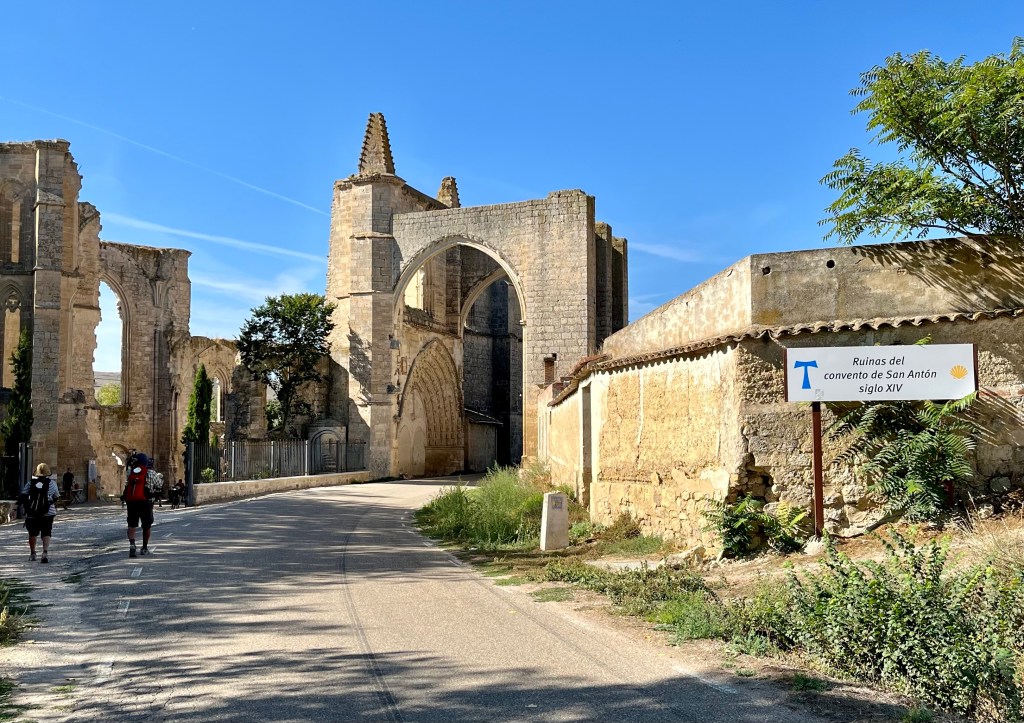
I walked through the morning, through the towns of San Bol and Hontanas, and then past the ruins of the Convent of San Anton.
The 14th century convent ruins
There’s still an albergue there, run by a religious order, that offers the full rustic effect: no electricity and a shared evening meal, in return for a donation. I prefer a little more modern shelter, thank you, but I was happy to refill my water bottle at their fountain and make a small donation.
My destination, at last
The last 2.5 Kms into Castrojeriz were down a paved road. That’s better than the rocky paths I walked today but still a hard surface. It’s always nice to see the town limits sign for my destination.
I’m staying tonight in a hostel right at the near edge of town. No more walking today, which is good. However, tomorrow I’ll have to walk the length of the town just to leave it. My hostel, El Manzano, is run by a lovely young woman who took it over just two weeks ago. She’s from Argentina but lived for a year in Sedona, AZ and she is getting a trial-by -fire taking charge at the height of the pilgrim season.
A nicely-restored VW Bug parked outside my hostel
I’ve been calling ahead each day to confirm reservations I made a few months ago and have gotten no answer at the albegure I’m supposed to stay in tomorrow in Itero de la Vega. Some online research revealed that the owner died in August and the place is closed. That’s a Camino first for me (and for him, of course) so I was suddenly scrambling to find a place to stay. As I’ve mentioned earlier, these tiny towns have no excess capacity, so my plan was upended. After half an hour of calling and considering, I decided to combine the next two days and go all the way to Fromista (25 Kms!) tomorrow, where my hostel could accept me a day early, and let me stay two days. So I traded a long walk for a day off. My longest walk so far has been 22 Kms, so I should be able to do a few more. Let’s see what happens.
Burgos to Hornillos del Camino – 21 Kms, 29,195 steps
The Meseta is a vast, high plateau that takes a week to walk across. It’s famous for being without shade, without water, and without a lot of towns. Though the plateau itself is flat, the towns are often off the plateau, down by a river. This means there are some serious daily ascents and descents to and from the Meseta. Unsurprisingly, a lot of pilgrims choose to skip this area by taking a two-hour train ride from Burgos to Leon, as I did in 2019.
Leaving town was easy, just follow the markers
I wound my way through Burgos, around the cathedral and eventually made it to the outskirts of town. It was 49-degrees, so I wore my windbreaker for the first time. There were always a few other pilgrims in sight, as pre-dawn is a popular departure time.
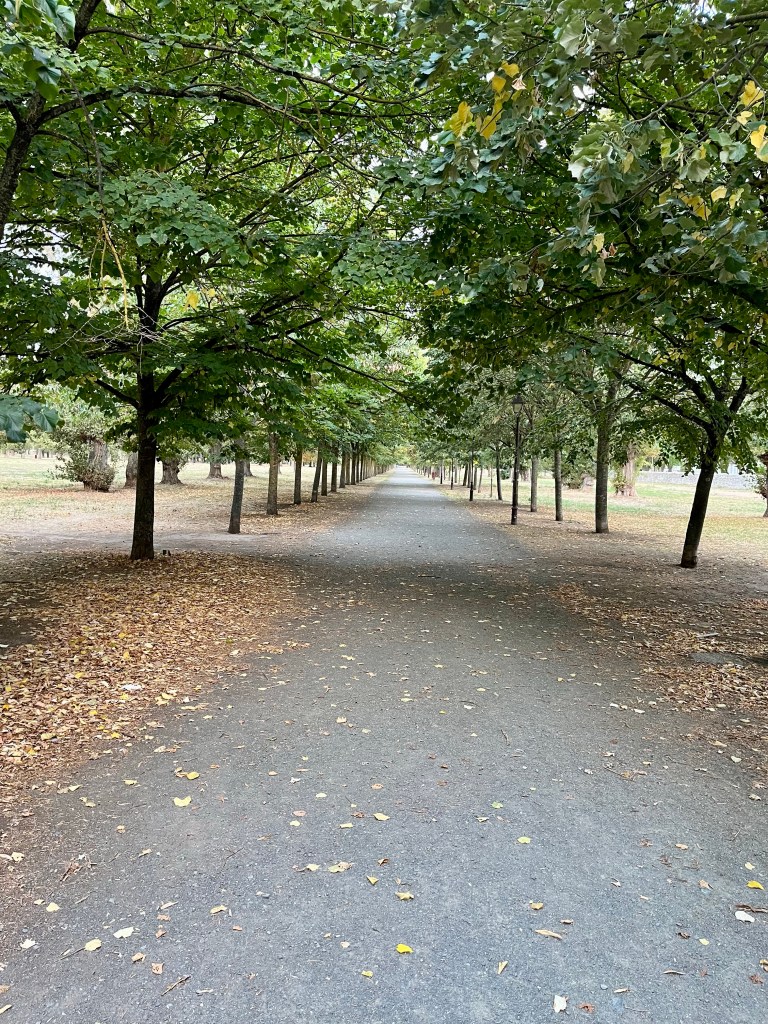
A park near the University – notice the nice path surface
After an hour or so, I was walking though farm fields and another hour later brought me to the ascent up to the Meseta. It was a long, steep uphill climb and at the top, everyone was shedding their windbreakers and other outerwear. Luckily, it was a bit overcast, cool, and we had a breeze. Sometimes the path surface was nice packed grit, sometimes it as crappy hard rocks.
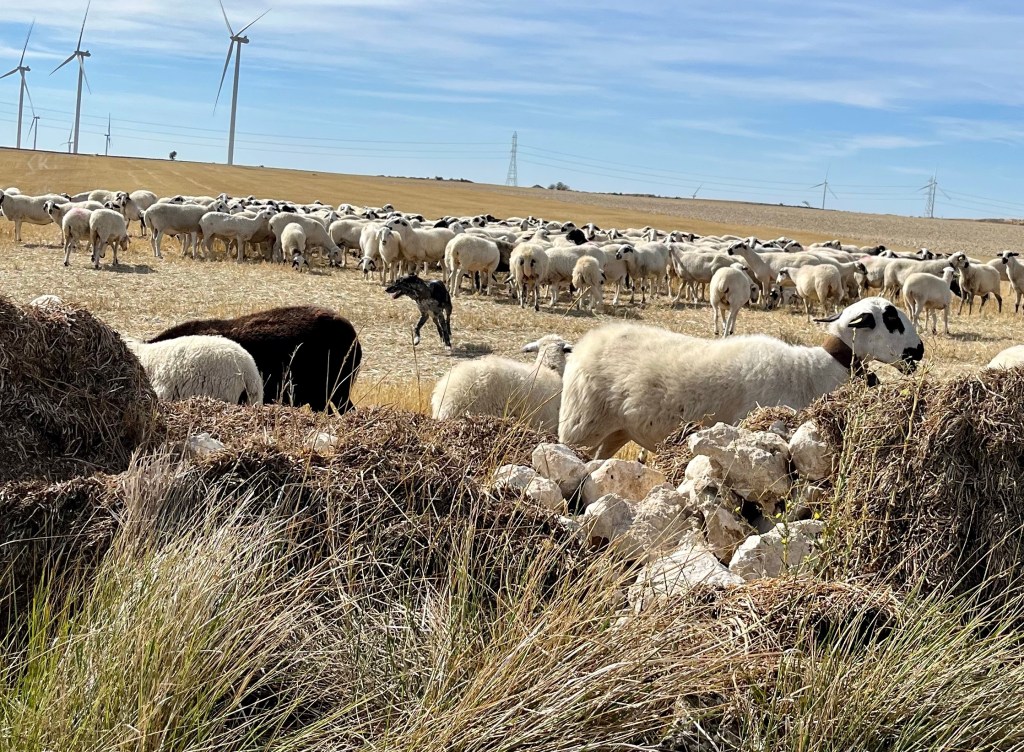
Typical Meseta sceneryThe very occasional tree, with attending sheep flock
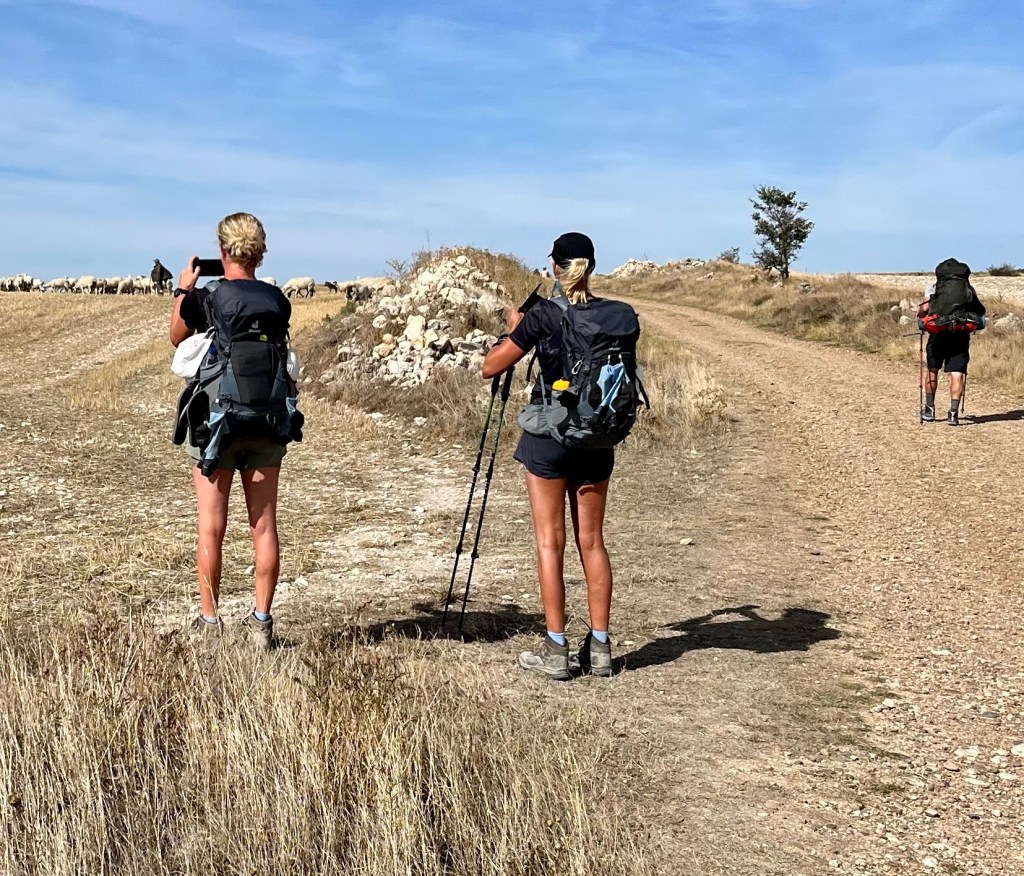
For the last few days, I’ve been keeping pace with a pair of young ladies I’ve dubbed The German Party Girls. They’re very blonde, very tan, and drink a lot of beer. They’re very attractive and they know it. I have little direct interaction with them but it’s fun to observe them when we’re at the same stops. They get full credit for doing the hard walking and carrying backpacks.
The GPGs stop to photograph the sheepThe sheep say baaaa
As always, what goes up must come down, so we went down a really steep descent. I protected my knees by making vigorous use of my hiking poles and taking short steps. I’d hate to do this in the rain! Several mountain bikes passed me on the way down, with speed but not difficulty.
I tried to keep my camera level, so you could appreciate the downhill angle
The picture above shows the steep descent and winding path to Hornillos del Camino. Hornillos means “furnaces” and refers to the kilns where ceramic tiles were once fired, a local tradition. The town has been around since the ninth century and generally exists now to service pilgims. Population: 70.
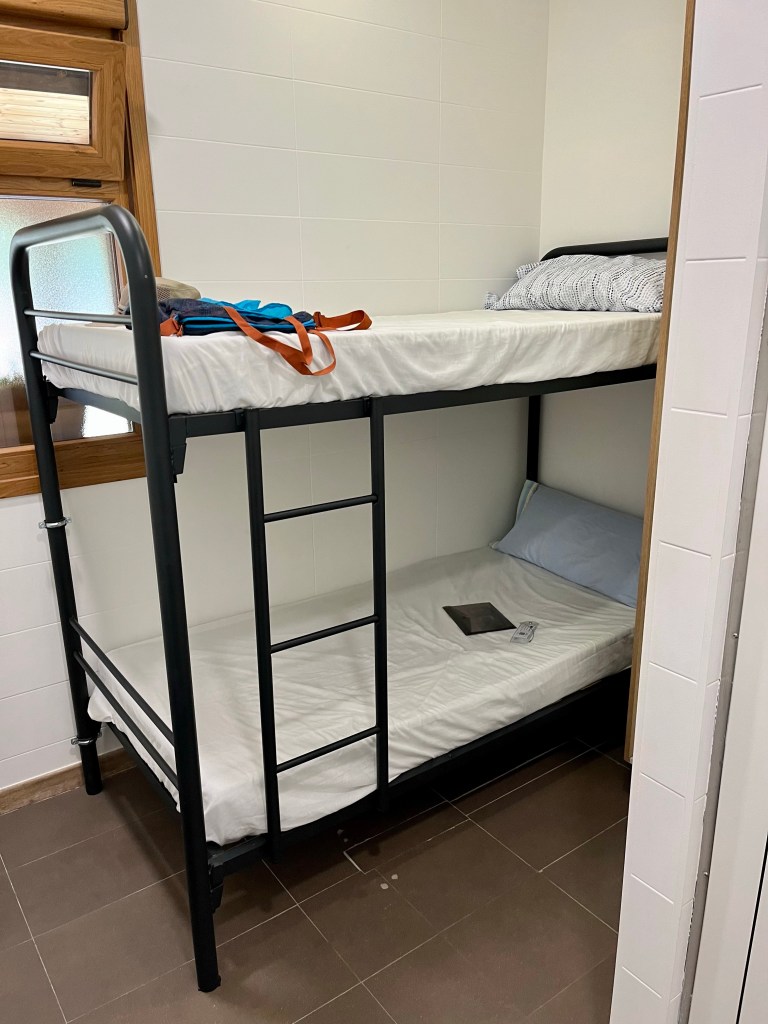
My luxurious private room
I was happy to arrive in the early afternoon at Hornillos Meeting Point, a well-run albergue. There was a line out the door to get in, but luckily I had a reservation for a “private room”. As you can see above, this means I did have my own room and bathroom, but the bunk beds were no different than those in the dormitory area. So, not overly luxurious but private nonetheless. I like my privacy but, more importantly, I have been known to snore and I wouldn’t want to inflict that on others in a dorm.
Tomorrow, more Meseta with a 20 Km walk to Castrojeriz. The weather forecast is for more of the same: cool morning, slight overcast, and dry. Excellent!
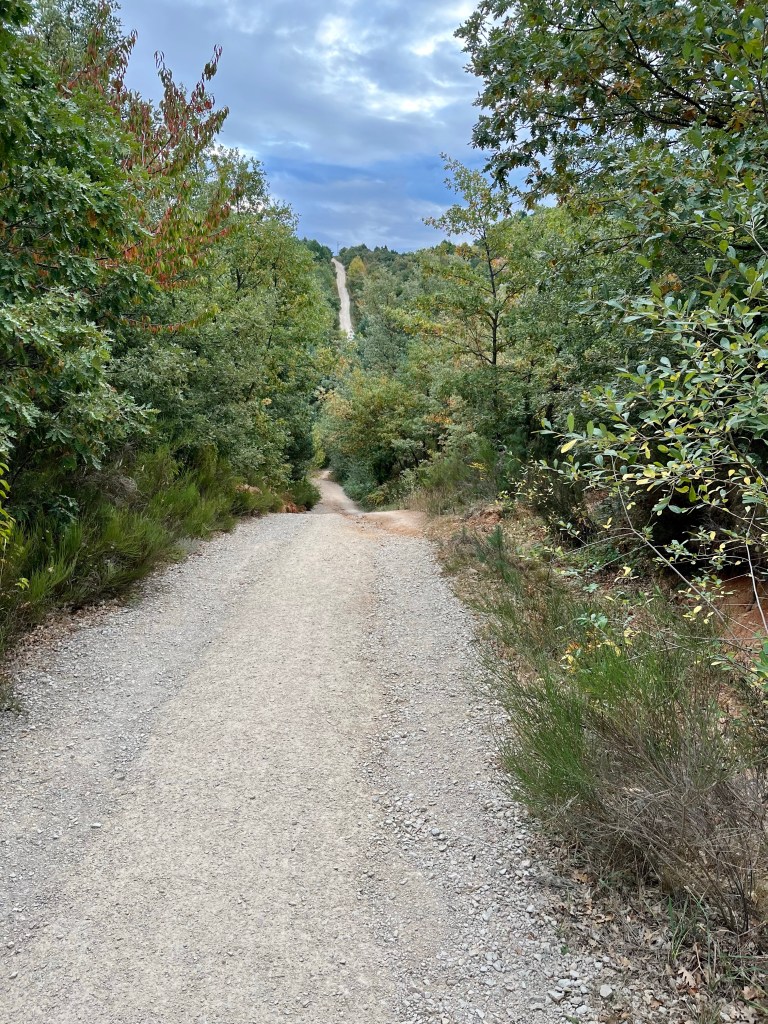
Dawn saw a line of pilgrims exiting Atapuerca and heading uphill through the surrounding farm fields. I thought the rocky trails of the last few days were bad, but this one took the cake. It was awful. Usually, the bad paths have a smoother tire track or border that pilgrims have worn down but this had none of that. 110% of my attention was required to be sure where my feet were going; I barely noticed the scenery.
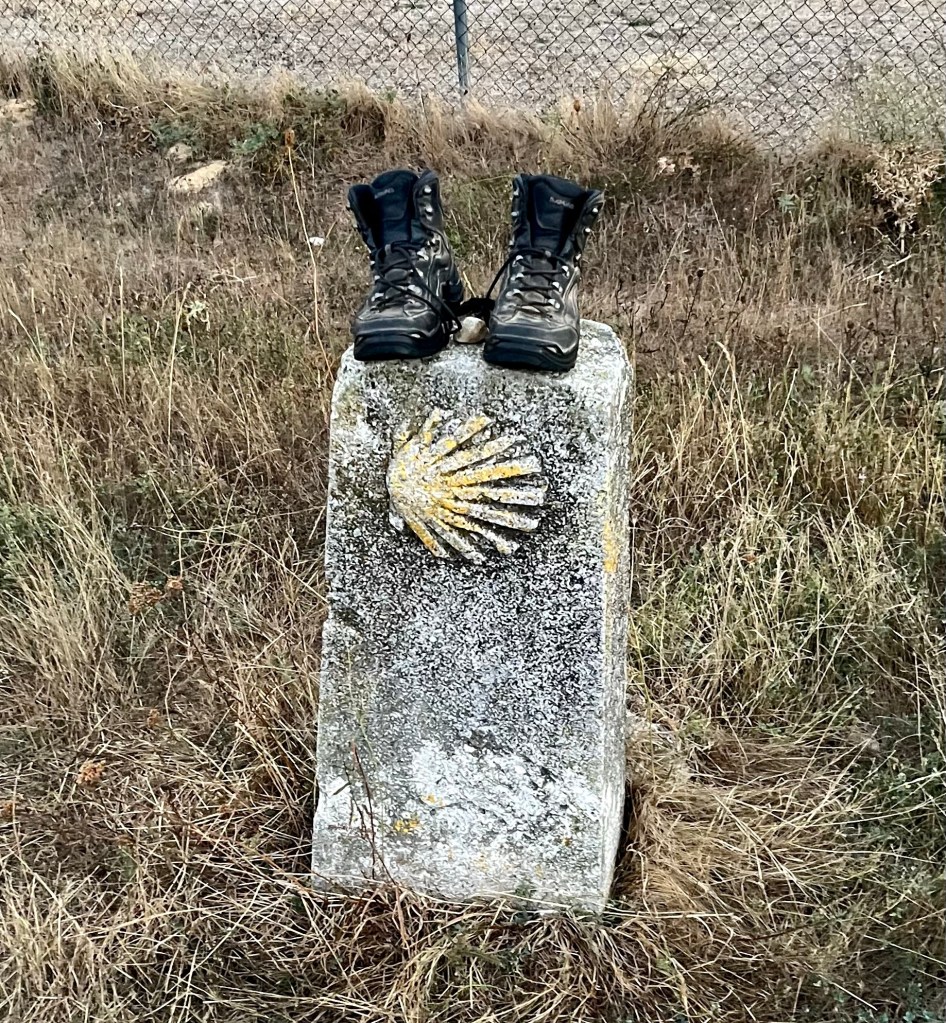
Rob, are these your new boots?
A couple from Texas that I met the night before over cocktails, Rob and Lauren, told me that Rob’s hiking boots had fallen apart in the previous week. So they’d ordered a new pair, to be delivered to them in Burgos. When we spotted these boots along the trail, I got a laugh when I asked Rob is they were his new pair, special delivery.
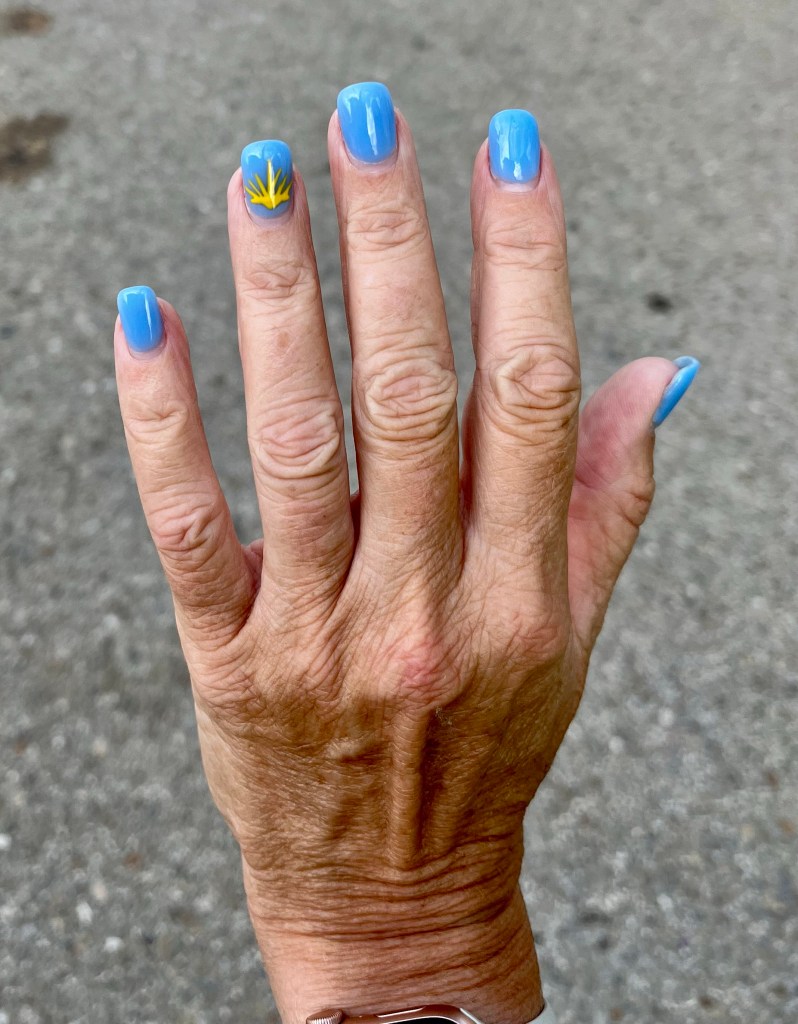
Lauren was sporting a Camino nail job
I caught up with Grace and Wendy in Obaneja, a small town with a roadside London-style, double-decker bus I remembered from 2019, painted as a billboard for the local albergue.
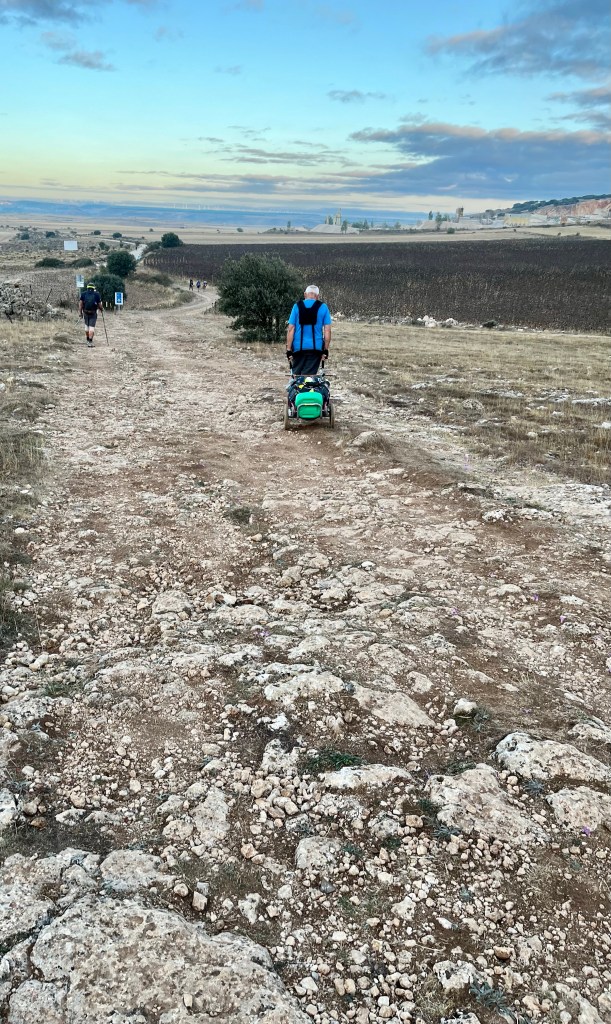
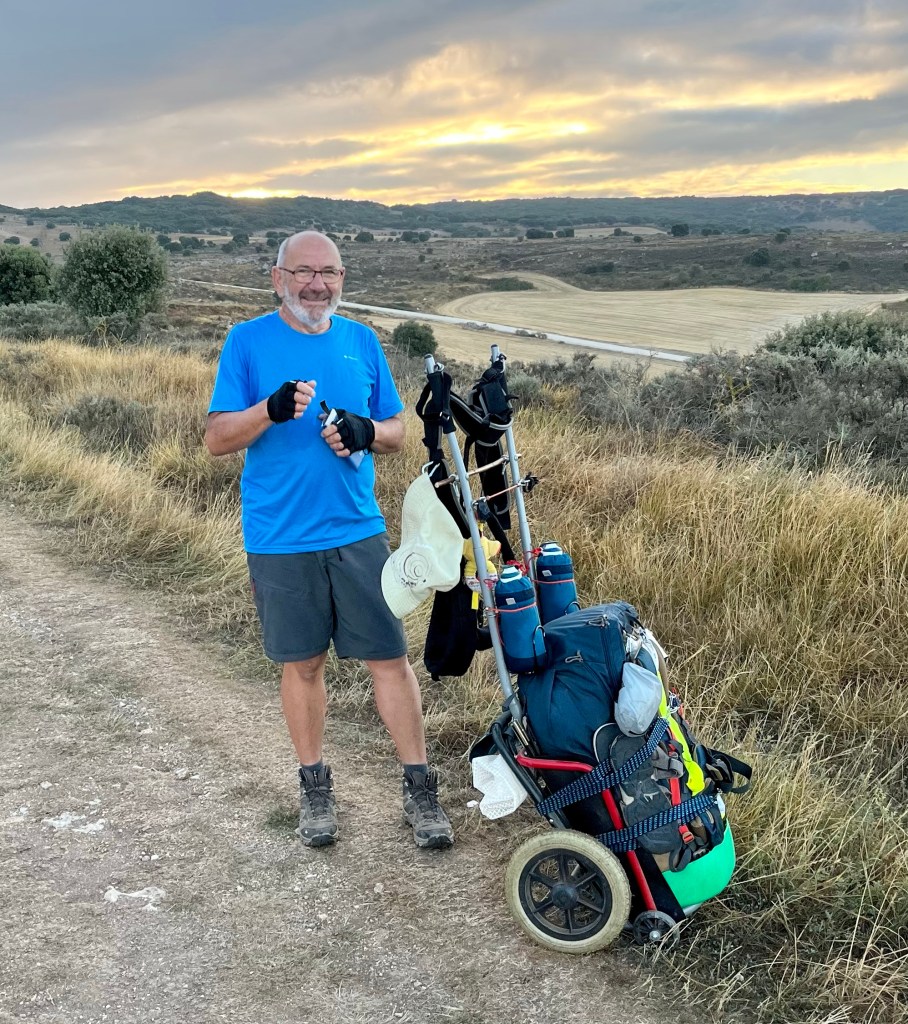
A backpacking cargo trailer, on a steep rocky downhillI would not want to haul that thing up some of the hills we climbed today
We made it to the outskirts of Burgos and took an optional route along the river, through a nice park, rather than walking for miles through an industrial area. The park was shaded and had separate pedestrian and bicycle paths, water fountains, and lots of nice benches.
A nice piece of wood-working
A technical note: WiFi throughput at the places I’m staying in is often very poor and/or heavily-loaded. It can take several minutes to upload a photo, which means these posts can take a long time to compose and upload.
We made it to Burgos and went our separate ways. Wendy and Grace are done with their Camino, will have a rest day in Burgos tomorrow, bus to Madrid the next day, and then eventually go home to Australia. It was really nice to have such interesting “trail buddies” for a while and I wish them well,
My accomodation was a hotel on what turned out to be “restaurant row” in the old part of town. The hostess told me that the street actually predates the larger city. I was happy to have a wide choice of places at which to eat, at my doorstep.
I met Grace and Wendy for a farewell drink that evening and, near their hotel, we saw a large street mural being painted. What a feat!
Tomorrow, I head to Hornillos del Camino and into the famous Meseta plateau. The weather looks promising.
Villafranca Montes de Oca to Atapuerca – 18 Kms, 26,664 steps
After a good night’s sleep in the San Anton Abad hotel, and after a few trips through their outstanding, protein-laden breakfast buffet, I left town just at dawn for Atapuerca.
Villafranca Montes de Oca in the rear view mirror
I remembered from my 2019 Camino that there was a climb out of town, but I’d forgotten how long and relentless it was. After about 45 minutes of steady uphill walking, I finally reached the point where the trail flattened out through the woods. Luckily, the weather was cool and partly cloudy, which made the climb easier.
The trail was flat and pleasant, briefly
Eventually, the trees became a pine forest and I walked along what looked like a service road for hours. I saw one or two other pilgrims as I went, including Grace and Wendy, who left me in their dust. For long stretches, the path surface was a miserable, rocky mess.
At the top of a steep descent; notice the subsequent steep ascent up ahead
I make use of my hiking poles for all ascents and descents. Uphill, they really help the legs power along. Downhill, they can take a good bit of the load off the knees. They can also prevent a face plant if you trip over some sneaky stone (which I have, a few times). I’ve seen a lot of younger people walking without them and I’ve seen a lot of younger people wearing knee braces. In my estimation, hiking poles are worth every penny.
Weird art projects on display along The WayAll the descents push your feet foward in your shoes; some people make custom adjustments in their shoes as needed
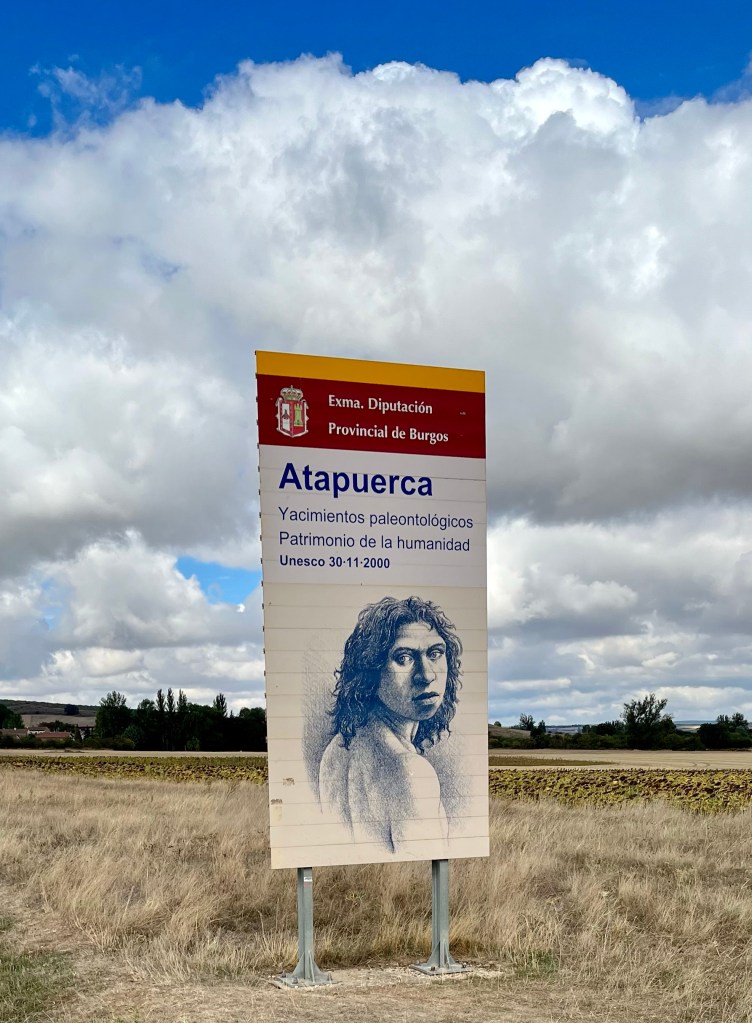
After stops in the small towns of San Juan and Agés, I finally made it to Atapuerca. This is the town that gives its name to the nearby caves where wall paintings and other evidence of human activity have been traced back 1.5 million years.
“The birthplace of mankind“
I got an unpleasant surprise when I arrived: my accomodation had no reservation for me. This despite an exchange of emails back in May with the very woman at the front desk. I showed her the email she sent me, she said that I was supposed to have followed up with a credit card number (which is not stated in her email). This was a serious problem. Atapuera is a tiny town and this is prime pilgrim season so everything in town was booked. However, I was pleasant with the woman and she graciously (and, I think, a little guiltily) called around town and found me a nice room nearby. It was probably nicer than her place, actually. So, despite a bit of a shock, it all turned out OK in the end. As they say, “the Camino provides”.
Tomorrow, I’m off to the big city of Burgos, population 180,000, at the end of a 20 Km walk.
Belorado to Villafranca Montes de Oca – 14 Kms 18,427 steps
This post is coming to you a day late because the awful WordPress app I use deleted the post just as I was about to publish it, and I was too disgusted to re-do it yesterday.
The Belorado town administrators have gone to great lengths to make their town a pilgrim-friendly place. Which makes it sad that there are so few open restaurants and bars to feed the pilgrims.
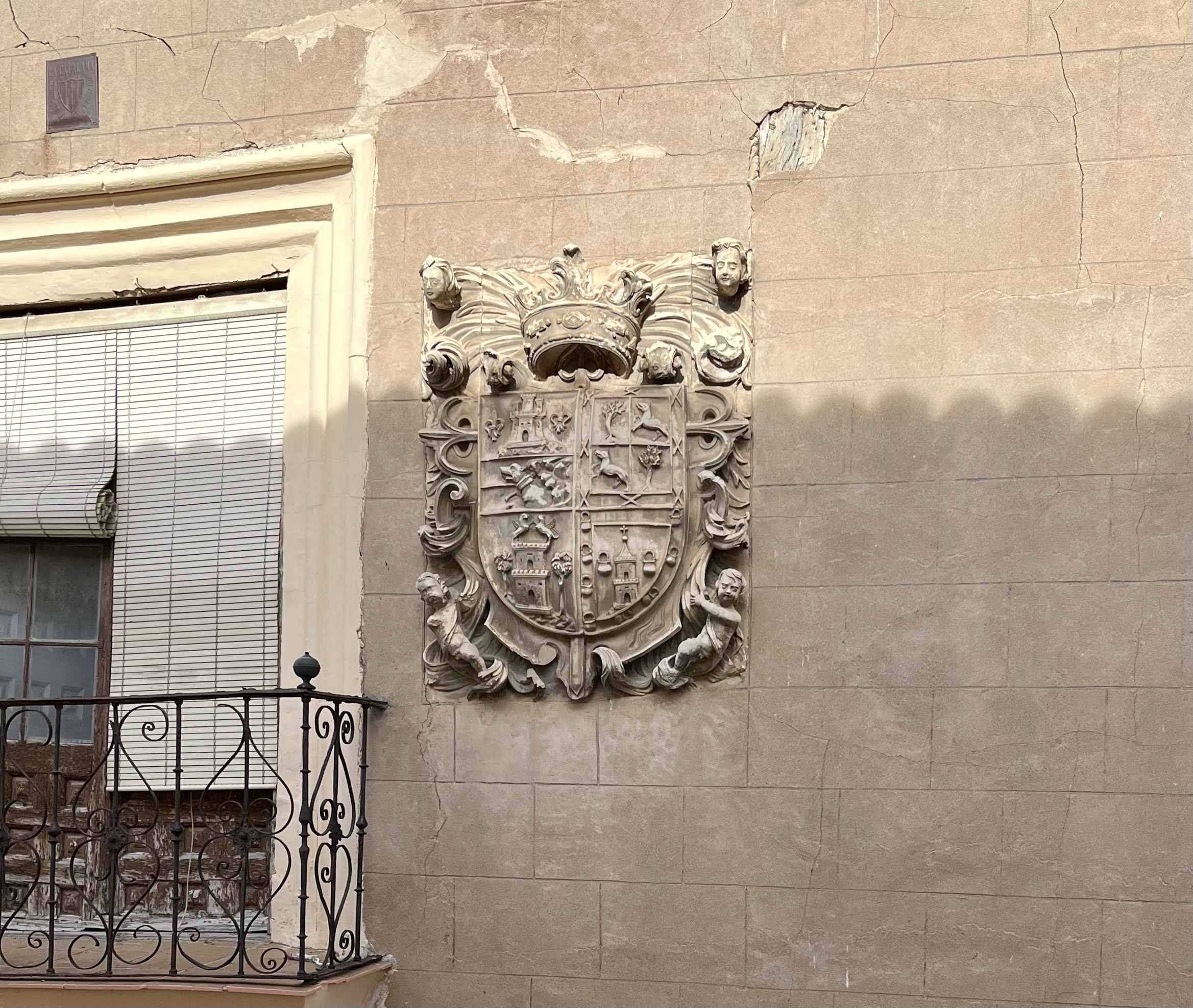
Many Belorado houses have family crests on display
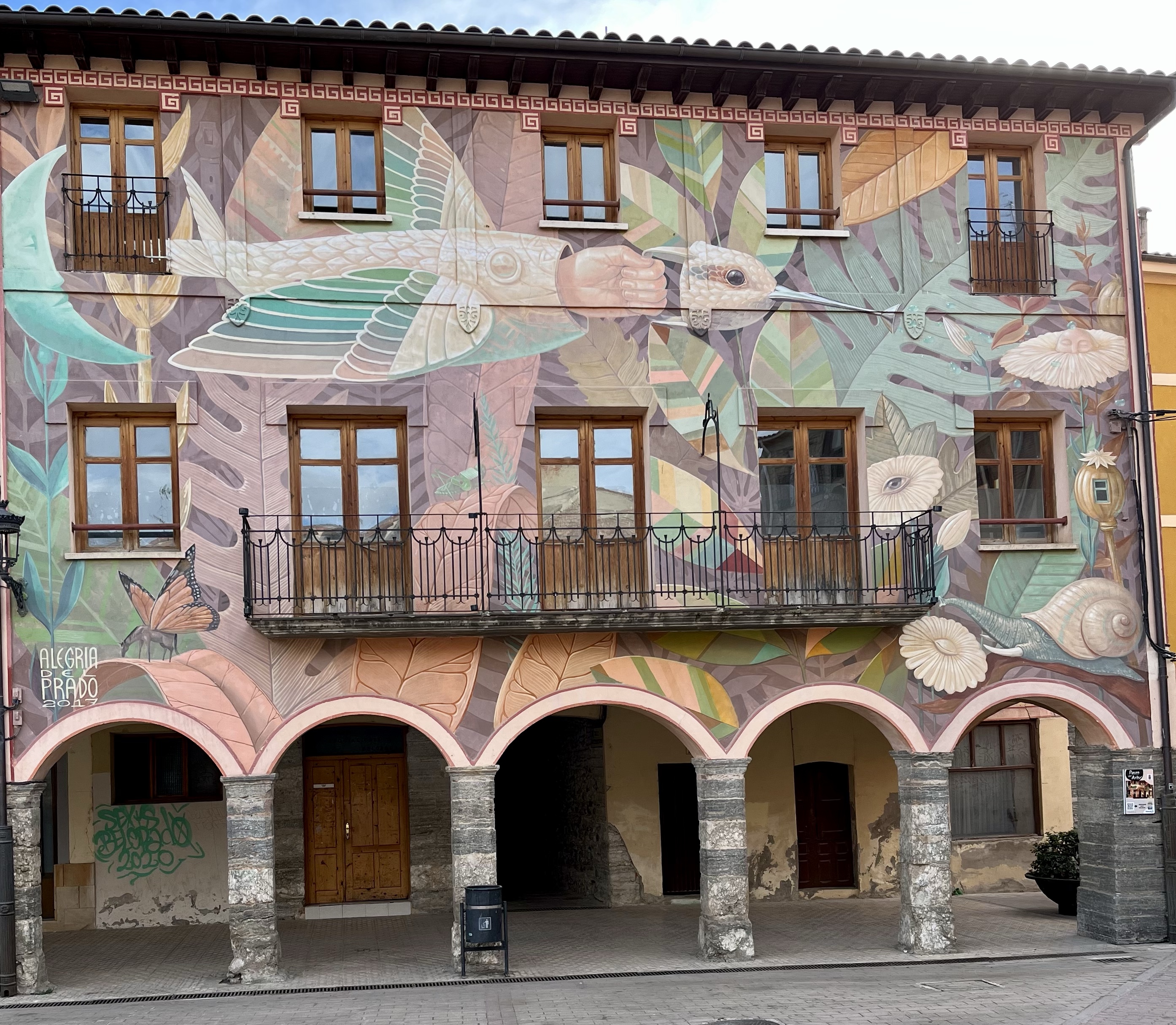
Whole buildings have become works of art
I left town right at dawn, with a group of pilgrims, and headed for my next stop.
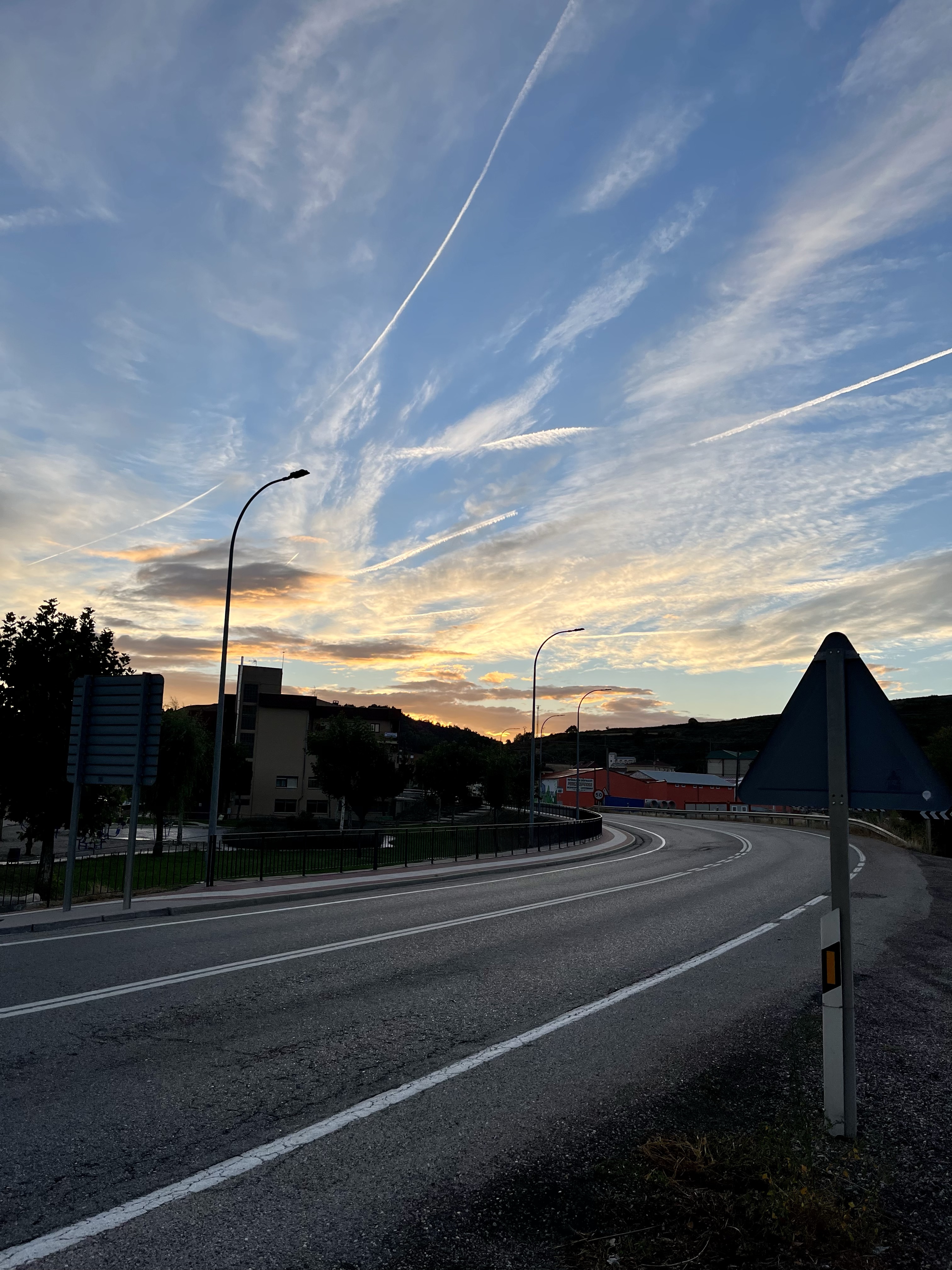
Another beautiful Spanish dawn
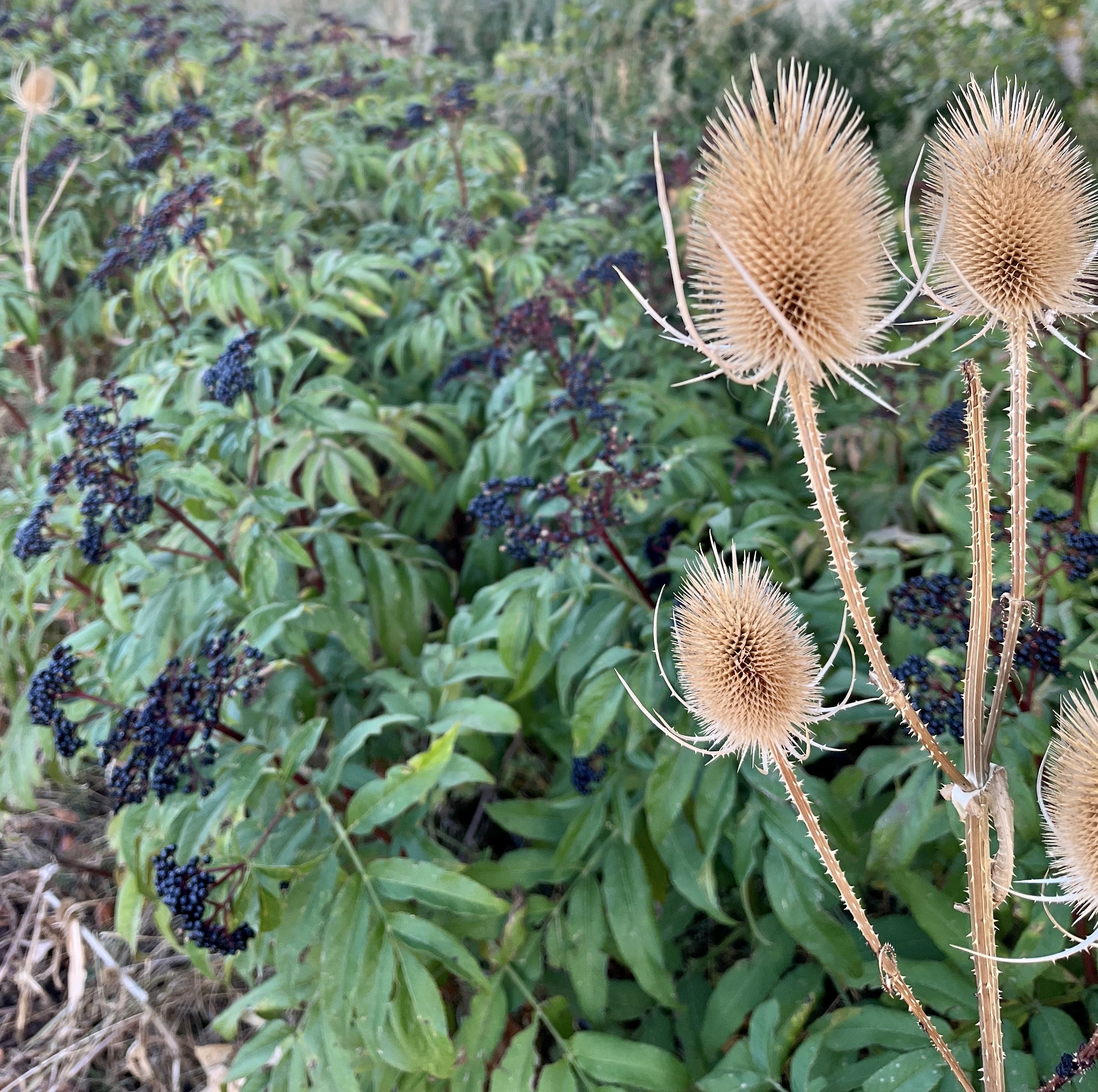
The ever-popular thistle and wild blackberries
A new crop: plums
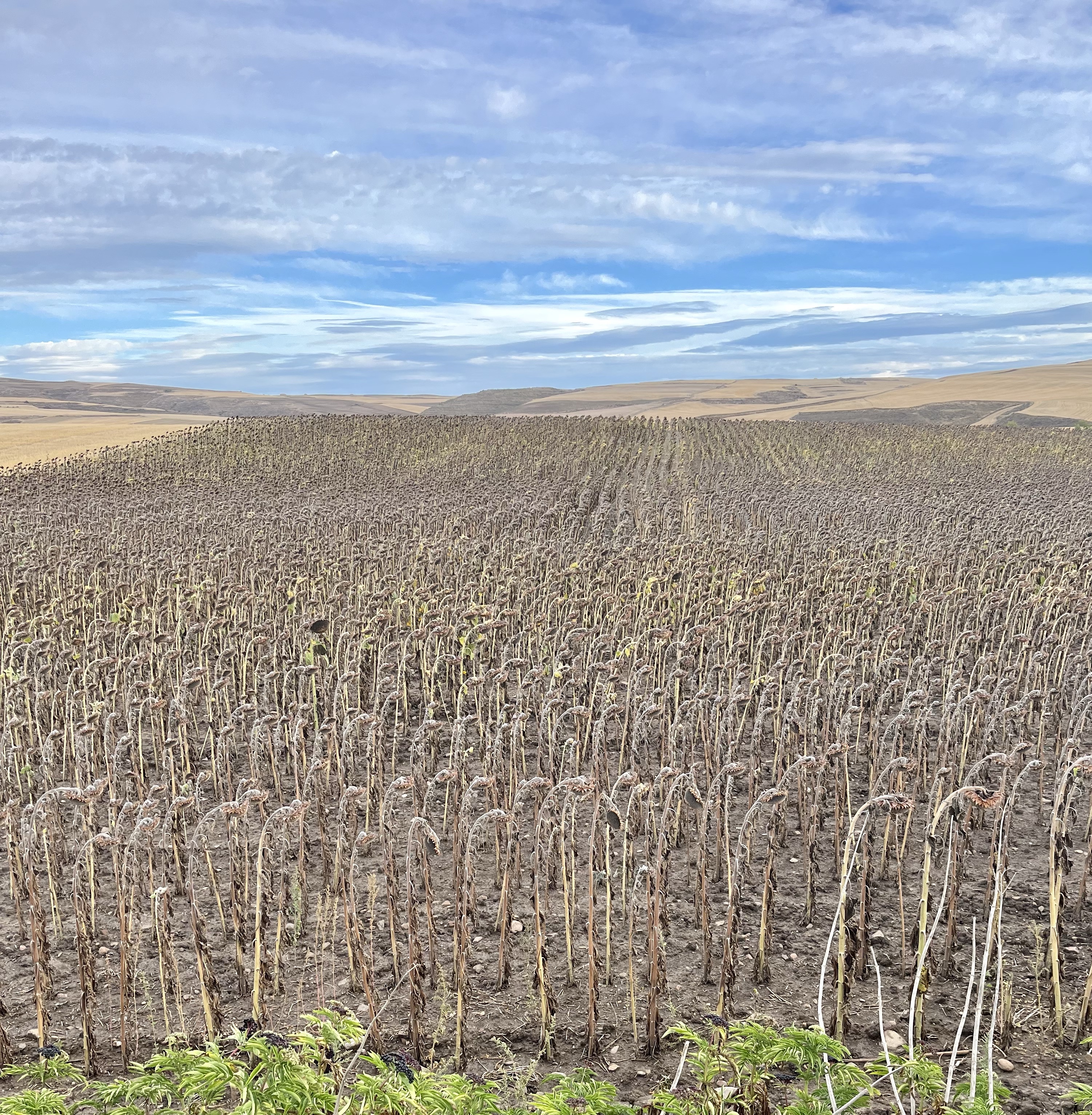
As mentioned in earlier posts, I’m passing huge numbers of sunflowers. Another pilgrim told me that the reason there are so many is the war in Ukraine. Spanish farmers usually “rest” some of their sunflower fields every tenth year, but due to the war and the subsequent crop damage in Ukraine, all Spanish fields have been planted, to meet demand.
Filling a Ukrainian shortage
The day passed with beautiful vistas and some difficult ascents and descents. On one particularly long and steep descent, I thought, “boy, I wouldn’t want to be coming up this path”. Later at my albergue, I met two women who were doing the Camino backwards and asked me about the path I’d walked today (which they would walk, in reverse, tomorrow). I sugar-coated it a little for them but, man, they were in for a hard day.
Rolling hills under beautiful skies
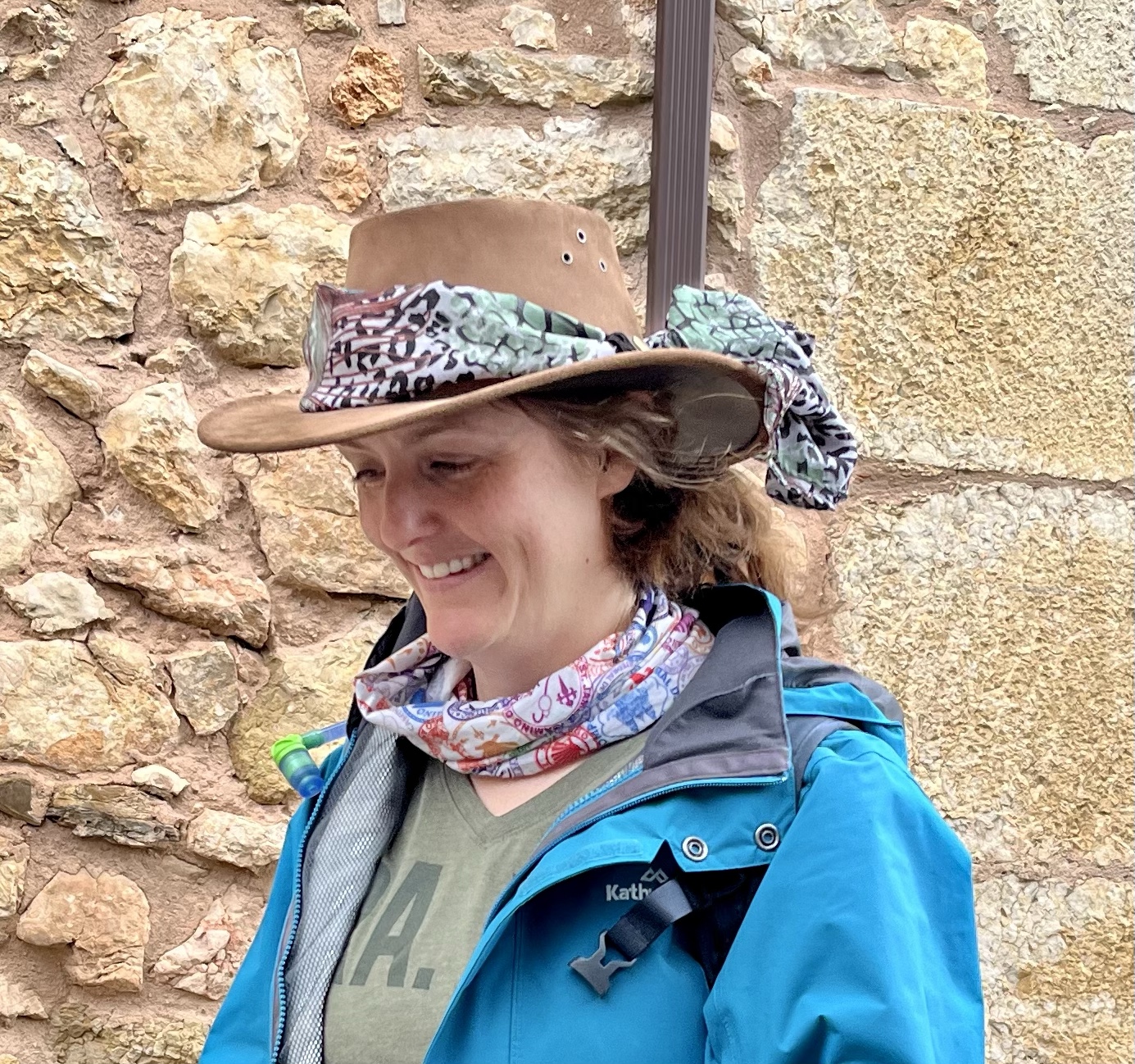
I’ve been lucky to walk and hang out with two nice women, Wendy and Grace, from Wollongong, Australia for the last week or so. Our stopping points and even lodgings have been the same; a Camino coincidence.
Grace models her leather Camino hat
Tomorrow I have a longer walk to Atapuerca, a place where ancient cave paintings indicate human activity as long ago as 1.5 million years. Sadly, the caves are not near the town and so I won’t be visiting them.
Santo Domingo de la Calzada to Belorado – 22 Kms, 31,208 steps
Just follow the yellow paver road
Leaving town this morning was easy, just follow the nice pavement markers and yellow paving stones. Rumors of a rainy start proved to be wrong; it was cool and breezy, very nice walking weather. The path surface today was finer gravel and crushed bluestone, a terrific improvement over yesterday’s bruising rocks.
An hour and half after leaving Santo Domingo, I crossed the border from the La Rioja region into Castilla and Leon, which is the largest autonomous region in Spain. A lot of the rest of my walk will be spent in the provinces of this region.
Nice Camino waymarking in this region
I remembered several of the small towns I passed through this morning from my 2019 Camino. I wondered what my friend “Claude from Canada”, who walked this area with me then, is doing these days.
The landscape is dominated by wheat and oat fields
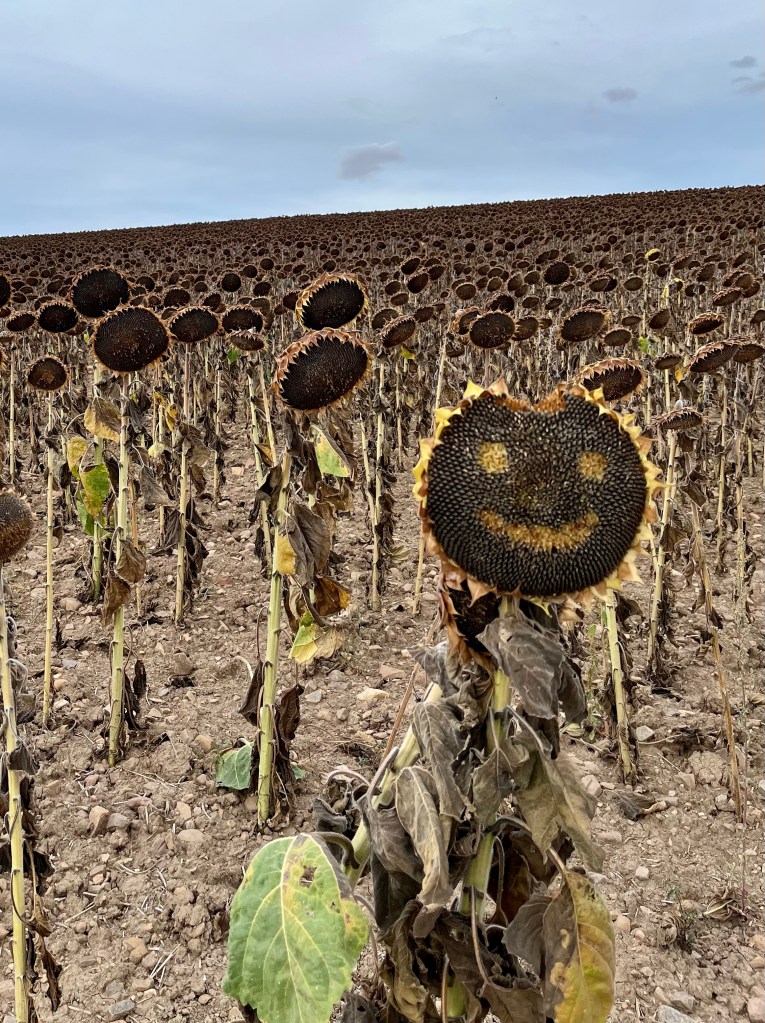
I had one of those fun “Camino Magic” moments this morning. I was walking past acres and acres of sunflowers and decided I should take a picture. Just as I got my iPhone out, I pulled abreast of the perfect happy sunflower:
It was just there, I didn’t do it
There’s a big new roadway going into the area I was walking through and, at one point, there was a monster construction equipment traffic jam, on the Camino, that I had to wend my way through.
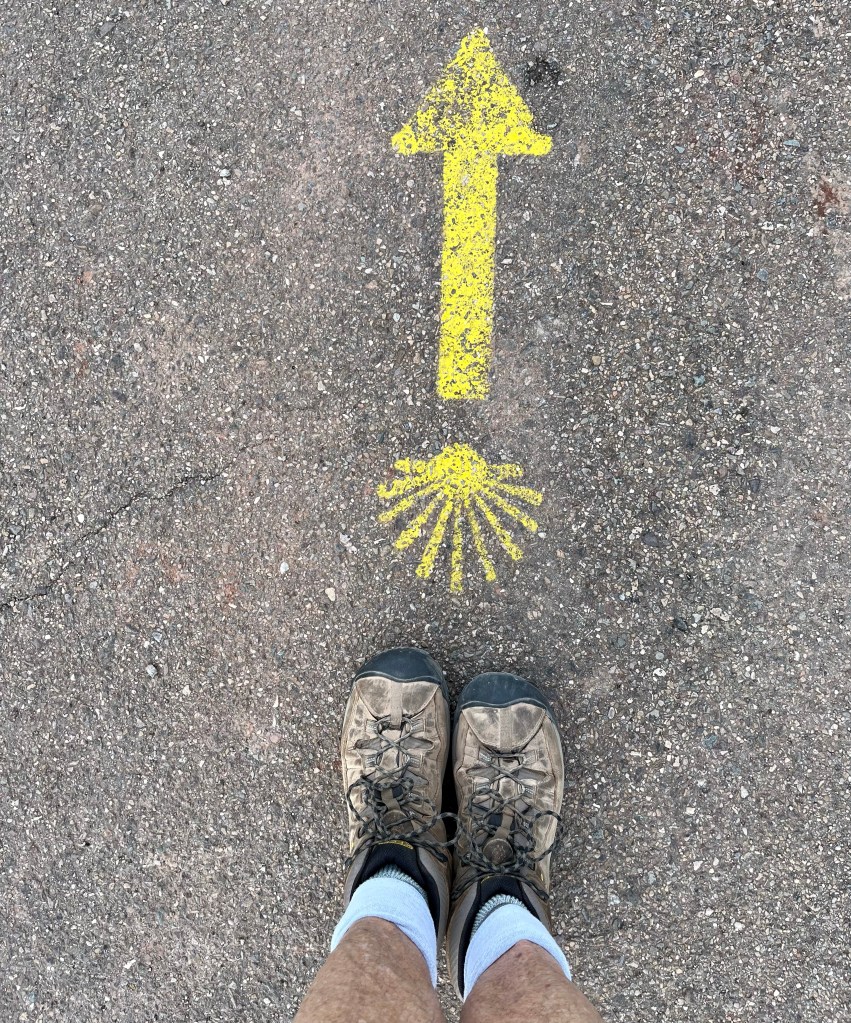
As you know by now, we pilgrims follow the “yellow arrow” waymarking closely. Official Camino signage now incorporates the arrow, as we’ve seen. However, some businesses have “hijacked” the arrow to solicit customers and I’ve seen pilgrims go astray as a result. For example:
This is a real waymarking…… and this is marketing
You’ll notice that there’s also a small official sign next to the Bar-Restaurant sign, but it’s easy to overlook.
The second half of my walk today, about 11 Kms, was into a 20-30 mph wind. Boy, that is fatiguing. God help you if your hiking hat doesn’t have a chin strap. I was really pleased to get into the Belorado suburbs at last and out of the wind.
I remember Belorado from 2019: the “siesta” effect is really bad here, to the extent that all you can get to eat up until mid-afternoon is whatever tapas (made early that morning) are left and nothing at all from 3:00 or 4:00 until 7:00. And, there are not that many bars, cafes, or grocery stores to begin with. Long and short of it, I’ve had nothing to eat since 11:00 and I’m hungry.
Tomorrow, I have a shorter walk of about 12 Kms to Villafranca Montes de Oca, where I’m staying in a nice hotel with a good restaurant and a great breakfast buffet. Yum.
Najera to Santo Domingo de la Calzada – 21 Kms, 30,707 steps
Today’s walk was thankfully without any rain. In fact, it was cloudy and cool with a nice breeze, which would have made the 21 Kms easy. However, most of the the walk was spent on very rocky farm roads that were hard on the feet.
Najera made it easy to get out of townA new crop joined the hay, grapes, and olives along the way
Do you remember the picture I posted of the “Santiago 790” roadsign in Roncesvalles on Day 2? Today I passed this helpful marker; only 581 Kms to go!
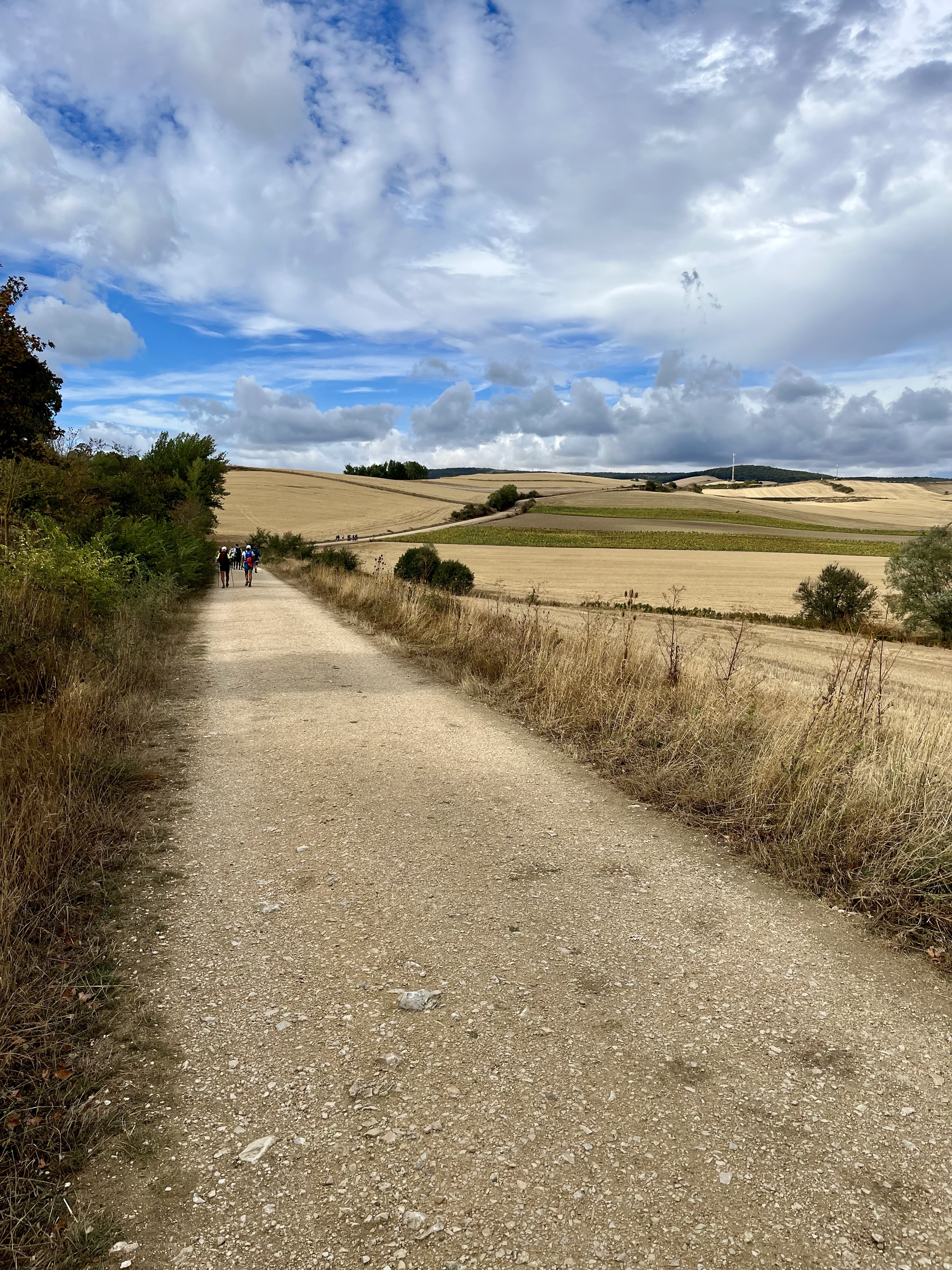
As the extended line of pilgrims stretched out across the fields today, I thought of those visible backpacks as sails on the sea, or Conestoga wagons in the American Great Plains. You can see them bobbing along, marking the path, even at great distances.
Zoom in to see the pilgrims in the distanceThe clouds occasionally produced some nice effects
Did you ever wonder about someone’s behavior and hope that’s never YOU? Several times now I’ve seen older men (50+) walking with younger women (20s), clearly not related, and the old guy is pontificating about whatever. Non-stop blab, blab, blab, and she says nada. I wonder, what is this? Why is she walking with this guy? Is it better than walking alone? Safer? It could be nothing, except the guy is sort of taking a flirtatious Daddy role – kind of icky. Today, I followed one of these pairs and when we got to town, the girl separated herself, just to get away from him, making a fake turn down a side street. After a few minutes she came back and continued along in front of me, and I thought “well done”.
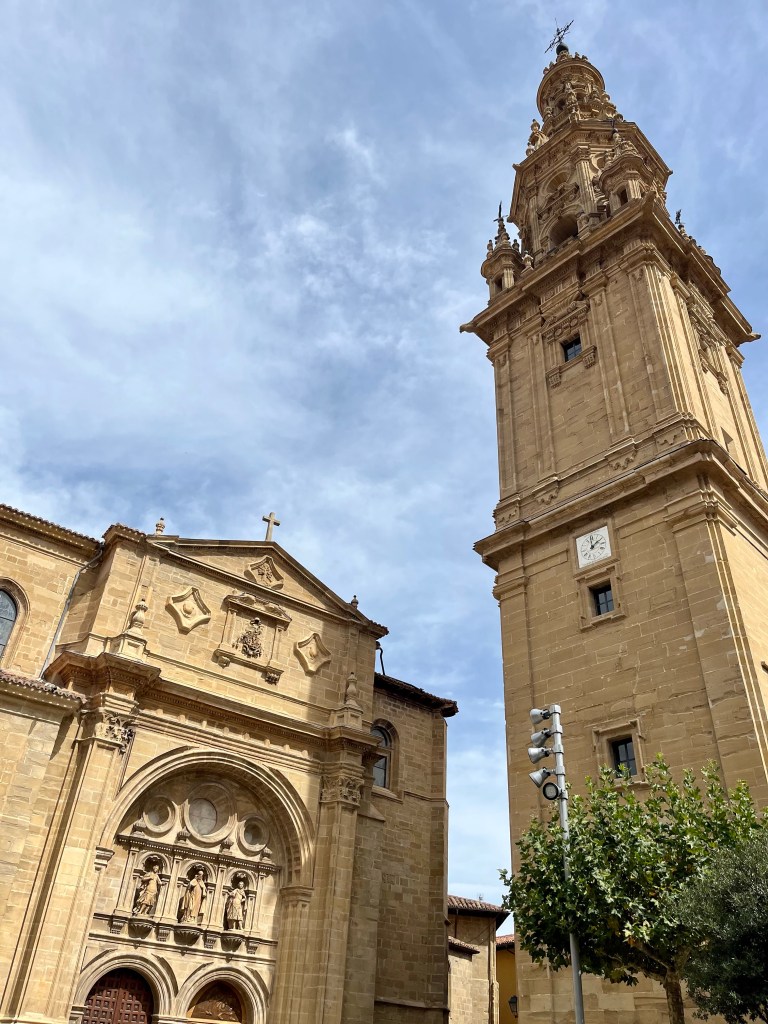
The Santo Domingo Cathedral
Santo Domingo de la Calzado means “Saint Dominic of the Roads” and isn’t a very ecclesiastic-sounding name. However, St. Dom was a local kid who was refused entry to the monastery because he was illiterate. He became very successful anyway and spent a lot of money building roads and bridges for the pilgrims, and religious buildings, back in the 11th century. Eventually, he got his religious recognition.
My lunch: Patatas a la Riojana
Outside my hostel here, there are a couple of vending machines built into the wall. Not an uncommon sight. However, one of them includes a selection of sex toys, vibrators, handcuffs, etc. Not something you often see in a vending machine along with CocaCola, potato chips, and cookies. Perhaps bridging the food-sex gap was this product, which I’ve never seen before:
Truly bizarre!
On that weird note, I think siesta is over and it might be Sangria time. Tomorrow is a 22 Km walk to Belorado, with possible rain. Cheers.
I bid Navarrete farewell this morning and headed out around 7:45 AM. It was cool, about 53-degrees F, but that was comfortable for me. It was Sunday and nothing was open. My pension didn’t even offer breakfast, so I was operating on no coffee.
There were other pilgrims already on the street, though, and together we made our way on The Way out of town.
A full moon showed me the way
Several times now, I’ve seen pilgrims go the “wrong” way, and I saw one do so this morning. He or she was way too far ahead to call to or whistle at. Did they miss seeing the yellow arrows and stele indicating a left turn? Or, did they know what they were doing and deliberately go “off” the Camino path?
Sometimes the Camino authorities send us on a longer route, just to keep us off the highway shoulder. It’s a safety issue when there are a lot of pilgrims. But, if you know this and have a good map or app, you can save yourself some steps by creating your own shortcut. Perhaps the pilgrim I saw miss the turn this morning was doing just that.
In fact, later this morning I had a chance to do the same thing but, because I wanted some coffee, I chose to take an optional path to the town of Ventosa, adding 1 Km to my walk.
Ventosa’s “1 Km of Art” sign post
Interestingly, the Ventosa folks decided to reward pilgrims who walked that extra distance with a one kilometer roadside art display. The road featured periodic large-scale pictures, paintings, and sculptures. Pretty cool! There’s also a nice website supporting it.
Ventosa roadside art
And there was a really nice cafe, open and fully-operating on Sunday at 9:30 AM, in town where I satisfied my coffee jones. Worth every extra step!
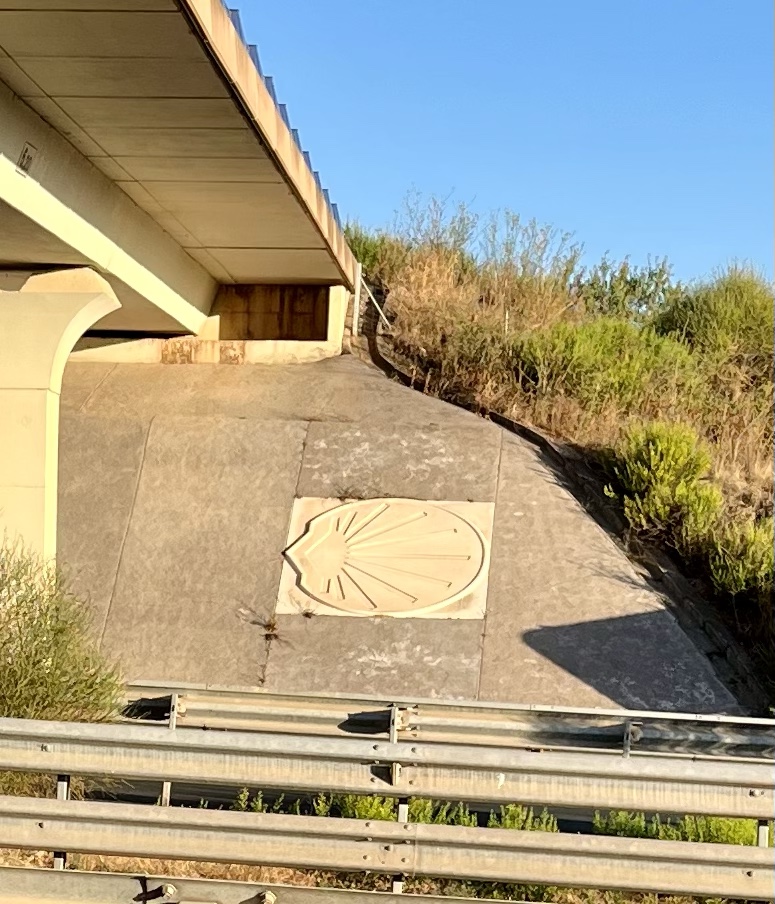
Even highway overpasses are into the Camino
The day was sunny and getting warmer as morning wore on. The lack of shade compared to previous days was offset by a nice cooling breeze.
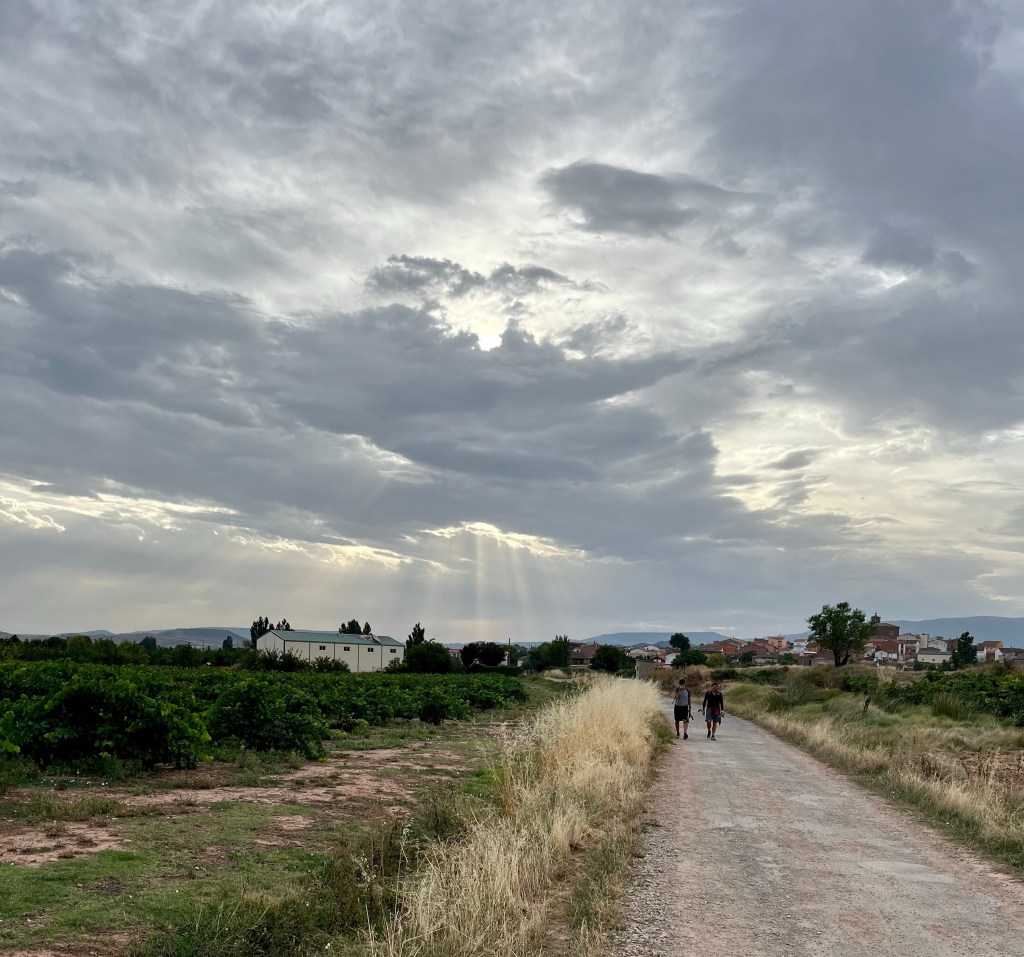
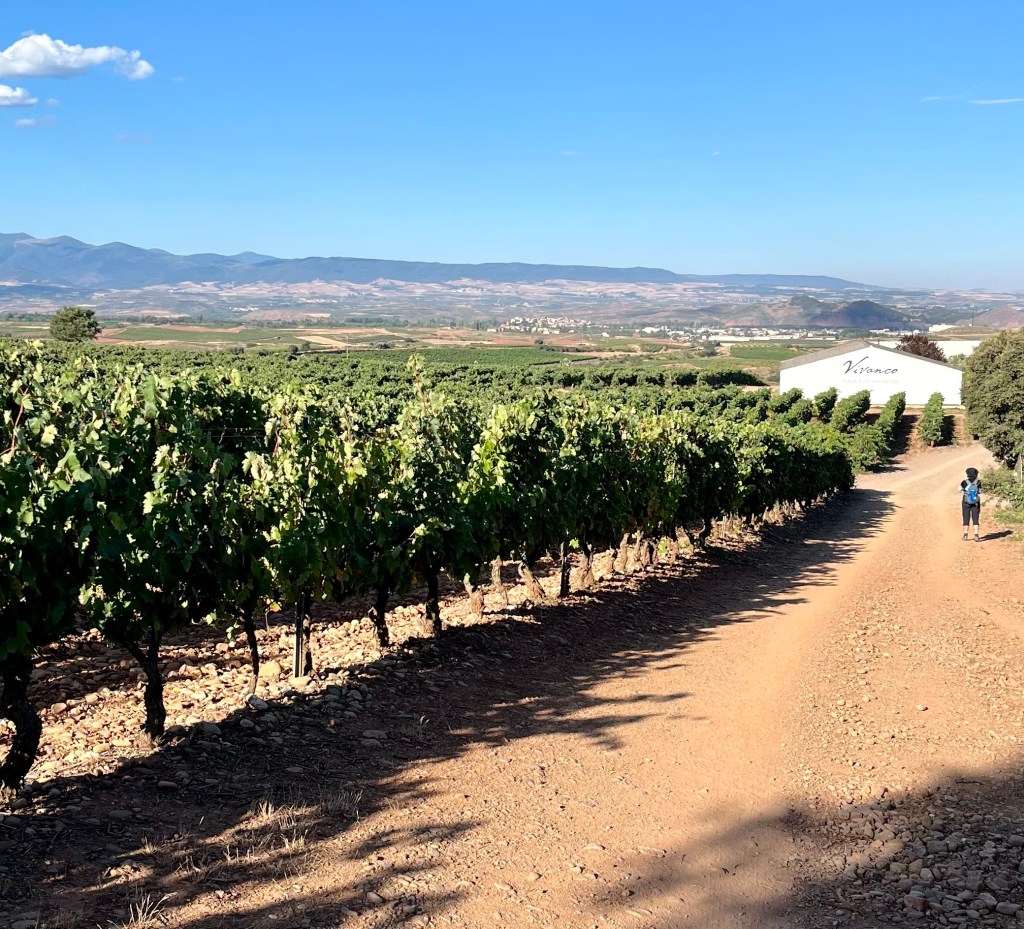
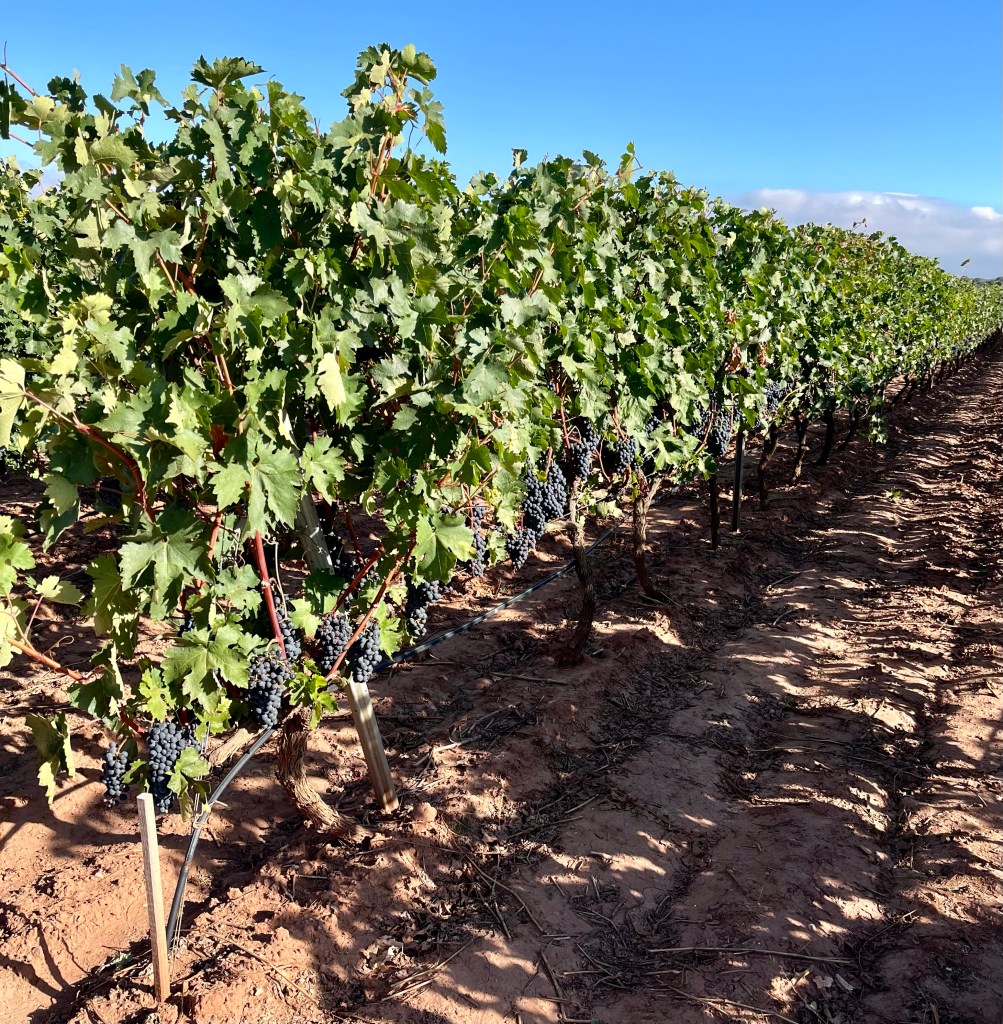
I was definitely passing through Rioja wine country, surrounded by hundreds of acres of vines.
A view across the vineyardsVines bursting with grapes…… ready for harvesting
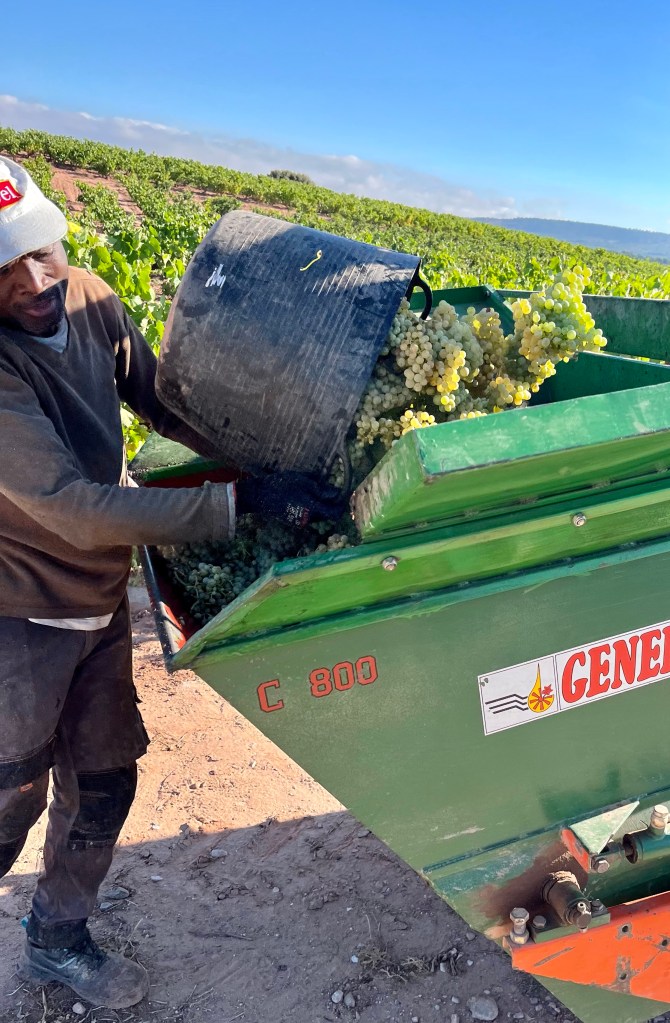
It wasn’t long before I came across pickers harvesting the grapes. It’s done by hand and looks like hot, difficult work. All the pickers looked like immigrants. Seeing this takes away a little of the romance of the finished product.
A basket of grapes goes into the truck
Nonetheless, seeing those grapes made my mouth water a bit. I knew what I was going to drink with lunch!
Outside of town, I came across a chozo, an ancient grape pickers’ shelter:
Chozo anyone?
The process of walking on the Camino can be complicated. On level, paved streets, it’s like walking anywhere. But on rocky hill paths and farm roads, it’s much more demanding. You have to be aware of where your boots are coming down, where large or loose rocks are, you may be taking shorter steps going up- or downhill, and you may be using your hiking poles. In addition, you may be passing or being passed by other pilgrims or bicyclists. And, oh yes, don’t forget to take in the view and maybe snap a few pictures!
Sadly, the Camino is already derailing the plans of some pilgrims. I’ve seen a sprouting of knee and ankle braces this week and, at lunch, overheard a discussion about taking a bus to the next big town due to foot injuries.
So far, so good for me. We may get some rain in the coming week and I’m not eager to see how that red Rioja clay sticks to boots as mud. Tomorrow starts my third week on the Camino, as I head for Santo Domingo de la Calzada, 21 Kms away.



























 The Occasionally-Examined Life