I want to share some of my self-isolation experience with you but, first, I need to let you know that my French girlfriend, Marti, came over from Paris on the Eurostar train a few days after I arrived and we are self-isolating together here in Canterbury. This is probably not what the British authorities had in mind exactly, but we’re following the isolation rules by the book and I think the intent (not exposing anyone outside our “bubble” until we’re sure we’re not infected) is being met.
So, we’re here together, which is fabulously better than me being here alone. We’re on Day 8 since Marti’s arrival, so we have six more days until we can leave the flat.
Our Airbnb flat is comfortable, brand new, and well-equipped. Our hosts purpose-built the building, with its twelve short-term rental flats, and it just opened in August. They’re very experienced hosts, have done everything right, and let us know that they have others in self-isolation here as well.
The University of Kent is nearby and I think we may have a few flats rented out to students. Unlike so many UK hotels and B & Bs crippled by the decline in tourism due to the virus, our hosts seem to have navigated the downturn successfully, so far.
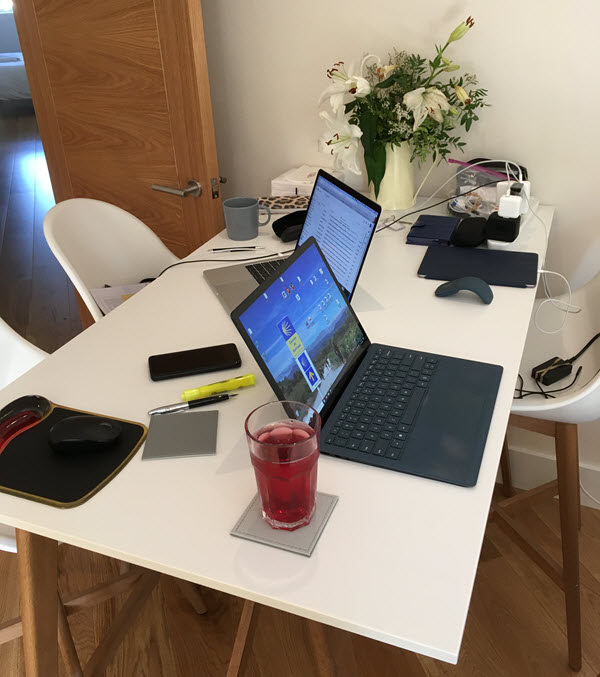
Our “Technology Center”
The flat’s Wi-Fi connectivity and speed are excellent, even with both of us working. The flat comes with a nice, large TV and plenty of entertainment offerings, and we can stream online shows without any problem. UK power plugs are large and the matching adapters for our EU and US devices are equally so but, with a UK power strip, we’ve managed to accommodate all of our devices.
Once a week, we have groceries delivered from Waitrose and, after a few adventures getting the proper English names of things correct and discovering just how much 500g of raisins is, it has worked out well. For example: “plastic wrap” is “cling film” here, and “zucchini” is “courgette”.
The Waitrose online ordering software is very good. However, the prices of things here are somewhat high and the 1.24 dollar-to-pound exchange rate doesn’t help. We were happy to find good French and Spanish wines and Irish Whiskey available. Waitrose’s delivery service is excellent.
We generally cook for ourselves but we also follow a tradition, established last Spring when we were locked down together in Paris, of ordering in for Saturday lunch. Salads and sandwiches, for example, from the local Pret A Manger restaurant are very good.
Our daily schedule includes exercising and stretching for me and online yoga classes for Marti. I’ve even managed to get in some 45-minute “walks”, going from the front of the flat to the back, return, and repeat.
We keep busy online and also enjoy reading books and newspapers, as usual. We also spend time keeping up with the latest news in the US, the UK, and Europe. Marti is a freelance communications consultant and she’s been tending to some business while here, even though she’s technically “on vacation”. As Mr. Retiree, I’m enjoying being lazy.
As shown in a photo in the first post in this thread, our flat’s balcony looks out onto a grassy yard, then across the Great Stour River, and into a nature preserve. It’s an incredibly soothing view and belies the fact that we’re just a 6-minute walk from the touristy Canterbury Cathedral area. We usually have a daily cocktail-hour tot of Jameson out on the balcony while we work on our British bird identification skills.
The flat is equipped with a washer/dryer, so we’re able to cover that duty easily enough without leaving the premises.
Just a hint of Fall colors coming in the trees
The English weather has been great, with lows in the 50s at night and highs in the 70s. So far, we’ve had no rain and only one gray day. Are we sure we’re in England? Coming from the US, the idea of no air conditioning, and windows and doors without screens seems wild, but the humidity has been low, the flying bugs seem to know their (outdoor) places, and we’re very comfortable. I’m looking forward to staying here into the Fall.
Marti will be here for another week after we’re out of isolation, so we’ll have time to explore Canterbury and see its sights. Then she’s returning to Paris, where I hope to join her in early November for an extended stay.
From my perch here in Canterbury, I’m a keen observer of the moves the United Kingdom (UK) government is making with regard to Coronavirus restrictions.
Yesterday, Prime Minister Boris Johnson held a briefing, along with two of his advisers, to break the bad news about the need to tighten restrictions. Here are the current UK stats:
Seems mild compared to numbers in the U.S. (where average deaths/day last week was 734)
The key restriction was that, beginning next Monday, people in England can only gather, indoors or out, in groups of six maximum. This is a reduction for the current allowance of groups of 30. Police will be empowered to fine or arrest those who do not mind the rule. Johnson was clear that “this is not a second national lockdown” and that “it breaks his heart to have to insist on the restrictions”.
For my geo-politically-challenged readers, the UK consists of England, Scotland, Wales, and Northern Ireland. Each has limited self-government and each controls its own COVID restrictions. Those announced by Johnson yesterday apply to England only. The details for the entire UK are available here: https://www.bbc.co.uk/news/uk-51506729
In England, pubs, restaurants, shops, places of worship, and other venues will remain open as before, but people can only attend in groups of up to six.
Face coverings are compulsory if you’re using public transport and must be worn in shops. Oddly, shop workers are exempt.
The UK has “hot spots” of infection and that has caused some recent local lockdowns, for example, on the city of Leicester, to be applied in response.
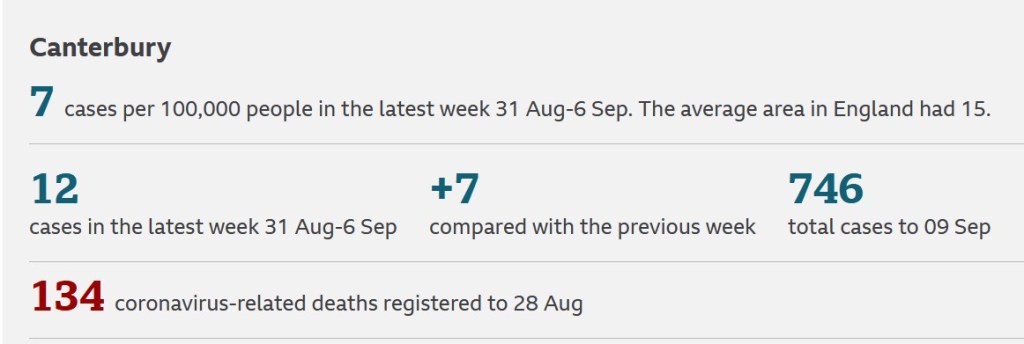
The stats here in my corner of England are comparatively very good:
During Johnson’s briefing, charts were shown indicating that young people (teens, 20s, 30s) were responsible for the majority of new COVID cases.
As in many other countries, the lure of the beach, and vacation-related, large-scale outdoor gatherings were too much to resist for many, resulting in virus spread. With colder weather ahead of us, it’s hoped the numbers will go down.
I’m writing with apologies to Geoffrey Chaucer, who wrote the original, famous Canterbury Tales, whose title I’ve appropriated for this category of my posts.
For a variety of reasons, I decided to leave hot, humid Northern Virginia, U.S.A. last week and travel to Canterbury, U.K. Some of these were personal, some practical, and some plain paranoid. The U.S., currently riven with toxic politics, violence, and horrendous COVID-19 numbers, was just not a healthy place for me. I took a risk in traveling but I believe it was worth it.
There is some confusion about whether or not Americans can travel anywhere and, though restrictions are constantly changing, I’m sharing this account of my trip to the U.K. as an example of travel in the age of coronavirus.
This is the view of my Airbnb balcony, the river’s edge, and the nature reserve beyond it. Combine that with very pleasant cool, dry English weather and it’s absolutely idyllic. And, if you have to quarantine for a few weeks, there’s a lot to watch (birds, ducks, fish, etc.) out there. Ahhh!
My trip started with an uneventful Uber ride to National Airport outside Washington, D.C. The airport was fairly empty and everyone was wearing a mask, of course. I checked my bags in and was surprised that, instead of tossing them onto the belt behind her, the agent handed them back to me and asked me to take them down the hall and hand them over to TSA for scanning!? Well, that was new.
No problems going through personal TSA screening – with TSA Pre-Check, I didn’t have to take off my shoes or belt, and my phone and even liquids just stayed in my carry-on bag. I didn’t even use a bin – I just put my bag right into the scanner.
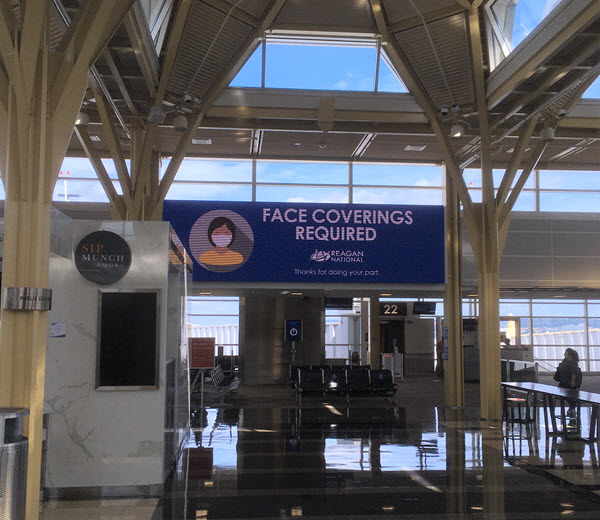
Reminder at National Airport
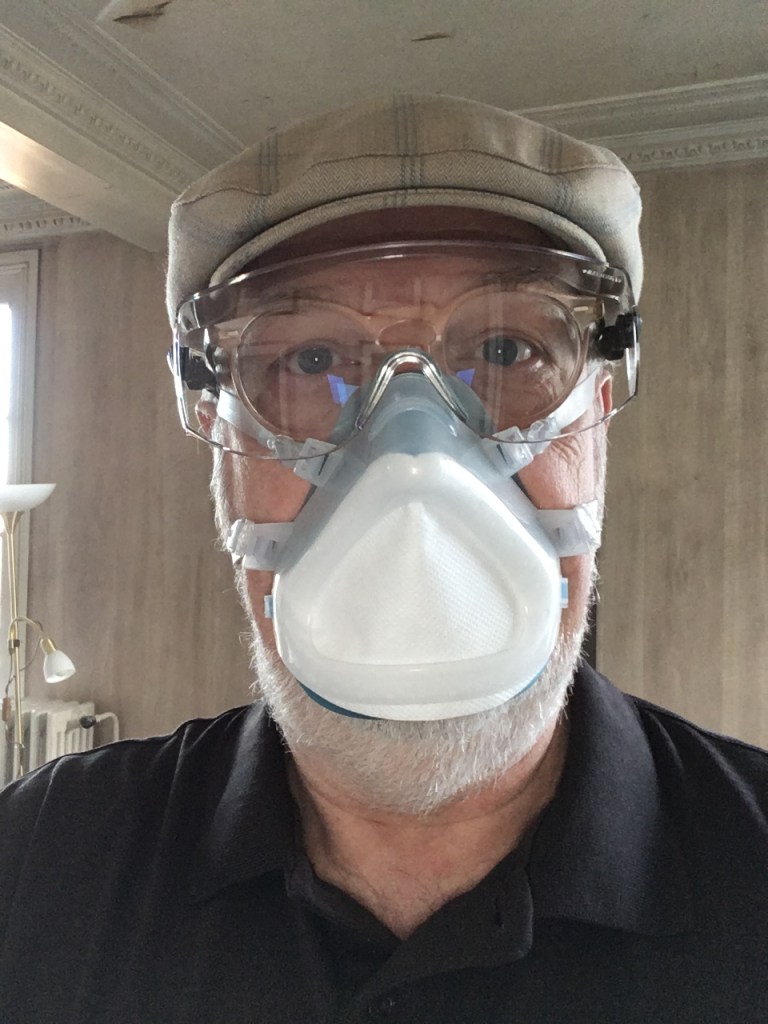
At the gate, seats were marked with stickers to create distancing and there were plenty of signs reminding everyone to be smart. However, I noticed a lot of people wearing masks incorrectly (under the nose, under the chin), even airline pilots. Hoping to keep the cooties at bay, I was wearing an N-95 mask, which I changed every four hours, and safety glasses. I also had a plan of glove-swapping, hand-sanitizing, and sanitizing-wiping going.
My Delta flights were half-full and generally pleasant. Delta is blocking Main Cabin middle seats and reducing Delta One (where I sat) seating to 60%. It was smooth flying into Atlanta, then a 2-1/2 hour layover until my flight to Heathrow.
All U.K.-bound passengers had to present a completed a “U.K. Passenger Locator Form” (PLF), which specifies health status and U.K. self-quarantine location, along with a boarding pass before being allowed onto the plane in Atlanta.
On the international flight, I requested a seating change after the nearest passenger to me kept coughing during boarding. Delta One amenities and food service on my 9:50 PM flight were only scaled back a little bit and I elected to go straight to sleep. A healthy tailwind produced a mere 7 1/2-hour flight, which is usually what I expect on a flight from Dulles Airport outside Washington, D.C. to London.
On arrival into an empty Heathrow Airport, I was more concerned about being turned away at the UK border because “tourism” is not an essential reason for coming in. I needn’t have worried: non-essential visits are now allowed (as my online research had indicated); the Immigration agent scanned my passport and my PLF and waved me right on through without another word.
I was, in fact, the first person off the plane and so (thank you, Mr. Murphy) I was the last to get my baggage. Or not get it. My small bag appeared on the baggage belt but my big bag did not! Oh-oh. Delta is very good about tracking bags and I was getting regular texts telling me where my bags were at every step, so I knew they had both been loaded onto my London-bound flight in Atlanta. But where was the big bag now? Sheesh.
It took an hour to file my missing baggage report, and then I met up with the car and driver I’d hired to drive me to Canterbury. I’m usually more of a public transport guy but I used a car service this time because, otherwise, I’d have had to take two trains and a taxi, and so a single car ride seemed safer, virus-exposure-wise. Masks on, windows down, blessed cool, dry weather.
During the drive, I was mentally inventorying all the important, irreplaceable stuff in my (possibly) lost bag, including every scrap of clothing I own other than what I was wearing.
My Canterbury Airbnb building
My Airbnb flat in Canterbury is very nice, brand new, and well-appointed. After a good night’s sleep, I felt great. My groceries order was delivered the next morning and, hallelujah, my big bag was found and delivered to me in the afternoon. All is right with the world.
The current U.K. policy is that all passengers entering via train, plane, and ferry must self-isolate for 14 days. This is not “quarantining” – you’re not supposed to leave your premises for any reason; not for shopping, not for exercise. Random checks are conducted and the fine is a substantial £1000 ($1330) for a first offense. Some of my English friends scoff at the chances of actually being caught out, but I think I’ll follow the rules to the letter.
Only 12 more days to go.
Disconnecting from the U.S. news and social media flow, even temporarily, has already produced a dramatic reduction in stress for me. I’m very glad to be out of the U.S. and feel much safer here.
The original shock of the wrenching changes to our lives caused by the pandemic has worn off a bit and it appears we’re settling into The New Reality. We humans like routine and predictability and many of us seem to have quickly adapted to the new behaviors now required of us.
For example, I used to hate having stuff in my pants pockets, but now before I leave the house I load up. I carry a small money/card clip, a 3 oz. bottle of hand sanitizer, a small folded piece of paper (useful for grasping store door and cooler handles), my cell phone, my keys, plastic gloves, a comb, coins (if I think a rare cash purchase may occur), and an unsharpened pencil (useful for safely poking self-checkout machine screens).
I put on a face mask, of course, a hat and sunglasses, and I often take a small bottle of water with me, for use in the car, and my own sturdy reusable shopping bag. I also put on my watch and my civilian dog tags (ID and emergency contact info). Whew – it’s amazing that I get out the door!
This is just the standard inventory I load up with each time I go somewhere public, and I’ve become quite used to it. Similarly, coming home, has its own hand-and-reusable-mask-washing drill, and unloading routine. It’s a time-consuming pain in the butt, but I’m used to it now. You probably have a similar procedure and inventory.
Perhaps this is overkill?
In combination with that, there are the new complications in the shopping process itself. Masking up, disinfecting your shopping cart handle (if you use one), using the store’s hand sanitizer (if offered), maintaining survival distancing from other shoppers, minding the One-Way stickers on the aisle floors, avoiding unnecessary touching of anything, doing the as-little-contact-as-possible check-out dance, getting out of there, and using the hand sanitizer again. Sound familiar?
The cumulative effect of this for me is that I’ve become more efficient: I combine shopping stops and often decide I can’t be bothered to make small, incidental, or impulse shopping stops. It’s now too much trouble to “pop into” some place I’m passing on the odd chance that they’ll have something I think I need. This turns out to be good for the bank account.
Plastic is King now with credit and debit cards and digital pay being used predominantly for payments. I can’t remember the last time I went to an ATM. Who wants to touch money that’s been touched by other folks? This bias has even impacted the coin supply: banks are restricting the amount of coinage retailers can get because the amount of it in circulation has dropped severely, causing a shortage.
A very rare sighting!
Speaking of shortages, they are, of course, still with us. Thankfully, toilet paper is in good supply, as are gloves, masks, and hand sanitizer. But now I can always spot where the Lysol and Clorox sanitizing wipes are supposed to be: they’re the perpetually-empty shelves with the “Please just buy one” signs attached.
Note that the CDC recommends wipes with 70%+ alcohol content and that many products touted as disinfectants have not actually been tested and shown to kill the current coronavirus. For your reference, the CDC provides this list of EPA-approved cleaners and disinfectants that will. Note that the many products that use Benzalkonium Chloride as their active ingredient will kill bacteria but not this virus.
And so it goes, in 2020, the Year of the Pandemic. We adapt, we negotiate with the fates, and we survive, if we’re smart. Stay smart, people.
If you’re going to be outside the U.S. in early November and haven’t already made arrangements to vote, I’d like to recommend VoteFromAbroad.org.
This non-profit, non-partisan group has a great web site, from which you can request a special Federal Post Card absentee ballot.
Their easy-to-use site helps you fill-in an FPCA request form and email it to your local voter registrar – it’s very easy and clear.
Once accepted by your registrar, your ballot will be emailed to you in late September. Depending on your state, you may be able to request the ballot be delivered by fax or by online download. You print it, mark the ballot and sign it, and then mail it back to the U.S. Couldn’t be easier.
Note that once you’ve voted using an absentee ballot, you may have to take special measures to be able to vote again in person if/when you return to the U.S. For example, you may have to visit your voter registrar’s office in person and request that your status be changed back to that of a local voter. If you have to do this, be sure to get some documentation attesting to the change from the registrar’s office – you can show it at your local polling place when you vote next, just in case the “system” doesn’t get the message.
Can overseas voters make a difference? You bet they can! According to the Department of Defense, there are over 3 million voting-age Americans overseas.
Yesterday, the European Union announced it was ready to receive international travelers from 15 countries. The United States, which in the past has provided more than a billion euros in annual E.U. tourism revenue, was not on the list.
Not accepted in many countries for now
Due to the high COVID-19 infection rate in the U.S. and our general national pandemic leadership vacuum, we’ve become a pariah country. Yes, amazingly, U.S. citizens are no longer welcome in other countries. In this regard, we’ve been lumped in with India, Brazil, and Russia. This is sad news and disappointing for those of us whose lifestyles involves frequent travel.
What was not clear in the E.U. announcement were the details, wherein the “devil always lies”. Specifically, are U.S. passport holders in general restricted from entry into the E.U. or is it just travelers coming from the U.S.?
This is relevant, for example, for U.S. citizens who may actually be living in foreign countries and who have not been to the U.S. in several years. Surely, they’re not going to be banned from the E.U.?
Reciprocity is another factor in decisions about border restrictions. It’s often an issue with big E.U. countries such as France and Germany, and the fact is that the U.S. still bans entry for non-U.S. citizens from E.U. countries.
And, there’s another complication: some E.U. countries are making independent decisions; Greece and Portugal are said to be opening their borders to U.S travelers anyway but the process is not entirely clear yet.
Finally, we have the testing and quarantine requirements that some countries are talking about putting in place for all international (i.e non-E.U.) arrivals. I would not find a two-week quarantine (out of a planned six-week stay) too odious but that’s clearly a deal-killer for typical tourists planning a one- or two-week vacation.
Uncertainty about the safety and availability of air travel will deter many travelers for now. And, in a blow to the short-term rental market, some cities have used the global travel pause of the last few months to consider how to combat “over tourism”. Amsterdam, for example, just announced restrictions on Airbnb rentals within three downtown districts, limiting them to a total of 30 days of rentals per year.
What’s to be done? The U.E. and U.K. and many individual countries have pledged to review their policies every two weeks and to make adjustments as warranted. That’s good news but isn’t helpful for those of us in the U.S. right now. It may be that we have to leave here and travel to some “intermediate country” that will have us for a month, in order to establish our health and our isolation from the terrible infections in the U.S., before we can return to Europe.
I returned to the U.S. from Paris in late May and completed my required 14-day quarantine, without travail. I’m now installed in an Airbnb apartment in Arlington, Virginia and looking ahead to spending an unexpected summer here. In a few weeks, I’ll move begin house-sitting nearby for a friend and that will last until September or October. It’s not what I imagined I’d be doing now a year ago, but we all have to make the best of the Current Situation.
This week I visited my old friend Dave Forbes at his Disturbingly Delicious Foods store in nearby Falls Church. Dave is an IT consultant who decided to get into the condiments business, hence his unofficial local title as “The Sauce King”.
Face it! Here in the U.S. we’re hooked on condiments (we’re talking about ketchup, mayo, barbecue sauce, etc.) and most of those sold in the U.S. are loaded with salt, sugar or corn syrup, and fat, i.e. they’re not very good for you.
Dave set out to create “delicious, healthy, artisanal, plant-based sauces, spreads, and dips” as an alternative. Visit his fun web site to see his philosophy and information about the foods he creates. I made a small contribution by suggesting the name MAYONOT for his alternative to mayonnaise.
Imagine, if you will, a condiment that tastes a lot like ketchup but is made from kale, rather than tomatoes. That would be Dave’s KALECHUP sauce.
When I dropped in on him, Dave was busy bottling a batch of his tasty new HUNKY DORY sauce. This is a tangy red sauce that goes well with a broad range of foods and has no added sugar or fats and very little salt in it.
I particularly like this quote from his web site:
“Thus we offer to you, dear consumer of ketchups, BBQ, steak, and hot sauces, relishes, mustards, mayonnaises, aiolis, and quesos, an entire family of super delicious, post-modern, New American condiments, sauces, toppings, and dips that manifest the spirit of the original (some more so than others — whilst we consider ourselves non-traditional traditionalists we also dabble in being traditional non-traditionalists) while embracing being as good for you as possible.“
Dave does have a good sense of humor. It’s been fun to watch him, over the last few years, become quite a food scientist and he’s been certified by the county, the state, and the FDA. He also holds several patents for his recipes.
So, just how healthy are Dave’s sauces? Check out the Nutrition Label for MAYONOT:
That last time I saw that many zeroes was on a bottle of spring water. Now go look at the label on that mayonnaise you have in your refrigerator. Quite a difference, no?
Dave’s business is a deliberately a small operation and he’s very hands-on in the production process. It was entertaining watching him deftly bottle his new product.
Yep, they’re filled by hand, one-at-a-time
The store is jammed with interesting products and he has some co-marketing arrangements with other local artisanal food producers, such as Stachowski’s Meats and Sausages.
The store is filled with an incredible array of sauces, spreads, and dips, and it’s a lot of fun to peruse the stock. These products check all the good food boxes: extremely healthy, tasty and versatile, locally-made, and fairly-priced.
If you’re in the area, you can visit Dave at 455 S. Maple Avenue in Falls Church, behind the pocket Target store. Tell him I sent you!
P.S. Yes, I’m enthusiastic about this and I was given a free bottle of HUNKY DORY, but I got it because I helped Dave unbox/box the empty/filled bottles.
The current state of international flying became personal for me last week, as I flew back to the U.S. from Paris. My 90-day Schengen visa was about to expire and an extension was not an option. After 10-weeks sheltering with a dear friend in Paris, after watching the scary and dangerous U.S. airport Arrivals Hall chaos in March and April, after nearby non-Schengen countries failed to re-open their borders, after dealing with airline refund and rescheduling shenanigans, and with a heavy heart, I was finally headed “home”.
My lockdown location in the 15th Arrondissment in Paris is in a wonderful little neighborhood, with plenty of food and wine stores and interesting places to go on short walks. Paris, one of the European epicenters for the Coronavirus, implemented a very strict lockdown policy and has come through the current phase of the pandemic in relatively good shape. Leaving it for the “Wild West” scene in the U.S. was risky and may yet have repercussions for me, but I couldn’t legally stay in France.
With many countries and airlines debating how and when to emerge from their own restrictions and cut-backs, here’s what I experienced flying back to the U.S.:
I prepared for my flight by wearing a mask called the Nano Mask, developed in 2005 for the SARS/Bird Flu outbreak. It’s no longer made but my Parisian hostess gave me her unused spare. The mask uses electrically-charged nano materials to filter and destroy bacteria and virus particles and is 99% effective for 48 hours (in comparison, the N-95 mask used in many hospitals is only 95% effective). It protects against inhaling airborne virus particles, whereas regular surgical or cloth masks only trap particles exhaled by the mask wearer.
I was not excited at the prospect of wearing a mask for 18+ hours, but I felt safe with the Nano Mask. I also wore eye protection: over-sized plastic safety glasses that fit over my regular glasses, and I came armed with disposable gloves, and sanitizing wipes and gel. Too much? Maybe, but I was taking no chances and, at 68 years old, make no apology for my precautions.
My comfortable Mercedes C-Class Uber ride to the airport had a flimsy, poorly-attached plastic shield along the back of the front seats, the windows were up, and the driver wore no mask or other protective gear (all contrary to Uber’s published coronavirus policies). The driver left it to me to load and unload my bags in the trunk.
Paris Orly airport is temporarily closed and all flights have been consolidated into Charles de Gaulle airport, Terminal 2, and the eerie emptiness started at the drop-off point. There were just a few cars discharging passengers, no curb-side staff, many terminal doors were blocked off, and trash blew along the sidewalk. I would not have been surprised to see a tumbleweed go by.
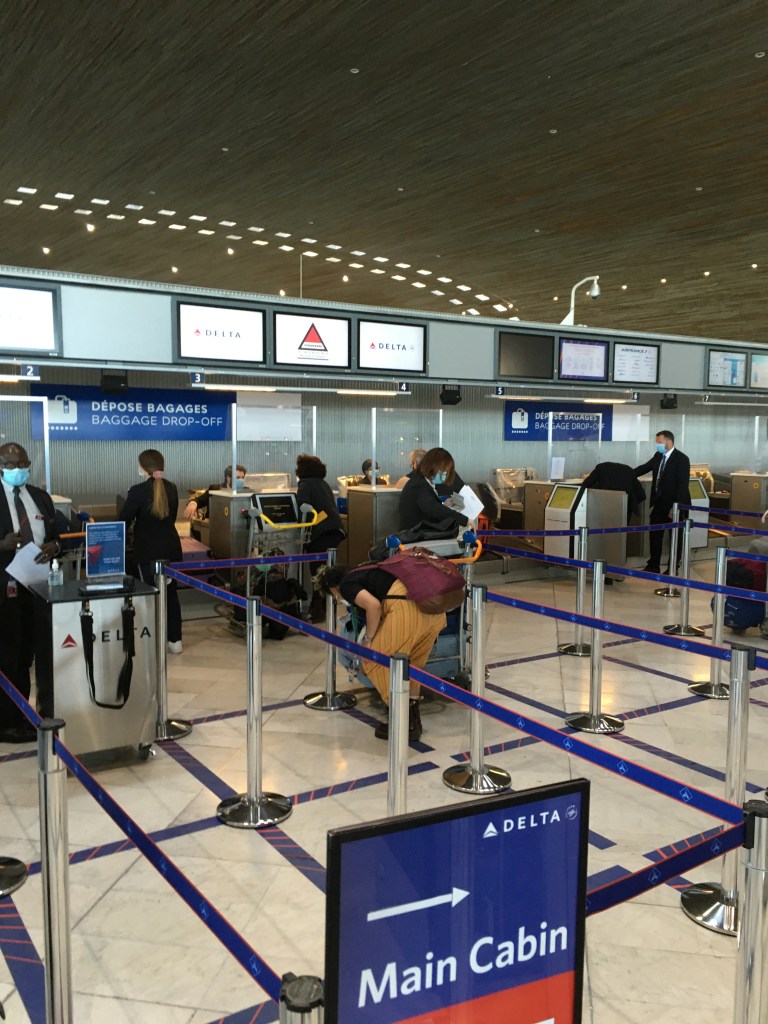
Air France desks
Inside, the staff and security officers outnumbered the passengers. My Delta flight check-in was handled from the Terminal 2E desks of Air France. This was the scene at the counter, which opened just two hours before boarding. There were only 10 people in line with me and no one at all after me, at least while I was there.
Crowd control without the crowd
The border and security areas included big halls of empty snaking stanchions and belts, and I went straight through them to be processed. Carry-on screening was slightly modified: belts and shoes stayed on and cell phones went into carry-on bags for scanning.
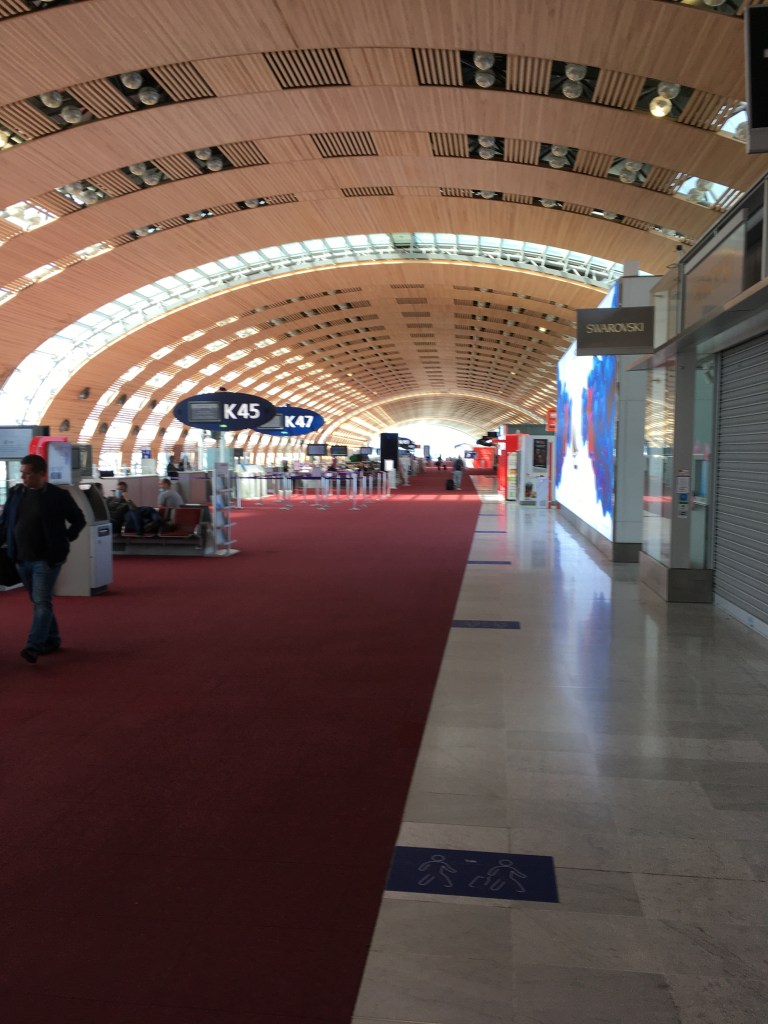
Once past security and into the “airside” of the airport there were no duty-free stores, souvenir shops, or restaurants open. Off to my right, a cordon of police officers, EMTs, and officials showed up and herded a group of 30 people through the security area, while ordering the the rest of us to remain where we were. They may have been deportees or possibly a national group being repatriated. They were not restrained in any way, except for the law enforcement cordon.
CDG Terminal 2E “K” Gates
No airline lounges were open but I didn’t have that long to wait for our 12:50 boarding. My navigation through the airport was direct and without any mystery. I counted 40 people waiting with me at gate K51. Our Airbus A330-300 seats 290 and I was told later the final passenger count was 62.
Airbus A330-300
When boarding started, we used a new “contactless” process where we scanned our own boarding passes. Everyone had a mask on and maintained good distancing down the jet way, right into the plane. Delta One seats have shoulder-high walls between them and the seats adjacent to me were occupied. So not a lot of social distancing and I was very happy to have my Nano Mask and safety glasses. Delta’s new Covid-19 Cleaning process notwithstanding, as is my usual practice, I wiped down everything I might touch with sanitizing wipes, turned on the air nozzle above, buckled up, and settled in.
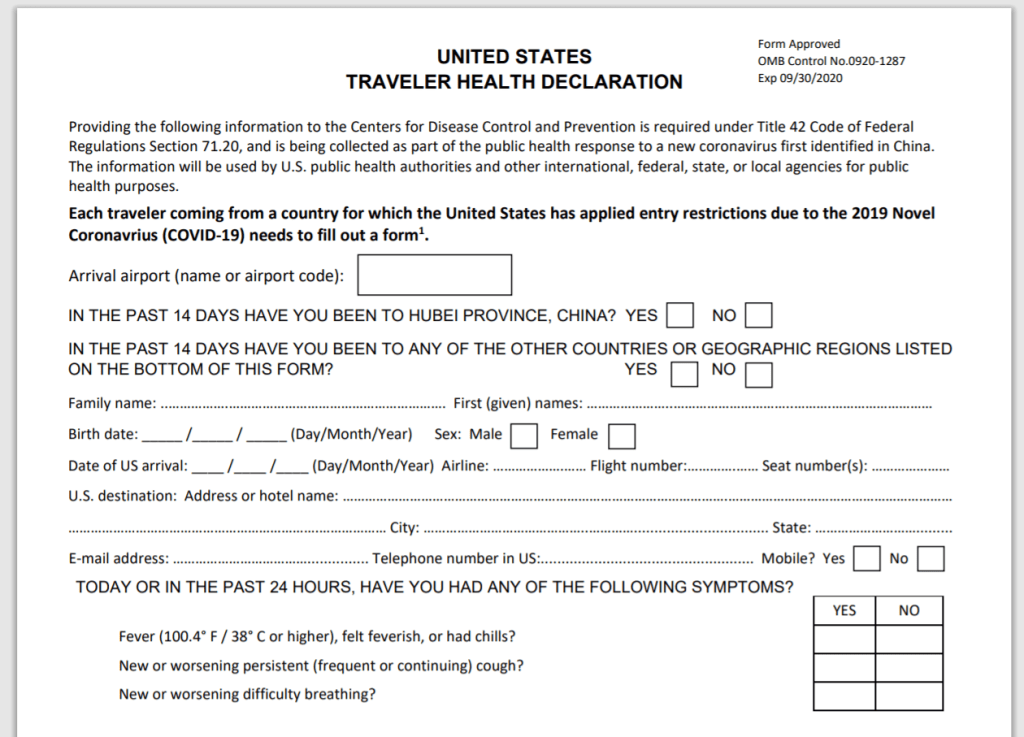
As we boarded we were given a Health Declaration Form, to be filled out before we landed. It inquired about where we’d been overseas, if we had any symptoms, and where we would be staying in the U.S.
Before we took off, the cabin crew made an announcement concerning seating changes. I guess there were so many empty seats, a few folks had already relocated themselves. However, when you have so few passengers, their onboard weight distribution is significant and so we were advised to talk to the cabin crew before changing seats.
Speaking of which, apparently when a big plane has few passengers and therefore weighs less, a really steep take-off angle is required. We certainly climbed out of CDG at quite an angle, which was kind of exciting.
The Delta cabin crew was welcoming and the flight itself was uneventful. The nine cabin attendants were from Minneapolis and all wore masks and gloves. The other passengers wore simple surgical or cloth masks and no one else wore eye protection. No, no one was in one of those white Tyvek hazard suits we’ve seen online.
Entrée choices included Chicken Breast, Sirloin Steak, and Mushroom Tortellini
Main Cabin (Economy) passengers got very little served to them beyond a snack bag and water and had been advised to BYO food; in Delta One class we were served a full hot meal from a slightly reduced menu, along with wine, beer, and booze. China plates and metal utensils were provided with my meal, but my red wine was served in a plastic baseball-park cup. We also received a light snack plate and beverages near the end of the flight.
When we landed in Atlanta, we were kept in our seats even after we were parked and the engines were shut down. We remained seated as a masked CDC team boarded and interviewed us, reviewing our Health Declaration Forms and taking our temperatures. No one was coughing or gasping for air, so we weren’t treated to the sight of anyone being escorted away and we were allowed to deplane in due course.
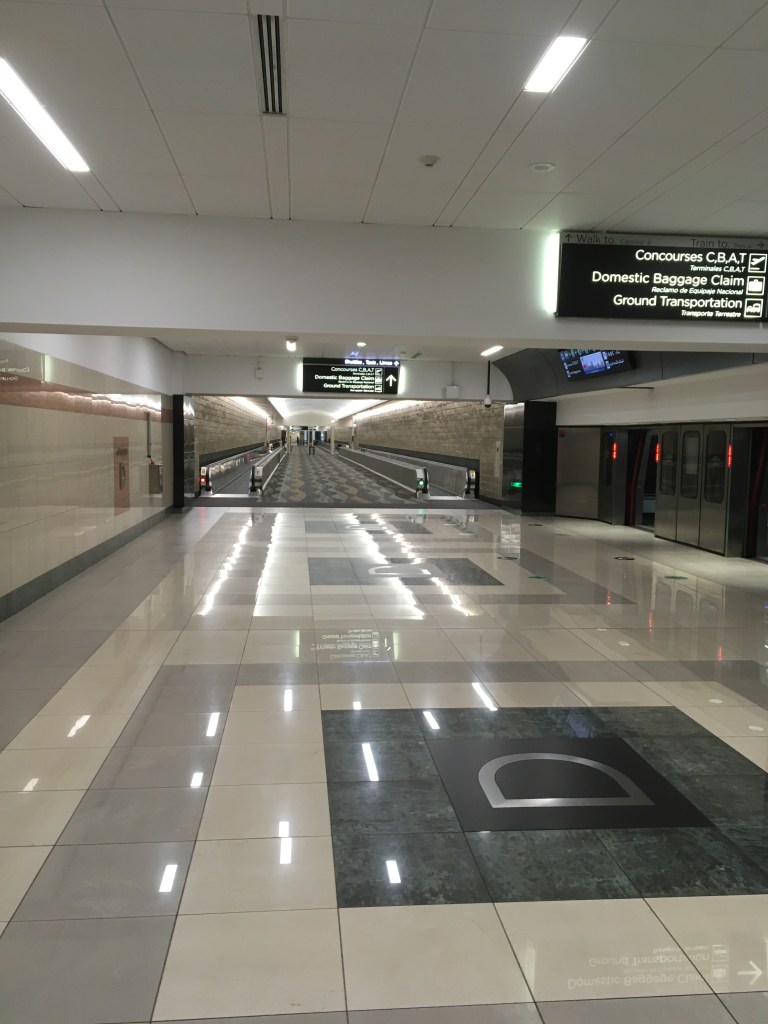
The huge Atlanta airport was scary empty. My fellow passengers and I walked down empty corridors and rode empty escalators. At customs, the path was again clear straight through acres of stanchions and belts (I used a Global Entry kiosk and skipped around all that).
When we entered the Baggage Reclaim hall, I asked a staffer which carousel our bags would coming up on and he laughed and said “the only one running”, out of 12 carousels. Bags in hand, I exited and went to the Delta connection bag drop area (many more empty stanchions) and startled the sole agent there.
After depositing my bags, I had to go through security again and I was all alone, not another passenger in sight. The TSA folks were practically snoozing and I had to wait while they fired up the scanner for my carry-on. They said they’d seen just three passengers in the last several hours!
Plenty of room on the Plane Train
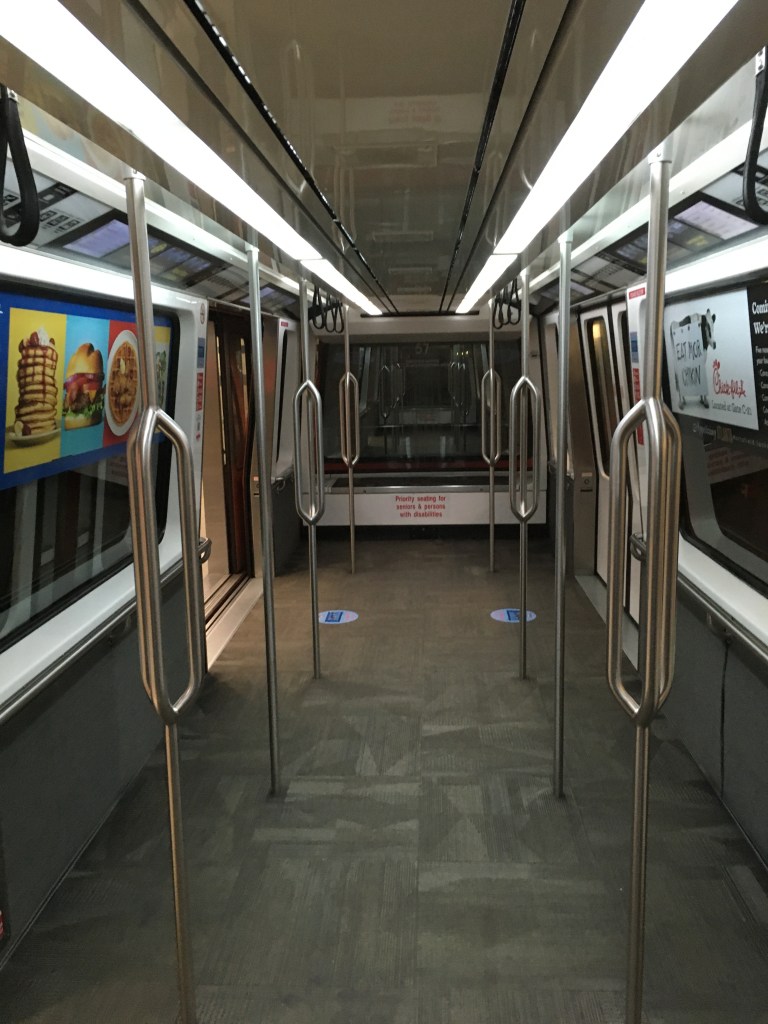
I proceeded downstairs to the famous Plane Train shuttle to go to my domestic flight terminal. This is a system of slick, four-car trains and there was no one else on the platform. When the train arrived, I had it completely to myself; no one else in any of the cars.
Not a soul in sight
I alighted at the deserted Terminal D platform and by now I was half expecting Rod Serling (of “Twilight Zone” fame) to emerge from a side door. He did not, and I went upstairs to the D gates and, happily, saw some other passengers. I actually found an open Delta Sky Club nearby, where I cooled my heels and enjoyed their very limited offerings for 45 minutes.
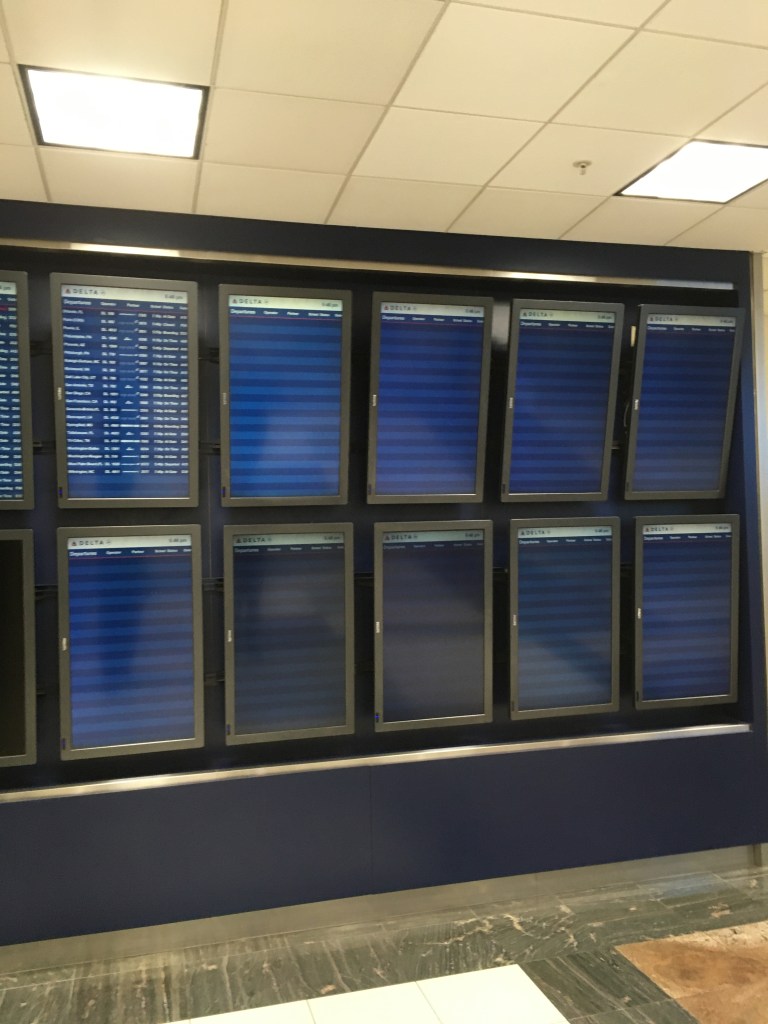
Plenty of room on the Departures board now
Back out in the terminal, a “crowd” of 20 people was on hand at the Gate D14 where I boarded my flight to D.C. and had a First Class row to myself. My mask was starting to rub a bruised notch in the top of my nose and my safety glasses were irritating my ears, but I knew I was almost home. I was glad to have my eye protection and noted that no other passengers I saw anywhere, and only one or two airport workers, wore goggles or a face shield. Everyone onboard, of course, had to wear a mask.
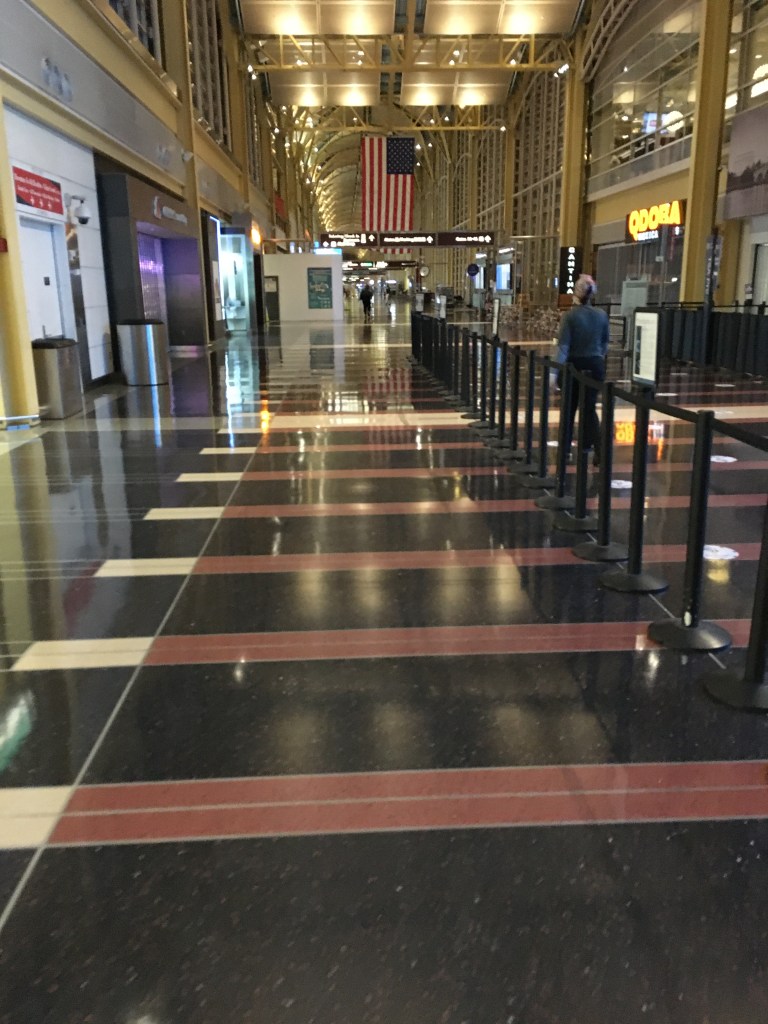
Welcome to National Airport
After our reception in Atlanta, getting out of our seats once we parked at the gate in D.C. and gathering our stuff right away to deplane was a welcome return to normality. Reagan National was, of course, deserted at 9:30 PM and I had no trouble getting my bags, going up to the the third level, and going outside to find my Uber ride. My driver wore a mask this time. Door-to-door travel time: 18-1/2 hours.
In summary, the masks alone made these flights unusual and all the other safety measures were ever-present in mind. However, it was not a bad experience generally and I arrived on time, along with my bags, at my desired destination, which is not always the case. The absence of hordes of other travelers, while spooky at times, was also kind of nice. It remains to be seen if I caught anything from my fellow passengers, but I never felt crowded or endangered. The shake-up of the airline industry continues, but I’ll be ready to fly again when international tourism begins to recover. Evaluate your own risk tolerance and join me, if you’re comfortable doing so.
This story is not complete without mentioning that I’m now in a federally-required self-quarantine for 14 days. Using a CDC-provided log, I’m taking my temperature twice a day and noting any symptoms. So far, so good.
“They say all good things must end”, according to an old proverb and, as interesting as Lockdown Hell in Paris has been, later this week I must take my leave. As mentioned in my previous post, my Schengen visa will expire soon and, as no other countries have “lowered their shields” to welcome international tourists yet, I’m obliged to go back to the U.S. until things loosen up again.
My flight on Delta Airlines, with a connection in Atlanta, looks to be a day-long challenge. I don’t usually enjoy juggling luggage, carry-on bag, and travel docs at the airport, and adding a face mask, face shield, gloves, re-breather unit, hazmat suit, magnetic boots, blast helmet, garlic clove necklace, hydroxychloroquine injector, glow-in-the-dark Juju skull, and other items I’m assured are required for today’s airline passengers to be safe will just complicate matters.
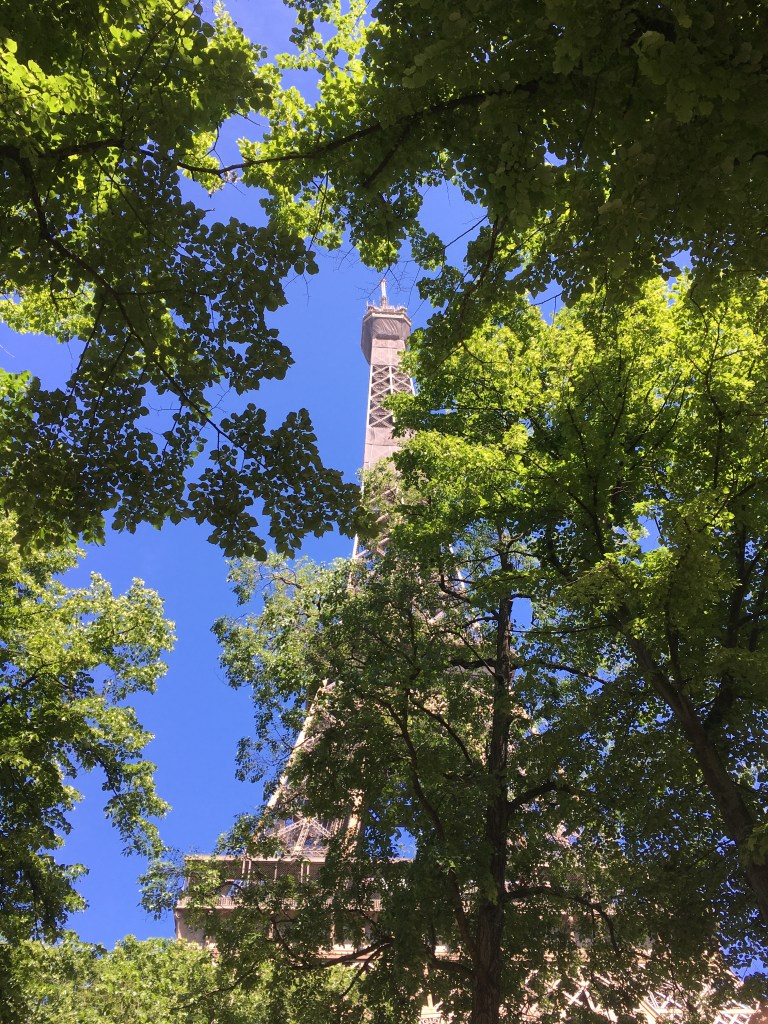
Last week, Marti and I did manage to have a fun picnic beside the Eiffel Tower. We had some nice baguette sandwiches, chips, and a split of a tasty Bordeaux. We really enjoyed the relatively crowd-free grounds, sunny day, and warm temperature. Sadly, the Tower grounds are now completely surrounded by glass walls and tall fences, so the days of simply strolling beneath it are gone. You now have to pass through gates (presumably with a ticket) in order to get in. I guess that’s a reaction to the huge crowds that used to visit the Tower and will probably do so again in the future.
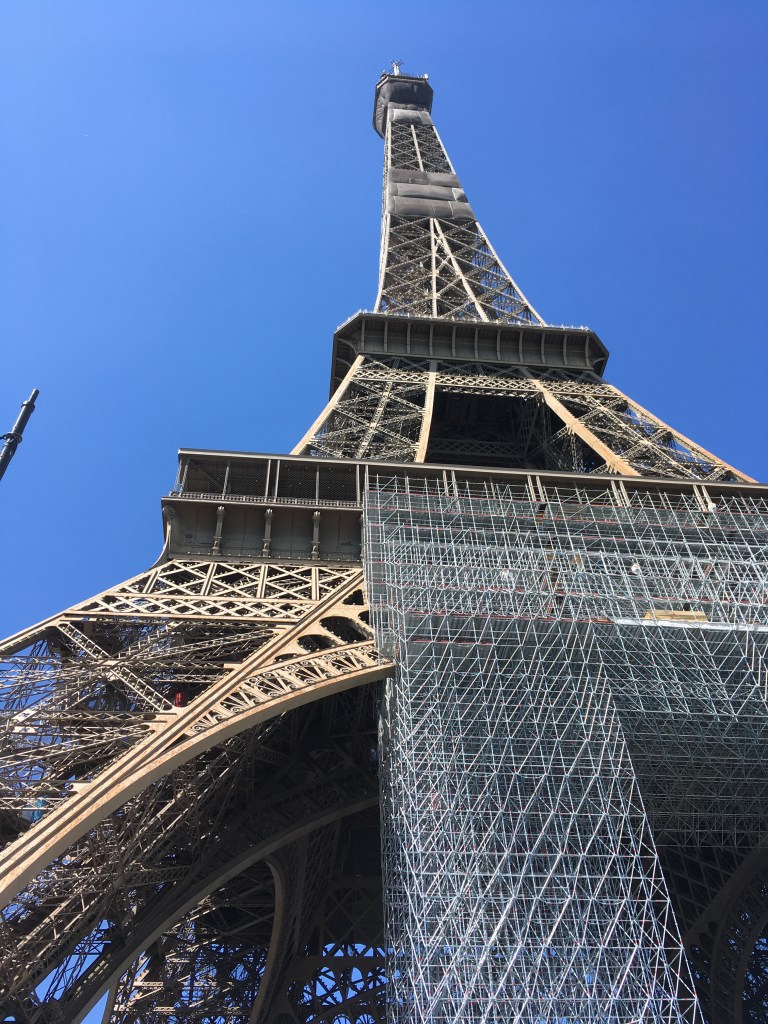
Temporary scaffold for workmen
As in many public places, maintenance work on the Tower is also going ahead at a furious pace while tourists are absent.
I’ve been staying in a really interesting six-story building in the 15th Arrondissment (district). Paris apartment buildings are a wild collection of architectural styles, and our building has a lot of fairly unusual wooden railings, pillars, and soffits. Must be a maintenance nightmare to paint it all but it’s really distinctive and gives the building a softer, almost chalet-like appearance. Our balcony is wide enough to hold a small table and two chairs, and we’ve enjoyed cocktails and sometimes an al fresco meal there.
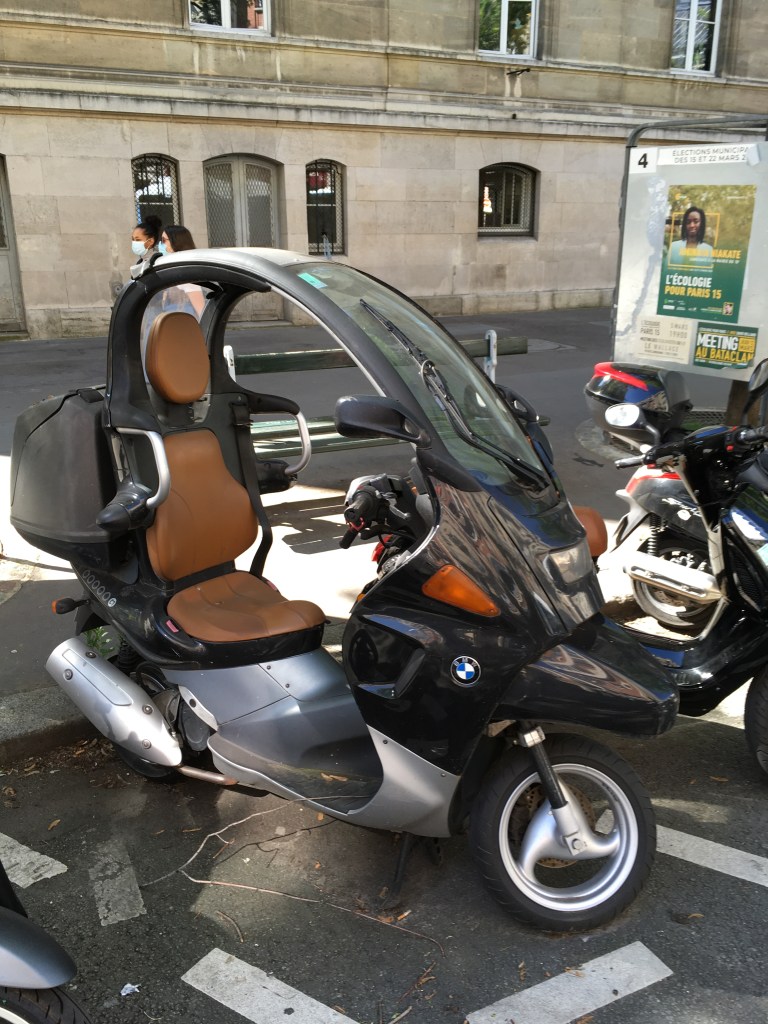
The all-weather BMW scooter – très chic!
I’m thinking about what it will be like to return to the U.S. and where will I be able to find a good baguette? Dare I trust Instacart to find good bread? My post-arrival, two-week, self-quarantine will seem like a step backward after the loosening of restrictions here but I’ll get through it.
I’d be remiss not to thank my great friend Marti, in whose home I’ve sheltered for the last 10 weeks. She is a real lady, a jewel, and it was wonderful to be with her as, together, we rode out the horror and uncertainty of this pandemic. Bonsai, my dear.
Let the packing begin, then. I’ll report the details of my trip in posts here, so that you can read a firsthand account of the state of air travel today. Fasten your seat belts!
Life here has returned to something more like normal. We’re enjoying the ability to move about freely without documentation and we walked over to the Eiffel Tower yesterday. It’s closed, of course, and so is the giant grassy sward (the Champs de Mars park) in front of it. In fact, since the gardeners have been on leave all this time, the grass is now waist-high and they’re probably going to need to bring in farm equipment to cut it and dispose of it. Our walk was only a couple of miles but it felt good to get out of the neighborhood.
Vehicle traffic here has returned more vigorously than pedestrian traffic for now, and it’s nice to see so many non-food retail stores open again. About 50% of people on the street wear masks, which are only compulsory on public transport. Businesses are allowing workers who must do so to come into the office.
We went to a kitchenware store yesterday and bought a new bread knife; the retail experience was familiar: masks required, one customer at a time (it was a small store), and mandatory use of hand sanitizer provided by the store before entry. At the same time, the still-shuttered status of cafes and restaurants seems to stand out more than ever now. We’re planning a picnic at the Eiffel Tower but temps have plummeted here (that polar vortex in the US last week has crossed the Atlantic, I guess) and we’re thinking we’ll do it next week when it warms up again.
As to the picnic menu, we’ll probably pick up takeaway baguette-based sandwiches at the butcher, some fruit, and a bottle of wine. The famous Rue Cler Market Street is in the vicinity and partially open, so there are a lot of choices.
Prices here have dropped for many things. For example, my favorite Veuve Cliquot non-vintage champagne was €55 a bottle in March, and I saw it yesterday for €38. Luckily food prices have remained unchanged (not going up as I hear they are in the US).
After running a gauntlet of airline ticket shenanigans, I’ve booked a flight back to the US at the end of May. My Schengen visa will expire then and no other country is ready to welcome me (or other foreign tourists) at this time. Sadly, the US looks like a more dangerous place to be right now, virus-wise, but c’est comme ḉa – it is what it is.
For example, the UK’s lockdown relaxation plan is a mess and so I’ll wait until September-October (and, hopefully, the pubs re-opening) to think about going there.
For now, Paris continues to look like Southern California, with clear skies and plentiful sunshine, and we count our blessings. We’ve been so lucky, here in “Lockdown Hell”, and we appreciate it.













 The Occasionally-Examined Life