Voted From Abroad

You may have heard that the U.S. is having a national election soon.

I knew I wasn’t going to be in the U.S. on Election Day, November 3rd, and so I generated and sent, using the VoteFromAbroad.org website, a “Federal Post Card Application” for an absentee ballot. I discussed this in a post here back in July. 
In the U.S. the voting process is controlled individually by each state. Elections are administered by localities: counties, cities, and towns. I vote in Virginia (officially, a “Commonwealth”, but let’s not be snooty – it’s a “State”), which is not one of the enlightened states that allows voting by email, so I knew I would need to receive and complete a physical, paper ballot, and then send it in.

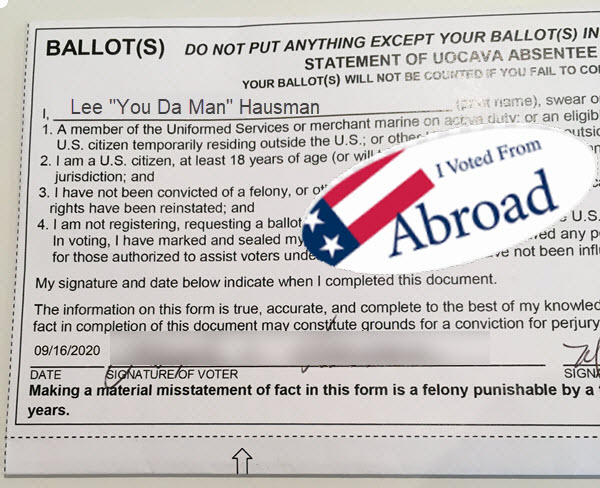
On September 16th, I received an email from my election office with a link that let me access and complete my ballot online, then download it as part of my “ballot package”. This was a .zip file containing five .pdf files, including:

• Ballot processing instructions – These were fairly clear but I noted that some of the terminology used here was inconsistent with that on the other materials.

• My completed ballot.

• A print-and-fold envelope, with legalese and lines for my and my witness’s signatures. I used this option, by printing and folding the page on the dotted lines to create an envelope. Then I placed my ballot inside, taped the folded enveloped shut, and signed. Stern warnings said nothing else could go into the envelope.

If I had wanted to use my own envelope instead, I could have printed the “completed front of envelope” file and taped it on my envelope. It was already filled-in with the address of my election office (but, oddly, that address lacked some details in the address sent to me by that office in the email containing the link). It was already franked for free U.S. postage.

If I had wanted to use my own envelope instead, I could have also printed the “completed back of envelope” file and taped it on. It contained the legalese and signature lines mentioned previously.

Once my completed ballot was safely in its envelope, I went down to the local DHL Shipping agent in the Ryman Stationery store. They prepared an DHL Express Document for me and, after I double-checked all the shipping information and handed over £30, my ballot was on its way to my U.S. election office.

Yes, the price was a bit steep, and, no, there was no cheaper, slower delivery option. But, by using DHL, I avoided the whole U.S. Postal Service delivery quagmire and could track the progress of the package online, so I was OK with it.

And 31 hours after I sent it off, my ballot was received in the U.S. at my election office and will, I have every confidence, be properly counted. The city where I vote only has 10,000 registered voters, so I’m pretty sure counting will go smoothly.

Bottom Line: I Voted!
When the Real World Seems Strange

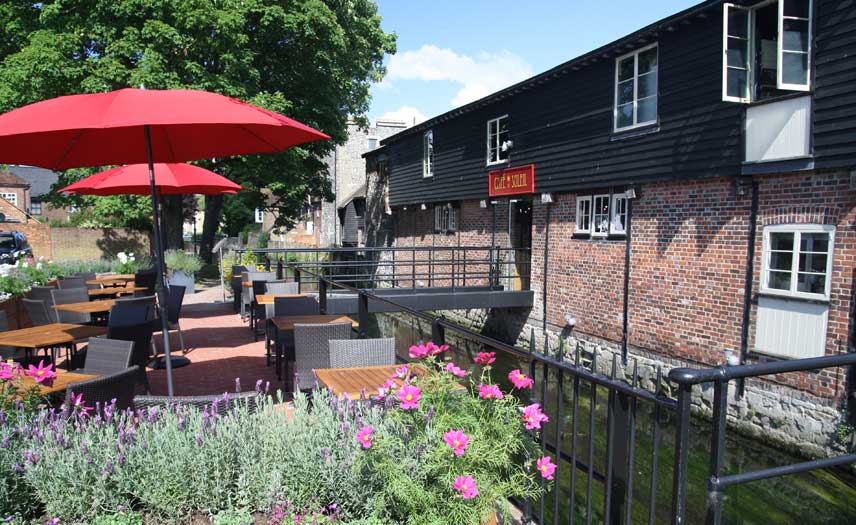
We’re finally out of self- isolation and have taken a few walks around Canterbury. On our first night of freedom, we celebrated with a dinner at the Café du Soleil, where the food was exceptional and our table on their terrace was right alongside the river channel.

That’s our table, in the foreground, right

The restaurant also has a nice dining room that’s accessed by crossing the bridge shown above. As we dined, several paddlers came along in inflatable boats. The food was outstanding and, after the sun went down, the terrace and building were illuminated with clever lighting. We found the restaurant to be very diligent about adhering to the recommended anti-COVID protocols and we felt quite safe there.

People are not required to, and don’t, wear face masks (which we do) in the streets here. Masks are required in retail stores, restaurants, and pubs but it appears that compliance is about 50%. This has prompted us to wear N95 masks in public, rather than simple surgical masks. If others aren’t going to wear their masks to help protect us, then we need to protect ourselves.

It occurred to me that an unexpected benefit of being in isolation was that we didn’t have to worry about, or even think about, what the rest of humanity was or wasn’t doing about masks and survival distancing, for two whole weeks. What a relief that was! Now that we have to do it again, I’m getting a fresh taste of what a lot of mental overhead it involves.

We took a walk down the High Street, passing first through the city walls, which go back to Roman and medieval times. Only about 50% of them remain. Westgate, shown above, is typical of the remaining constructions. The original builders, of course, never anticipated cars cruising through them or the Union Jack flying above the ramparts.

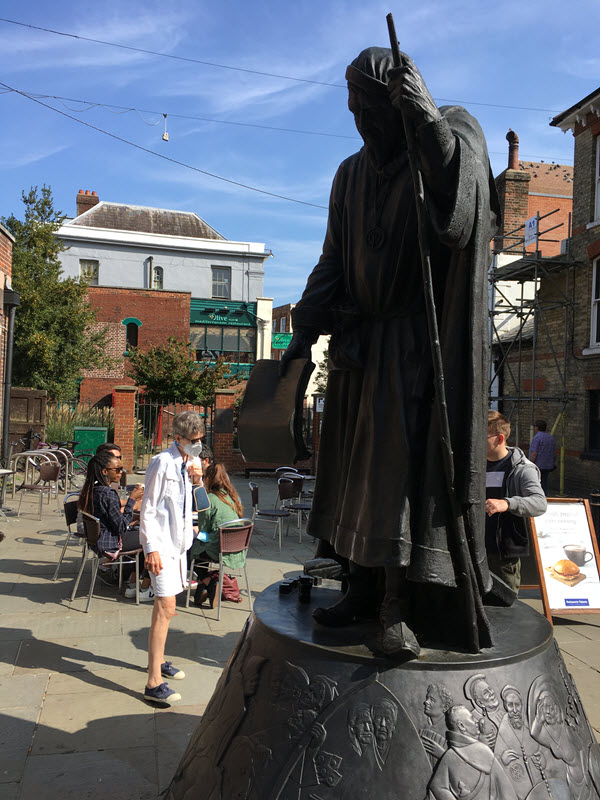
On the High Street, Marti examines the statue of Geoffrey Chaucer

Like many High Streets, this one is pedestrianized and features Tudor timber-framed buildings, banks, souvenir shops, clothing stores, pubs, restaurants (including McDonald’s and Burger King), and a whole lot of “For Lease” signs. The virus restrictions have been hard on small businesses here, too.

Millions and millions of Christians served, since 597 AD

Worship has been going on at the famed Canterbury Cathedral for 1,400+ years and it’s been a pilgrimage destination for almost as long. St. Augustine and Thomas Becket are but two of many historical figures associated with it.

We were disappointed to find that there’s an entrance fee of £12.50. Due to the encroachment of the buildings around it, it’s hard to even see the lower part of the Cathedral without coughing up the fee. We decided to come back to visit it on a weekday, when there should be fewer visitors.

Cathedral management has, of course, had to react to the virus with PPE requirements, timed-entry tickets, and so forth and the fee probably helps to offset these costs. In order to observe survival distancing, they’ve had to limit attendance at services. Audio guides and guided tours have been discontinued for now but live online video coverage of services is available.

Canterbury is compact and it takes no time at all to walk anywhere, which makes for a nice change from my summer suburban stay outside Washington, D.C. I’m looking forward to getting out more and learning more.

We’re still enjoying early Fall weather and the little nature reserve behind our flat. We recently saw two foxes and a Great Blue Heron there, which was very cool.

Life in Self-Isolation

I want to share some of my self-isolation experience with you but, first, I need to let you know that my French girlfriend, Marti, came over from Paris on the Eurostar train a few days after I arrived and we are self-isolating together here in Canterbury. This is probably not what the British authorities had in mind exactly, but we’re following the isolation rules by the book and I think the intent (not exposing anyone outside our “bubble” until we’re sure we’re not infected) is being met.

So, we’re here together, which is fabulously better than me being here alone. We’re on Day 8 since Marti’s arrival, so we have six more days until we can leave the flat.

Our Airbnb flat is comfortable, brand new, and well-equipped. Our hosts purpose-built the building, with its twelve short-term rental flats, and it just opened in August. They’re very experienced hosts, have done everything right, and let us know that they have others in self-isolation here as well.

The University of Kent is nearby and I think we may have a few flats rented out to students. Unlike so many UK hotels and B & Bs crippled by the decline in tourism due to the virus, our hosts seem to have navigated the downturn successfully, so far.

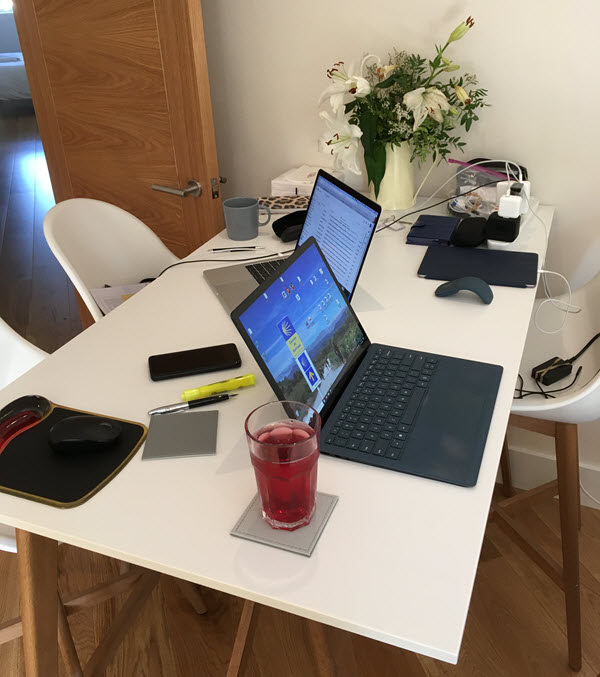
Our “Technology Center”

The flat’s Wi-Fi connectivity and speed are excellent, even with both of us working. The flat comes with a nice, large TV and plenty of entertainment offerings, and we can stream online shows without any problem. UK power plugs are large and the matching adapters for our EU and US devices are equally so but, with a UK power strip, we’ve managed to accommodate all of our devices.

Once a week, we have groceries delivered from Waitrose and, after a few adventures getting the proper English names of things correct and discovering just how much 500g of raisins is, it has worked out well. For example: “plastic wrap” is “cling film” here, and “zucchini” is “courgette”.

The Waitrose online ordering software is very good. However, the prices of things here are somewhat high and the 1.24 dollar-to-pound exchange rate doesn’t help. We were happy to find good French and Spanish wines and Irish Whiskey available. Waitrose’s delivery service is excellent.

We generally cook for ourselves but we also follow a tradition, established last Spring when we were locked down together in Paris, of ordering in for Saturday lunch. Salads and sandwiches, for example, from the local Pret A Manger restaurant are very good.

Our daily schedule includes exercising and stretching for me and online yoga classes for Marti. I’ve even managed to get in some 45-minute “walks”, going from the front of the flat to the back, return, and repeat.

We keep busy online and also enjoy reading books and newspapers, as usual. We also spend time keeping up with the latest news in the US, the UK, and Europe. Marti is a freelance communications consultant and she’s been tending to some business while here, even though she’s technically “on vacation”. As Mr. Retiree, I’m enjoying being lazy.

As shown in a photo in the first post in this thread, our flat’s balcony looks out onto a grassy yard, then across the Great Stour River, and into a nature preserve. It’s an incredibly soothing view and belies the fact that we’re just a 6-minute walk from the touristy Canterbury Cathedral area. We usually have a daily cocktail-hour tot of Jameson out on the balcony while we work on our British bird identification skills.

The flat is equipped with a washer/dryer, so we’re able to cover that duty easily enough without leaving the premises.

Just a hint of Fall colors coming in the trees

The English weather has been great, with lows in the 50s at night and highs in the 70s. So far, we’ve had no rain and only one gray day. Are we sure we’re in England? Coming from the US, the idea of no air conditioning, and windows and doors without screens seems wild, but the humidity has been low, the flying bugs seem to know their (outdoor) places, and we’re very comfortable. I’m looking forward to staying here into the Fall.

Marti will be here for another week after we’re out of isolation, so we’ll have time to explore Canterbury and see its sights. Then she’s returning to Paris, where I hope to join her in early November for an extended stay.

The Current English Restrictions

From my perch here in Canterbury, I’m a keen observer of the moves the United Kingdom (UK) government is making with regard to Coronavirus restrictions.

Yesterday, Prime Minister Boris Johnson held a briefing, along with two of his advisers, to break the bad news about the need to tighten restrictions. Here are the current UK stats:

Seems mild compared to numbers in the U.S. (where average deaths/day last week was 734)

The key restriction was that, beginning next Monday, people in England can only gather, indoors or out, in groups of six maximum. This is a reduction for the current allowance of groups of 30. Police will be empowered to fine or arrest those who do not mind the rule. Johnson was clear that “this is not a second national lockdown” and that “it breaks his heart to have to insist on the restrictions”.

For my geo-politically-challenged readers, the UK consists of England, Scotland, Wales, and Northern Ireland. Each has limited self-government and each controls its own COVID restrictions. Those announced by Johnson yesterday apply to England only. The details for the entire UK are available here: https://www.bbc.co.uk/news/uk-51506729

In England, pubs, restaurants, shops, places of worship, and other venues will remain open as before, but people can only attend in groups of up to six.

Face coverings are compulsory if you’re using public transport and must be worn in shops. Oddly, shop workers are exempt.

The UK has “hot spots” of infection and that has caused some recent local lockdowns, for example, on the city of Leicester, to be applied in response.

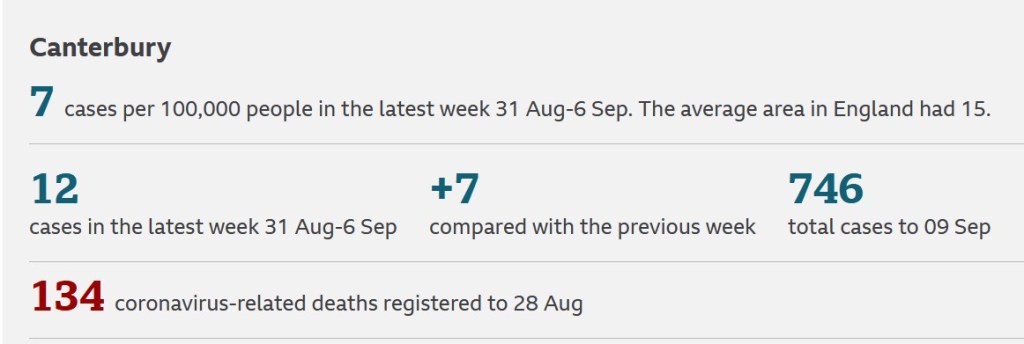
The stats here in my corner of England are comparatively very good:

During Johnson’s briefing, charts were shown indicating that young people (teens, 20s, 30s) were responsible for the majority of new COVID cases.

As in many other countries, the lure of the beach, and vacation-related, large-scale outdoor gatherings were too much to resist for many, resulting in virus spread. With colder weather ahead of us, it’s hoped the numbers will go down.

Travels Resumed

I’m writing with apologies to Geoffrey Chaucer, who wrote the original, famous Canterbury Tales, whose title I’ve appropriated for this category of my posts.

For a variety of reasons, I decided to leave hot, humid Northern Virginia, U.S.A. last week and travel to Canterbury, U.K. Some of these were personal, some practical, and some plain paranoid. The U.S., currently riven with toxic politics, violence, and horrendous COVID-19 numbers, was just not a healthy place for me. I took a risk in traveling but I believe it was worth it.

There is some confusion about whether or not Americans can travel anywhere and, though restrictions are constantly changing, I’m sharing this account of my trip to the U.K. as an example of travel in the age of coronavirus.

This is the view of my Airbnb balcony, the river’s edge, and the nature reserve beyond it. Combine that with very pleasant cool, dry English weather and it’s absolutely idyllic. And, if you have to quarantine for a few weeks, there’s a lot to watch (birds, ducks, fish, etc.) out there. Ahhh!

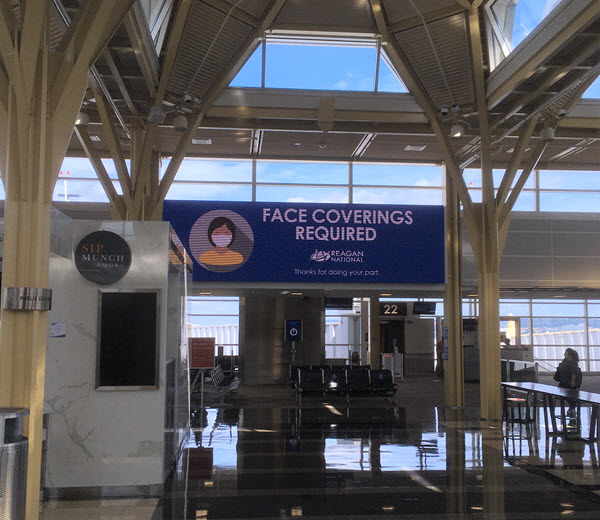
My trip started with an uneventful Uber ride to National Airport outside Washington, D.C. The airport was fairly empty and everyone was wearing a mask, of course. I checked my bags in and was surprised that, instead of tossing them onto the belt behind her, the agent handed them back to me and asked me to take them down the hall and hand them over to TSA for scanning!? Well, that was new.

No problems going through personal TSA screening – with TSA Pre-Check, I didn’t have to take off my shoes or belt, and my phone and even liquids just stayed in my carry-on bag. I didn’t even use a bin – I just put my bag right into the scanner.

Reminder at National Airport

At the gate, seats were marked with stickers to create distancing and there were plenty of signs reminding everyone to be smart. However, I noticed a lot of people wearing masks incorrectly (under the nose, under the chin), even airline pilots. Hoping to keep the cooties at bay, I was wearing an N-95 mask, which I changed every four hours, and safety glasses. I also had a plan of glove-swapping, hand-sanitizing, and sanitizing-wiping going.

My Delta flights were half-full and generally pleasant. Delta is blocking Main Cabin middle seats and reducing Delta One (where I sat) seating to 60%. It was smooth flying into Atlanta, then a 2-1/2 hour layover until my flight to Heathrow.

All U.K.-bound passengers had to present a completed a “U.K. Passenger Locator Form” (PLF), which specifies health status and U.K. self-quarantine location, along with a boarding pass before being allowed onto the plane in Atlanta.

On the international flight, I requested a seating change after the nearest passenger to me kept coughing during boarding. Delta One amenities and food service on my 9:50 PM flight were only scaled back a little bit and I elected to go straight to sleep. A healthy tailwind produced a mere 7 1/2-hour flight, which is usually what I expect on a flight from Dulles Airport outside Washington, D.C. to London.

On arrival into an empty Heathrow Airport, I was more concerned about being turned away at the UK border because “tourism” is not an essential reason for coming in. I needn’t have worried: non-essential visits are now allowed (as my online research had indicated); the Immigration agent scanned my passport and my PLF and waved me right on through without another word.

I was, in fact, the first person off the plane and so (thank you, Mr. Murphy) I was the last to get my baggage. Or not get it. My small bag appeared on the baggage belt but my big bag did not! Oh-oh. Delta is very good about tracking bags and I was getting regular texts telling me where my bags were at every step, so I knew they had both been loaded onto my London-bound flight in Atlanta. But where was the big bag now? Sheesh.

It took an hour to file my missing baggage report, and then I met up with the car and driver I’d hired to drive me to Canterbury. I’m usually more of a public transport guy but I used a car service this time because, otherwise, I’d have had to take two trains and a taxi, and so a single car ride seemed safer, virus-exposure-wise. Masks on, windows down, blessed cool, dry weather.

During the drive, I was mentally inventorying all the important, irreplaceable stuff in my (possibly) lost bag, including every scrap of clothing I own other than what I was wearing.

My Canterbury Airbnb building

My Airbnb flat in Canterbury is very nice, brand new, and well-appointed. After a good night’s sleep, I felt great. My groceries order was delivered the next morning and, hallelujah, my big bag was found and delivered to me in the afternoon. All is right with the world.

The current U.K. policy is that all passengers entering via train, plane, and ferry must self-isolate for 14 days. This is not “quarantining” – you’re not supposed to leave your premises for any reason; not for shopping, not for exercise. Random checks are conducted and the fine is a substantial £1000 ($1330) for a first offense. Some of my English friends scoff at the chances of actually being caught out, but I think I’ll follow the rules to the letter.

Only 12 more days to go.

Disconnecting from the U.S. news and social media flow, even temporarily, has already produced a dramatic reduction in stress for me. I’m very glad to be out of the U.S. and feel much safer here.