Stages 17 & 18: Atapuerca to Burgos to Leon

27-29 Sep 2019

I don’t want to give the archaeology work at Atapuerca short shrift – we went through the local museum and it was fascinating – so here’s a link to more information: Unesco Atapuerca

We stayed at the Albergue El Peregrino in Atapuerca, sharing a double room for 17.5 euros each. Over dinner, we met some interesting women in our age group who insisted I had to go to Bali. I’ve been getting lots of suggestions for future destinations and noting them down.
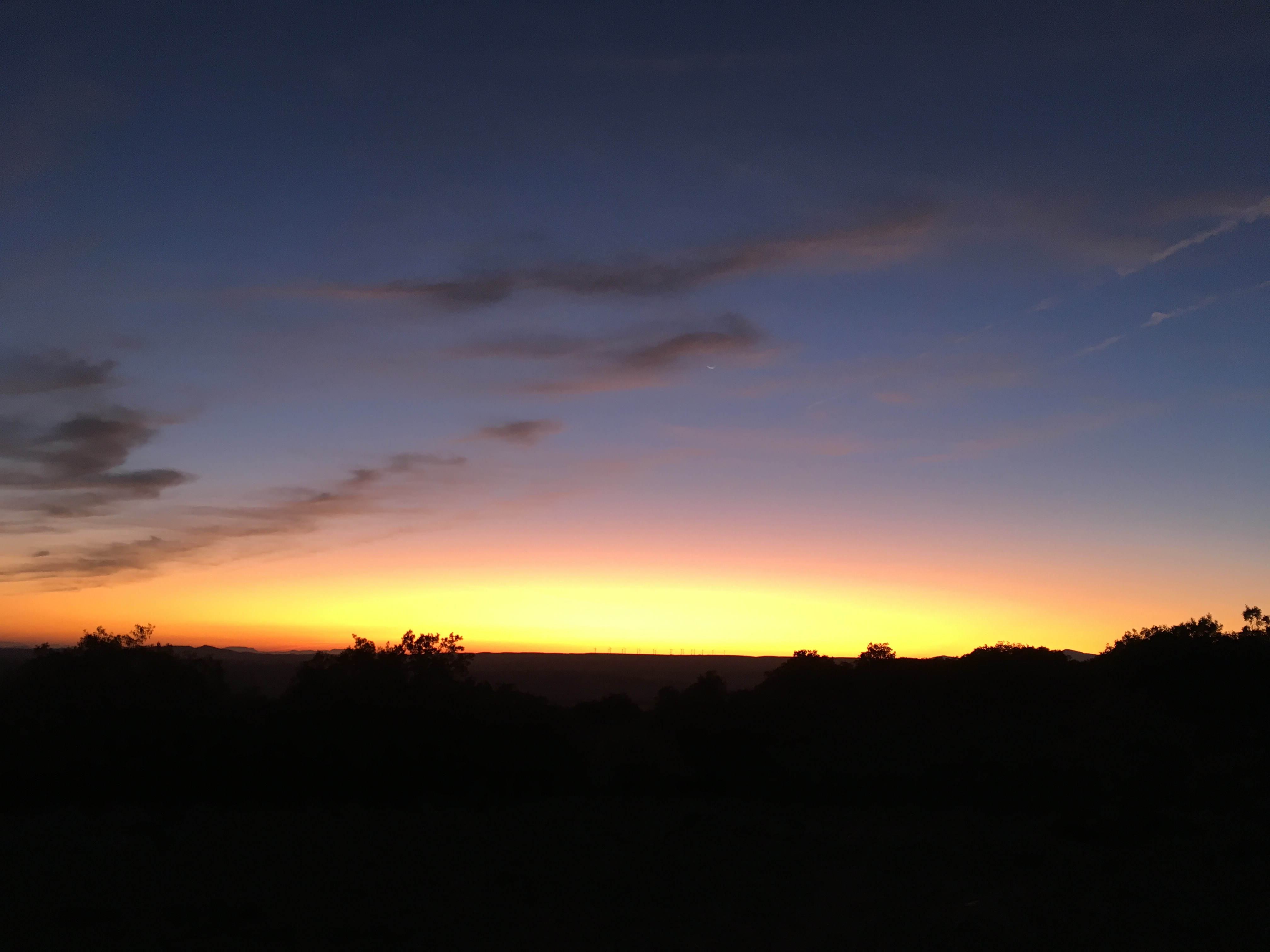
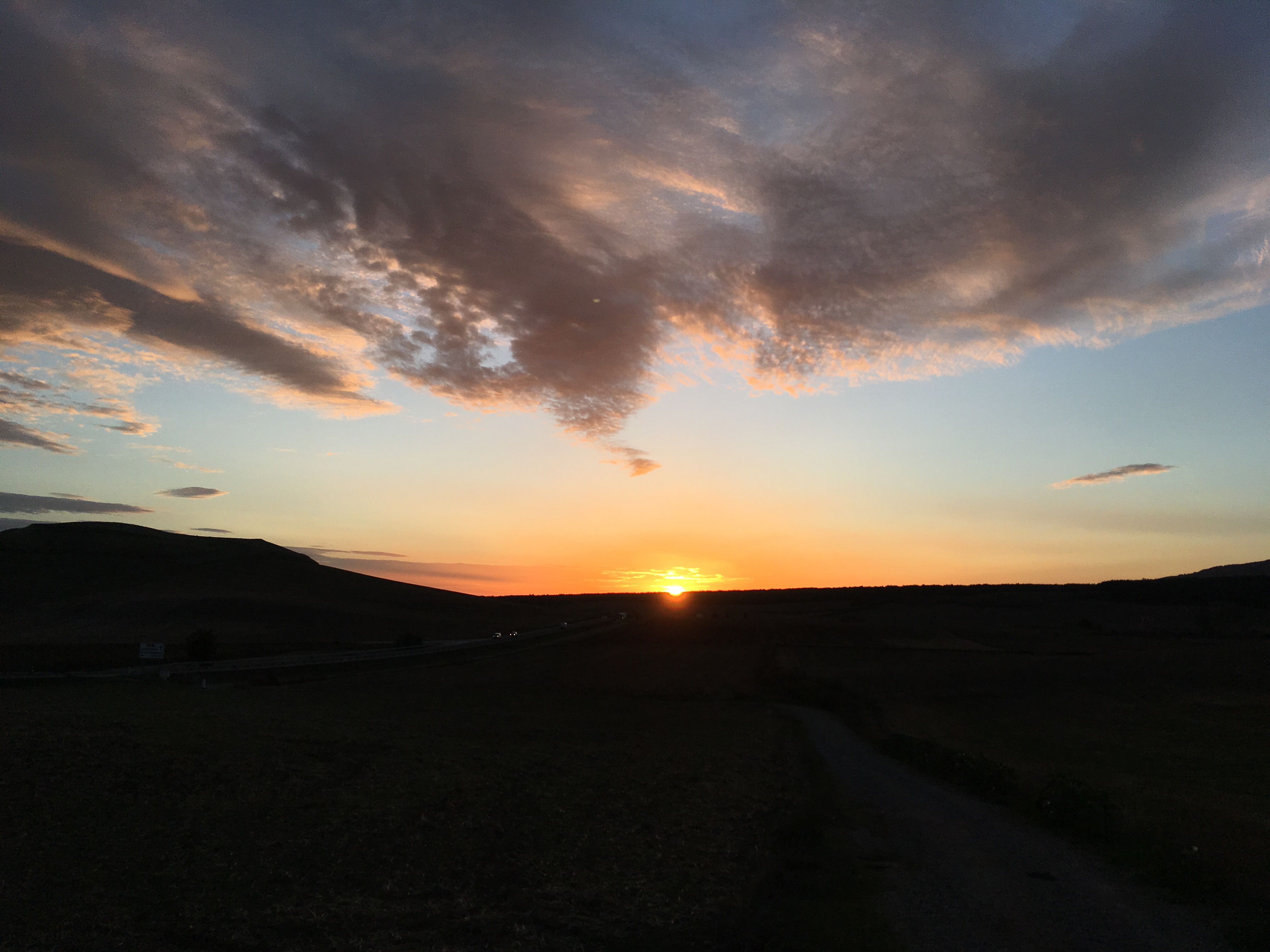
It was really dark during our pre-dawn climb (of course) out of Atapuerca, and we clambered over some really rocky trail sections by headlamp. After sun up, we passed through a few quaint villages and pine forests on our way to Burgos.

The last 8 Kms into Burgos go through an industrial area and it’s amazing that the guide books don’t mention that this means no food, no water, no bathrooms, and not even a place to sit down on a roadside bench. C’mon, don’t the people who work in these factories and warehouses have to eat? How about a bus stop with a bench?

This means I have no pictures of our entrance into Burgos. If you’ve seen one Volvo truck plant, you’ve seen ‘em all.

We finally made Burgos, found the Old Town, and got checked-in. After the usual Pilgrim Routine, we headed out for a late lunch:

Still my favorite: Ensalade Mixta

Claude and I are going our separate ways tomorrow; he with a day off in Burgos and then some Camino route variations, and I by catching the train to Leon. We decided to celebrate and found this “Irish pub” in the Old Town:
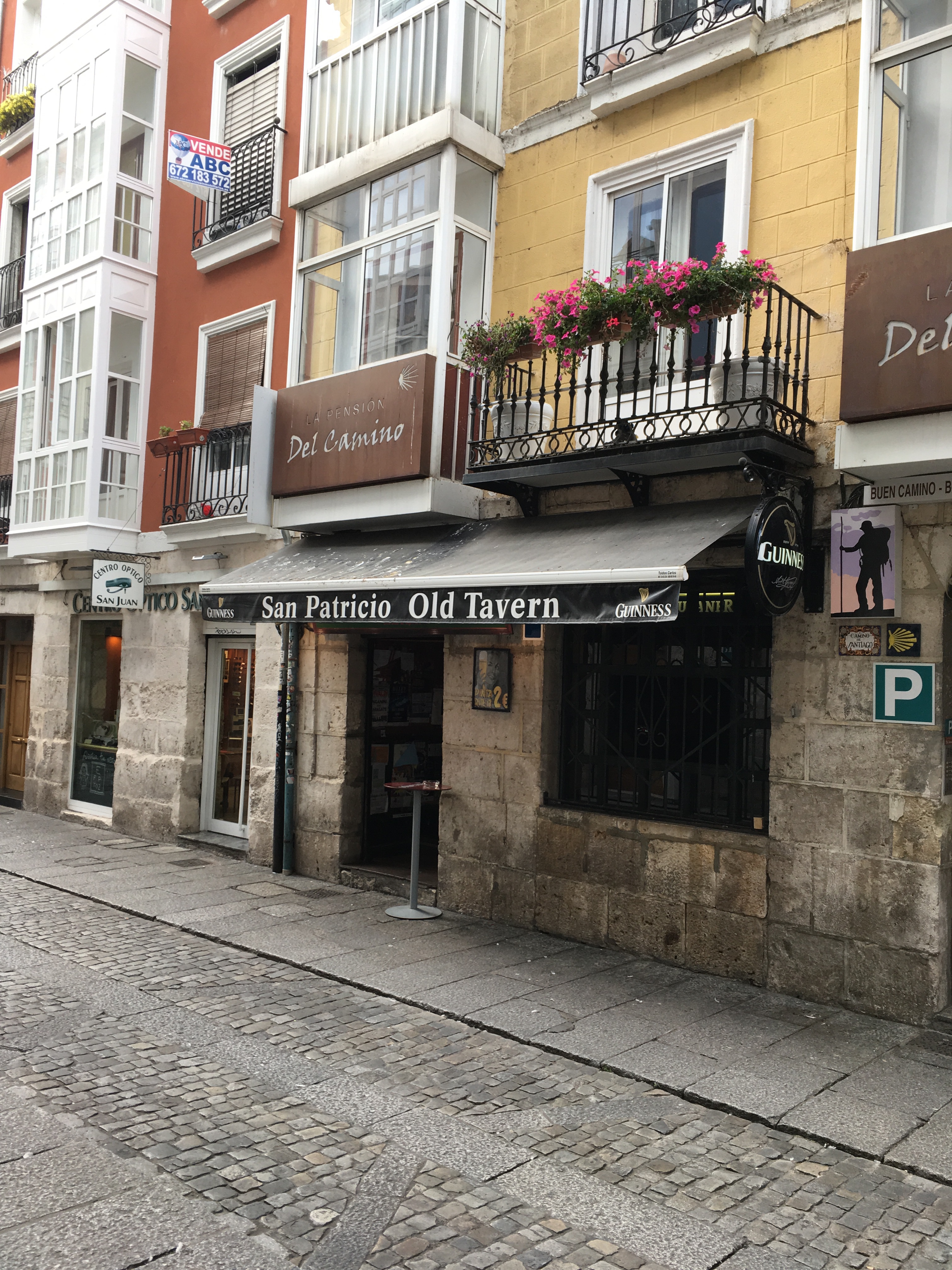
Note the Guinness sign

And we decided to have a Gin & Tonic. I was really surprised when the bar tender delivered this tasty monster:

We were both surprised and, of course, had to have another one to be sure the first one wasn’t just a fluke. It wasn’t. And, of course, that led to Claude suggesting we go to Burger King. Isn’t this how all these weird things start?

So, we Google Burger King and find one nearby. We go on over and examine the menu full of “Master Burgers” (not “Whoppers” but looked similar) and the touch-screen-only ordering. Cue the sensory dislocation due to cultural differences (plus G&Ts) and, after much dithering and screen-poking, we place our order and eventually we get our food and sit down.

It’s only then that we notice that 98% of the clientele consists of girls aged 10-14. The sound track was a dead giveaway: shrieking, OMGing, and loud cell-phone-on-speaker mania. It was spooky. Claude and I ate up and got out as quickly as we could. You think two old guys stood out in that crowd? And, no, the food was not that good.

The next morning, nursing a bit of a hangover, I packed up and went along to the train station and caught the 12:34 train to Leon. You may remember I have a full-size, 40-liter pack and a day pack. On the Camino path, I carry one or the other and ship the other one ahead. Not this time – I had to carry both and it was really awkward. I almost took a header down the steps getting off the train. The train trip itself was uneventful and there were a lot of pilgrims on board. We crossed the flat, hot, shadeless “Meseta” wheat fields and I was not unhappy about skipping the area.

Leon is a big, big city and I had a day off there the next day (Sunday – September 29th). There was a big parade of “Pendones” right past my hotel the next morning.
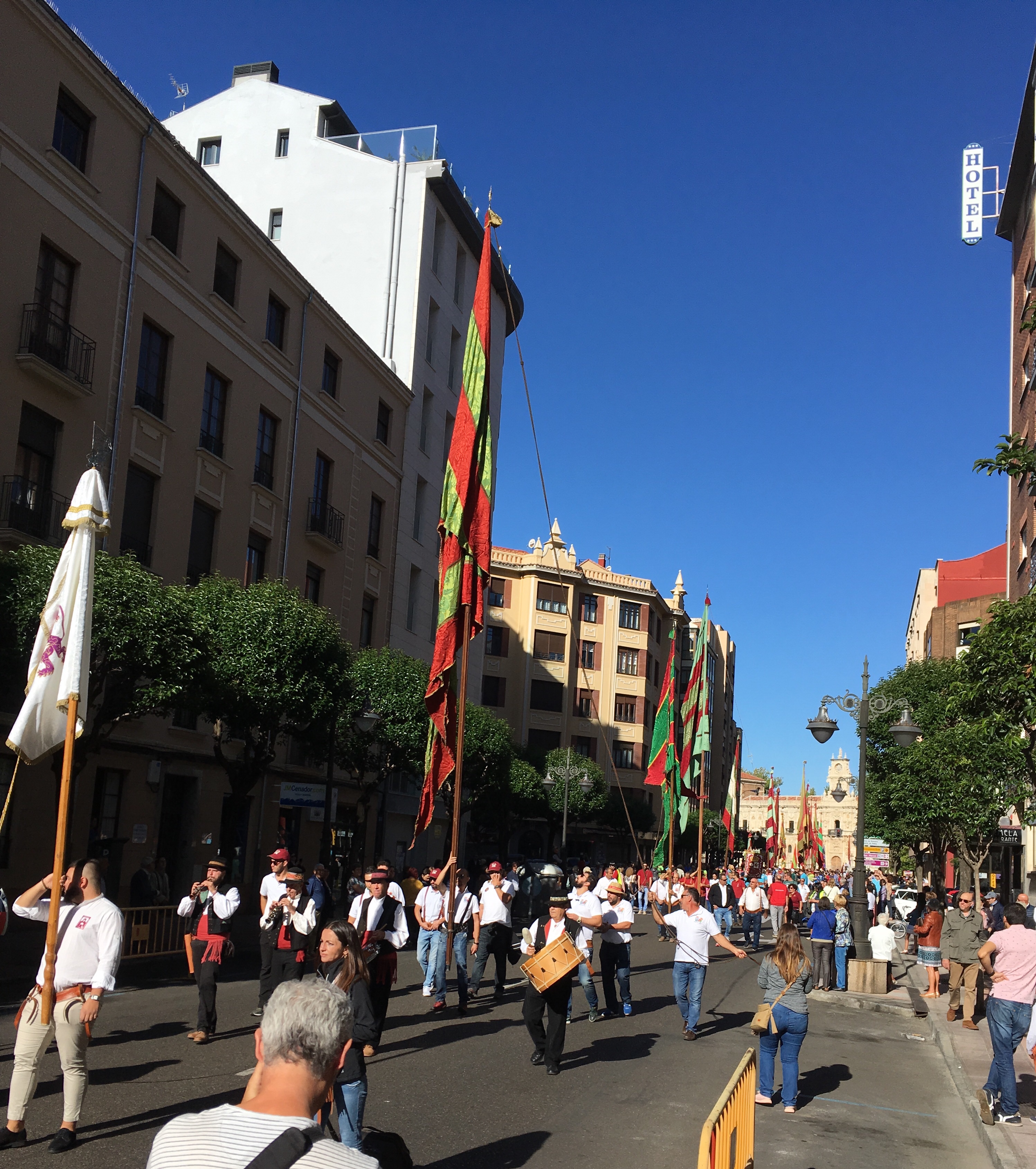
The Pendones are the big banners

I may not have this totally correct, but it looked as the banners were carried and accompanied by groups, social clubs perhaps, from different cities in the region. There’s some connection to military events in Spain’s past.

As you can see in the picture, one person carries the pole holding the banner by clipping it into a belt that’s much like a weight-lifter’s belt. As they march, they do a balancing act, sometimes aided by someone working a rope from the top of the pole. Other pole carriers, with their own belts, stand ready and jump in to switch off frequently, without lowering the pole. I saw no banners go down, which is remarkable because the tallest poles were about 50’ high.

Some groups had coordinated outfits, including women in very traditional dress, with castanets. Some had musicians with them:
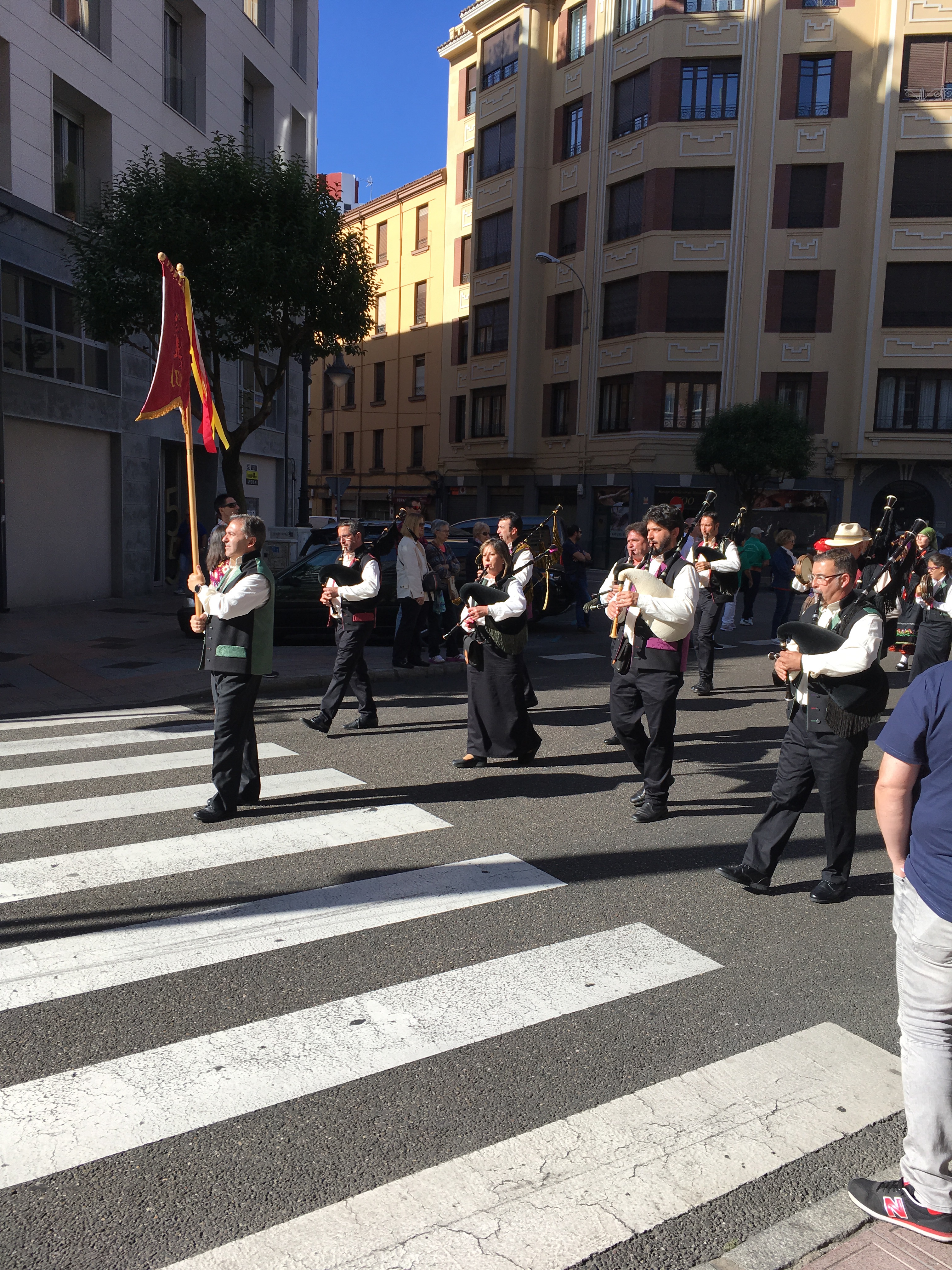
This group included Spanish bagpipers!

The parade went on for hours and I finally decided to see where they were going. I followed the jammed sidewalks down to the huge cathedral, where the banners were being presented and displayed.
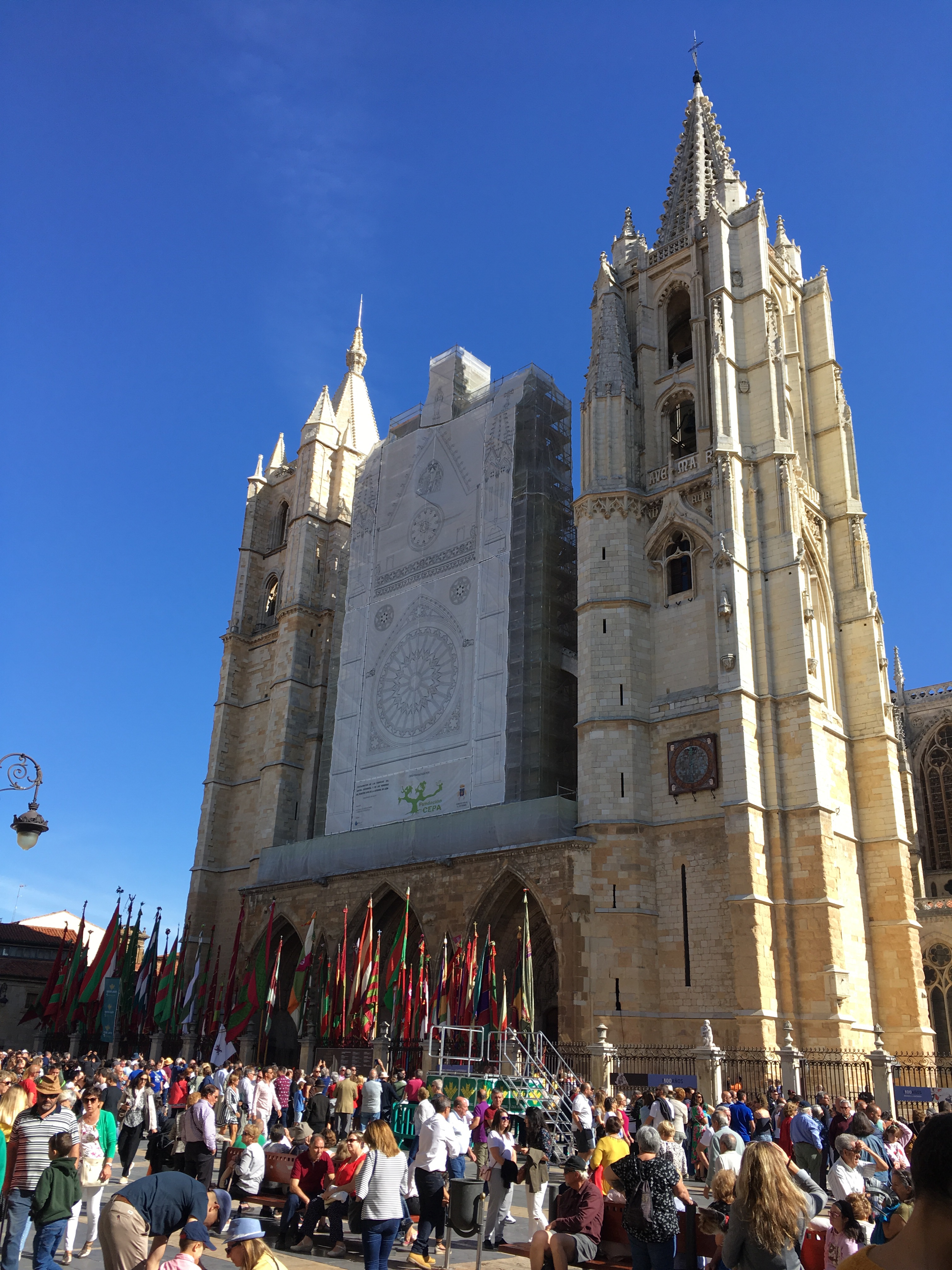
Picture doesn’t give a clear idea of how jammed the plaza was

Once you get into the Camino frame of mind, being in a big city is somewhat disconcerting. I was happy to leave Leon behind the next morning and get back on the Camino path.

Stage 16: Villafranca MdO to Atapuerca

26 Sep 2019

It’s rare, but every now and then a hotel, hostel, or albergue will offer a breakfast buffet, and we hit the jackpot before we left for Atapuerca:

All the usual Camino breakfast starches plus eggs, sausages, and bacon. Claude was in Protein Heaven. Our happiness lasted until we left the hotel side door and saw the stiff uphill ascent out of town that awaited us.

When the path finally, finally leveled off and I stopped seeing spots, and the sun was finally up, my walk took me through quiet forested lanes, dappled with sunlight. Claude fell back to chat with some fellow Canadians for a while.

The Camino seems to attract pilgrim-philosophers and some leave their wisdom behind for others:

Kathy Dunn, I think this was meant for you. Or WAS it you?

It’s not all fun and games, though. Periodically we see a path-side shrine to someone who has died on the Camino. The one above celebrates a Spanish cyclist. The Camino route for cyclists is often separate from the one for walking pilgrims, but sometimes they’re the same and cyclists come barreling by you on the path, without a hint of warning. The Spanish are great cycling enthusiasts and the Camino offers a great workout for mountain bikes, so add them to the traffic we walkers encounter.

We enjoyed the beautiful, clear weather and relatively good path surface all day. That’s Claude up ahead of my shadow.

We walked just 14 Kms today, through San Juan de Ortega, disciple of the legendary Santo Domingo, and here’s the town church:

Then through Ages, and on to Atapuerca, home to the famous archaeology sites that trace humanoids back 800,000 years.

No caveman behavior at our albergue, though.

Stage 15: Belorado to Villafranca Montes de Oca

25 Sep 2019

And we’re off to Villafranca Montes de Oca, with a dry 52 F starting out our 13 Km walk.

Apparently we’re making progress. Systems Check: Claude’s ankle is nearly 100%, my blisters are healing nicely, and neither of us is popping pain killers for a change. Yay!

Once again, we’re walking through rolling farmland with acres of wheat and dried sunflowers. The panorama is gorgeous.

Walking pace is a very personal thing and can vary a lot. When we want to talk and solve the world’s problems, Claude downshifts from his usual military pace to match my slower stroll. Other times he speeds ahead and we rendezvous at the next town.

We made it to Villafranca Montes de Oca and the heavily over-decorated Hotel San Anton Abad in good time. Here’s the view from our room of the local church

As I mentioned earlier, there are water faucets along the trail, like this one in town:

However, we usually prefer a different beverage after checking in and getting the pilgrim routine out of the way:

Speaking of which: “Craft” beer, as we know it, on tap is non-existent on the Camino. The Estrella and Ambar found everywhere on draft is basically a pale lager around 4-5% ABV and 25 IBUs. In larger cities, there are bottled beers and some may be craft but I haven’t tried any. In smaller towns, there’s this, and a non-alcoholic version, and a radler (beer + lemonade) on tap and that’s it. Slim pickin’s, indeed.

Some of our walk today was beside the N-120 highway, a busy two-laner with a lot of trucks. Most of the time, we’re on a path, separated from the highway but not always.

Tomorrow: historic Atapuerca.

Stage 14: Recedilla del Camino to Belorado

24 Sep 2019

One of the things I’m often reminded of while walking is that pilgrims have walked this path, through these hills, fields, and towns, for over 800 years. It’s kind of cool to now be part of that.

Claude and I left Recedilla del Camino before sunrise, once again navigating the path for the first 30 minutes using headlamps. It was a little warmer (58F) and dry but very windy. We walked 11Km directly into a steady 20mph wind, with gusts to 26, which is surprisingly tiring, and arrived in Belorado quite early, at 11am. Our walk took us, again, through rolling farmland with acres of wheat and dried sunflowers. Mercifully flat.

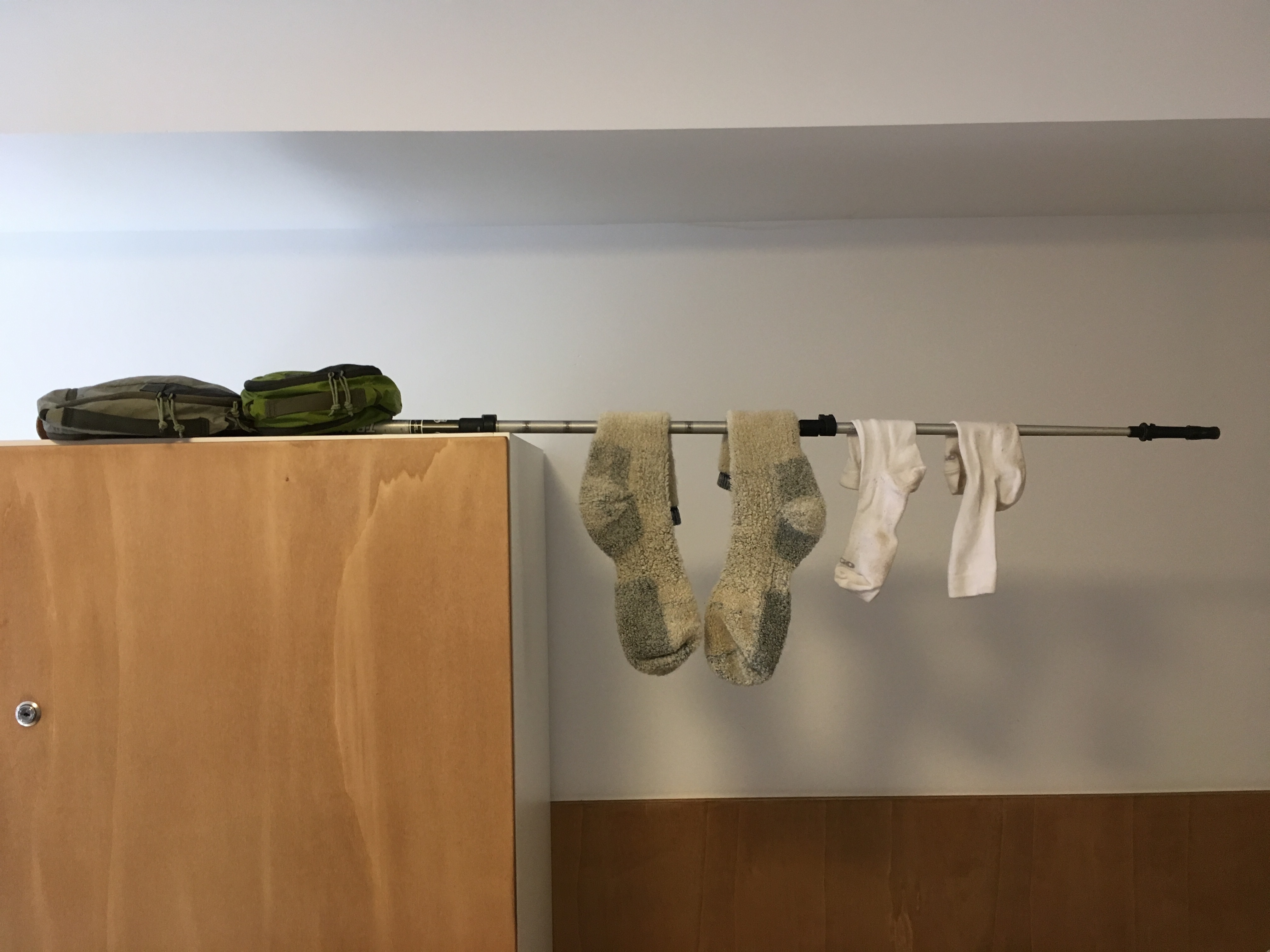
We checked into a good albergue, Hostel Punto B, which had a lot of nice facilities. I took the opportunity to pay to have my laundry done but the socks weren’t quite dry. Never underestimate a pilgrim’s ingenuity when it comes to rigging a clothesline!

The ever-versatile trekking pole repurposed.

We went out into town to find a farmacia, an ATM, and something to eat, and were successful with the first two. The siesta shut down all restaurants, though, and we had to settle for tapas and Sangria for lunch.

To be honest, I’m getting a little tired of the beer-wine-tapas diet (yes, folks, you heard it here first). The breakfast albergues and hostels offer is always coffee and toast or croissant, no protein, and lunch is often tapas or a salad (at least there’s usually tuna and egg in a salad). Dinner is usually something we make, like a sandwich, based on our forays to the local super mercado (no, nothing at all on the scale of an American supermarket) but there ain’t much variety in that. We usually pass on the Pilgrim Menu dinner because it’s too much food, too late. On the other hand, I got on the scale at an albergue (probably not too accurate) the other day, with my boots off, and it said 95Kg (209 lbs) which is around 20 lbs less than when I started my walk!

Traditionally, the Camino is a cash-only economy (though many hostels and hotels take plastic now), so you need to manage your cash carefully and, of course, only Euros are accepted. A lot of small towns do not have banks nor ATMs, so planning is important. The good news is that the Internet is very helpful in locating cajero automaticos.

Keyboard next to TV remote for scale

Inquiring Minds Want to Know, Part 2: What devices are you carrying? I’m carrying an iPhone 6 SE and the compact Bluetooth keyboard shown above, along with a recharging battery, and the usual charger cable and adapters. The keyboard folds up to become a lightweight 2” x 6” x 1” block and works very well.

I’ve spent the last nine months researching the Camino and place names like Zubiri, Logronio, and Belorado were the stuff of my dreams. Now when I find myself in these places, for real, I can hardly believe it. It’s very moving to actually be here.